
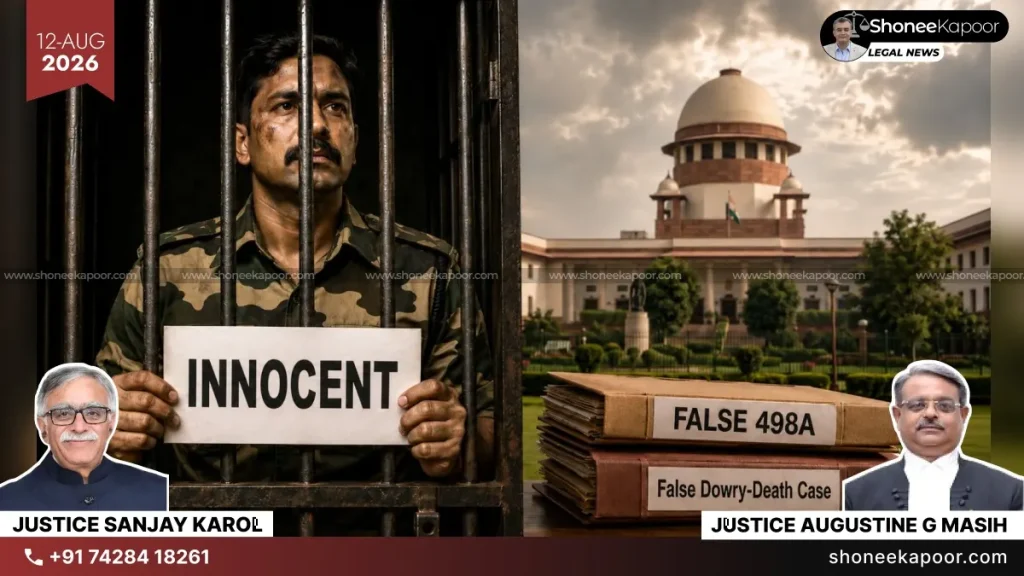
Can a husband be forced to face a full criminal trial even when official government records show he was hundreds of kilometres away on duty when the alleged incident happened? The Supreme Court has answered this while quashing the criminal proceedings against a BSF personnel in a major ruling on alibi, Section 498A IPC and dowry-death cases.
NEW DELHI: The Supreme Court has quashed criminal proceedings against BSF – Border Security Force personnel who was accused in a matrimonial cruelty and dowry-death case even though official BSF service records showed that he was away on duty when the incident took place.
Bench of Justice Sanjay Karol and Justice Augustine George Masih held that reliable official records proving an accused person’s absence from the place of occurrence can be examined even before trial. The Court made it clear that an accused should not automatically be forced to undergo a lengthy criminal trial when unquestioned documentary evidence itself can destroy the foundation of the allegations.
The case arose from the death of the appellant’s wife. The couple had married on April 21, 2014. An FIR was registered in Meerut in June 2016 against the husband and his family members alleging cruelty, dowry demand and dowry death. The allegations included a demand for a Tata Safari vehicle. The husband was later charge-sheeted under Sections 498A and 304B IPC and Sections 3 and 4 of the Dowry Prohibition Act, 1961.
However, the husband was serving with the BSF and his official service record showed that during the relevant period he was performing official duties outside Uttar Pradesh. A BSF certificate issued during the investigation showed that he had been detailed for official duty from May 27 to June 22, 2016. The material indicated that he was not present at the matrimonial home when the death occurred.
The Supreme Court held that the general rule requiring an accused to establish a plea of alibi during trial cannot be treated as absolute in every case. Where the defence relies upon official, undisputed and reliable documentary material, the High Court can examine such material while considering a petition for quashing.
The Bench observed:
“It cannot be read as laying down an inflexible rule that no species of documentary material touching upon presence or absence of the accused may ever be looked into at the threshold, irrespective of its source, character, and the absence of any dispute as to its authenticity.”
Earlier, the husband had approached the Allahabad High Court seeking quashing of the proceedings. He relied upon his official service records to establish his plea of alibi under Section 11 of the Indian Evidence Act, 1872.
The High Court, however, declined to examine those documents at that stage. Relying upon the Supreme Court’s earlier decision in Rajendra Singh v. State of Uttar Pradesh (2007), it held that a plea of alibi involved disputed questions of fact which ordinarily had to be proved during trial. The husband then approached the Supreme Court.
The Supreme Court found that the High Court had applied the earlier precedent too broadly. It explained that Rajendra Singh involved a private affidavit whose correctness could be challenged and tested through cross-examination. The present case was materially different because the husband relied upon official BSF records maintained in the normal course of official duty.
The Court found such material capable of being treated as unimpeachable evidence where its genuineness had never been seriously disputed.
The Bench observed:
“Where the material in question is an official record maintained in the ordinary course of duty by a wing of the Armed Forces of the Union, is placed on record from the earliest stage of investigation itself, and has never been impugned as forged, fabricated, or otherwise unreliable by the prosecution at any stage including before the IO, who himself acknowledged that evidence emerged that appellant was on his duty at the time of the incident such material partakes of the character of unimpeachable material…To hold otherwise would be to elevate procedural formalism over substantial justice and to compel an undeniably absent accused to undergo the ordeal of a full sessions trial notwithstanding admitted and unimpeachable proof to the contrary.”
This observation is important because criminal prosecution itself can become a serious burden where an accused is required to attend court, arrange legal representation and face years of proceedings despite objective records contradicting the accusation. The Supreme Court’s approach makes it clear that the protection of genuine complainants does not require courts to ignore reliable material capable of preventing an unjustified prosecution.
The Court also considered the surrounding evidence. The post-mortem recorded death due to asphyxia from ante-mortem hanging, while the inquest showed that the entrance and the room where the deceased was found were locked from inside and had to be broken open. The Court also noted the absence of material such as call-detail records independently showing that the husband had made any remote dowry demand around the relevant time.
Another relevant circumstance was that the husband’s parents, who were prosecuted from the same FIR, had already been acquitted by the trial court on October 17, 2025. The prosecution had failed to establish the allegations against them beyond reasonable doubt. The Supreme Court considered whether continuing a separate trial against the husband, despite his official duty records and the surrounding evidence, would serve any meaningful purpose.
The Supreme Court then relied upon its important decision in Rajiv Thapar and Others v. Madan Lal Kapoor, (2013) 3 SCC 330, which provides a four-step test for deciding when criminal proceedings may be quashed on the basis of defence material even before trial.
The Court reproduced the test:
“Step one: whether the material relied upon by the accused is sound, reasonable, and indubitable i.e. the material is of sterling and impeccable quality?
Step two: whether the material relied upon by the accused would rule out the assertions contained in the charges levelled against the accused i.e. the material is sufficient to reject and overrule the factual assertions contained in the complaint i.e. the material is such as would persuade a reasonable person to dismiss and condemn the factual basis of the accusations as false?
Step three: whether the material relied upon by the accused has not been refuted by the prosecution/complainant; and/or the material is such that it cannot be justifiably refuted by the prosecution/complainant?
Step four: whether proceeding with the trial would result in an abuse of process of the court, and would not serve the ends of justice?
If the answer to all the steps is in the affirmative, the judicial conscience of the High Court should persuade it to quash such criminal proceedings in exercise of power vested in it under Section 482 CrPC. Such exercise of power, besides doing justice to the accused, would save precious court time, which would otherwise be wasted in holding such a trial (as well as proceedings arising therefrom) specially when it is clear that the same would not conclude in the conviction of the accused.”
The Supreme Court noted that the Rajiv Thapar principles have also been recently endorsed in Pradeep Kumar Kesarwani. These principles recognise that although courts normally do not conduct a mini-trial while considering quashing, exceptional cases may justify examination of defence material where the documents are of sterling quality, undisputed and capable of completely undermining the prosecution case.
The ruling therefore does not mean that every accused can simply produce a private document or claim an alibi and obtain quashing. The protection applies where the material is exceptionally reliable, its authenticity is not genuinely disputed, it directly contradicts the prosecution’s case and continuing the proceedings would amount to abuse of the judicial process.
The distinction is especially significant in matrimonial criminal litigation. Serious provisions such as Section 498A IPC and Section 304B IPC exist to deal with genuine cases of cruelty and dowry death, but their seriousness also makes careful judicial scrutiny necessary where objective evidence clearly contradicts an allegation against a particular accused. A person should not have to complete an entire criminal trial merely to establish something already demonstrated by undisputed official records.
Accordingly, the Supreme Court allowed the husband’s appeal, set aside the Allahabad High Court’s order dated December 12, 2025 and quashed the FIR, charge-sheet and consequential criminal proceedings insofar as they related to him. The ruling did not disturb the separate acquittal already granted to his parents.
EXPLANATORY TABLE OF ALL IMPORTANT LAWS AND SECTIONS MENTIONED IN THE JUDGMENT
| LAW / SECTION | WHAT IT MEANS | RELEVANCE IN THIS CASE |
| Section 498A IPC | Punished cruelty by a husband or his relatives towards a married woman, including specified cruelty connected with unlawful demands. | Rahul and his family were accused of cruelty and dowry-related harassment. This was one of the principal offences in the FIR and chargesheet. |
| Section 304B IPC | Deals with dowry death where a woman’s unnatural death occurs within seven years of marriage and it is shown that soon before her death she was subjected to cruelty or harassment for or in connection with dowry. | One of the main charges against Rahul. The Supreme Court specifically examined whether the prosecution material could sustain continuation of this charge against him. |
| Section 302 IPC | Punishment for murder. | Rahul’s parents faced Section 302 read with Section 34 as an alternative charge during their separate trial. They were ultimately acquitted. |
| Section 34 IPC | Attributes joint criminal liability where a criminal act is committed by several persons in furtherance of their common intention. | Used with the alternative Section 302 charge against Rahul’s parents in their trial. |
| Section 3, Dowry Prohibition Act, 1961 | Penalises giving or taking dowry, subject to the statutory framework and exceptions. | Section 3 formed part of the criminal proceedings arising from the alleged dowry demand. |
| Section 4, Dowry Prohibition Act, 1961 | Penalises demanding dowry. | The prosecution alleged a dowry demand, particularly for a Tata Safari vehicle. |
| Section 482 CrPC | Preserved the inherent powers of a High Court to make orders necessary to give effect to the Code, prevent abuse of court process or secure the ends of justice. | Rahul approached the Allahabad High Court under this provision seeking quashing of the chargesheet and criminal proceedings. |
| Section 173(2) CrPC | Governed submission of the police report/final report or chargesheet after completion of investigation. | In an earlier proceeding Rahul had protection from arrest until submission of the police report under Section 173(2). |
| Section 11, Indian Evidence Act, 1872 | Makes otherwise irrelevant facts relevant when they are inconsistent with a fact in issue or make its existence/non-existence highly probable. It is commonly relevant to a plea of alibi. | Rahul’s official BSF records were relied upon to establish that he was away from the place of occurrence. |
| Section 103, Indian Evidence Act, 1872 | Places the burden of proving a particular fact on the person who wants the court to believe that fact, unless the law provides otherwise. | Cited by the State while arguing that Rahul carried the burden of proving his alibi. |
| Section 9, Bharatiya Sakshya Adhiniyam, 2023 | The judgment identifies this as the corresponding provision to Section 11 of the old Evidence Act. | Mentioned because the Evidence Act, 1872 has since been replaced by the Bharatiya Sakshya Adhiniyam. |
| Section 105, Bharatiya Sakshya Adhiniyam, 2023 | Identified in the judgment as the corresponding provision to Section 103 of the Evidence Act. | Relevant to the burden of establishing a particular fact such as the defence relied upon by the accused. |
| Article 14, Constitution of India | Guarantees equality before law and equal protection of laws. | The appellant argued that continuation of proceedings despite the material available would violate Articles 14 and 21. |
| Article 21, Constitution of India | Protects life and personal liberty except according to procedure established by law. Judicial interpretation includes protection of fair procedure. | Invoked by Rahul while challenging continuation of the prosecution. |
| Article 226, Constitution of India | Gives High Courts power to issue constitutional writs. | Discussed while reproducing the principles from State of Haryana v. Bhajan Lal concerning High Court powers to prevent abuse of criminal proceedings. |
| Article 136, Constitution of India | Gives the Supreme Court discretionary power to grant special leave to appeal from judgments/orders of courts and tribunals. | Rahul reached the Supreme Court by special leave. The Court considered its jurisdiction under Article 136 along with Section 482 principles. |
CASE DETAILS
| PARTICULAR | DETAILS |
| Case Title | Rahul v. State of Uttar Pradesh and Another |
| Court | Supreme Court of India |
| Jurisdiction | Criminal Appellate Jurisdiction |
| Neutral Citation | 2026 INSC 825 |
| Nature of Judgment | Reportable |
| Case Number | Criminal Appeal No. ___ of 2026 |
| Arising Out Of | SLP (Crl.) No. 2939 of 2026 |
| Appellant | Rahul |
| Respondents | State of Uttar Pradesh and Another |
| Bench | Justice Sanjay Karol and Justice Augustine George Masih |
| Judgment Authored By | Justice Augustine George Masih |
| Date of Judgment | August 11, 2026 |
| Place | New Delhi |
| Impugned High Court Order | Allahabad High Court order dated December 12, 2025 |
| High Court Proceeding | Application under Section 482 CrPC No. 23788 of 2018 |
| FIR / Case Crime No. | FIR / Case Crime No. 227 of 2016 |
| Police Station | Inchauli, District Meerut, Uttar Pradesh |
| Chargesheet | Charge-sheet No. 09A/16 dated July 15, 2017 |
| Criminal Case | Criminal Case No. 147 of 2018, State v. Rahul |
| Trial Court | Chief Judicial Magistrate, Meerut |
KEY TAKEAWAYS
- A man cannot be forced into a full criminal trial when unimpeachable official records prove he was away on duty.
- Alibi is not always something that must wait for trial. Courts can examine reliable and undisputed official records at the quashing stage.
- 498A and dowry-death allegations do not override objective evidence. Serious accusations still require credible material connecting the accused to the alleged offence.
- The Supreme Court refused to let procedure become punishment. Forcing an “undeniably absent accused” through a sessions trial despite contrary proof was held unjustified.
- Criminal process cannot become harassment by itself. Where the prosecution case has effectively collapsed, courts must use their powers to stop an unnecessary trial.
This Could Change Your Case-Get FREE Legal Advice-Click Here!
Disclaimer: The views and opinions expressed in this article are those of the Indian courts and do not necessarily reflect the official policy or position of “ShoneeKapoor.com” or its affiliates. This article is intended for informational and educational purposes only. The content provided is not legal advice, and viewers should not act upon this information without seeking professional counsel. Viewer discretion is advised.