
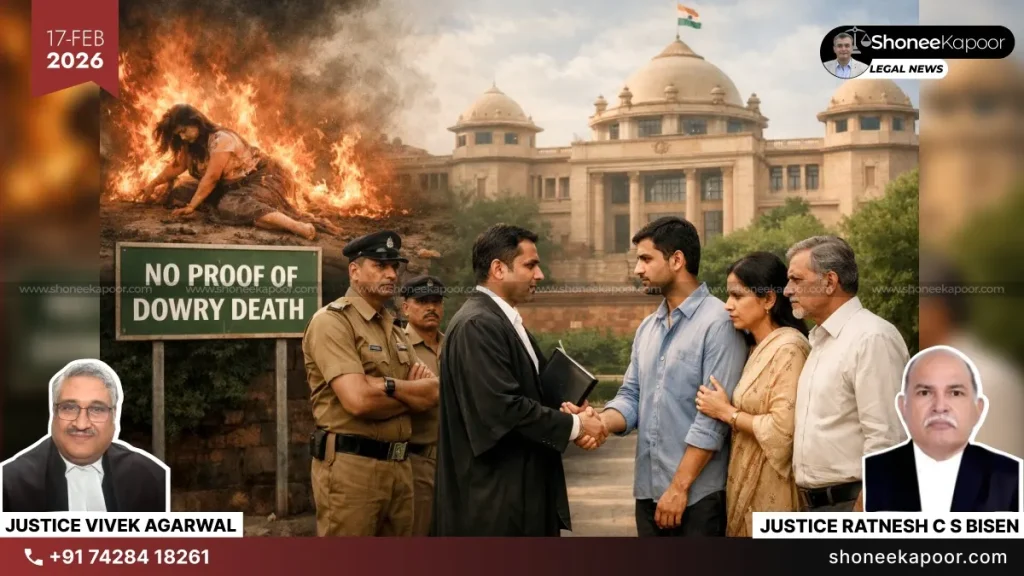
Can a dowry death false 498A case stand when the woman herself makes no dowry allegation before death? The MP High Court’s latest ruling raises serious questions about automatic arrests and presumptions in early marriage deaths.
JABALPUR: On 6 February 2026, the Madhya Pradesh High Court at Jabalpur, in a Division Bench comprising Justice Vivek Agarwal and Justice Ratnesh Chandra Singh Bisen, dismissed the State’s appeal challenging the acquittal in an alleged dowry death case.
The trial court had earlier acquitted the accused of offences under Sections 304-B, 302, and 498-A of the IPC and Sections 3/4 of the Dowry Prohibition Act. After examining the entire record, the High Court found no legal error in that acquittal.
The case involved the death of a young married woman within two years of her marriage. The State argued that since the death occurred within a short period after marriage, it should automatically be treated as a dowry death. However, the High Court did not accept this argument blindly; instead, it analysed the evidence in detail.
The most crucial evidence was the doctor’s dying declaration. In that statement, the deceased said she was disturbed due to personal reasons, including issues with her mother-in-law and doubts raised by her husband about her character. She clearly stated that she set herself on fire. There was no allegation of dowry demand or dowry-related cruelty in her final statement.
The Court clearly recorded:
“Thus, it is evident that as far as dying declaration is concerned, there is no allegation of demand of dowry or associated cruelty.”
This observation went to the root of the prosecution case, because a dowry death charge requires clear evidence of dowry demand and harassment soon before death.
During cross-examination, the mother of the deceased admitted that no dowry was fixed at the time of marriage and that no complaint was made about any demand for a Scorpio vehicle on the dates immediately before the incident.
The father also admitted that during her lifetime, his daughter had not made any complaint against the accused persons. Independent witnesses did not support the prosecution’s case, and some even stated that the incident occurred while she was cooking and that the husband suffered burn injuries while trying to save her.
After considering all these facts together, the Bench held that the trial court had rightly appreciated the evidence. The judges concluded, “Finding of the acquittal cannot be faulted with.” They further observed that the trial court “has rightly acquitted the accused persons” of all charges and that “no interference in the impugned judgment is called for.”
This judgment is important because it reinforces a basic legal principle: a criminal conviction cannot be based solely on presumption. The mere fact that a death occurs within a few years of marriage does not automatically prove dowry harassment. Courts must rely on solid evidence, not emotional assumptions.
Explanatory Table: Laws And Sections Involved
| Law and Section | Purpose | How Applied in This Case |
| Section 304-B IPC (Dowry Death) | Creates presumption of dowry death if a woman dies unnaturally within 7 years of marriage and was harassed for dowry soon before death. | State argued death within 2 years should trigger presumption. Court held no proof of dowry demand in dying declaration or evidence. |
| Section 302 IPC (Murder) | Punishes intentional killing. | Alternative charge of murder was framed, but no evidence of intentional homicide was established. |
| Section 498-A IPC (Cruelty) | Penalizes cruelty by husband or relatives, especially related to dowry harassment. | Allegations were made, but deceased never complained during lifetime and dying declaration did not mention dowry cruelty. |
| Section 34 IPC (Common Intention) | Fixes joint liability when criminal act is done with shared intention. | Added to suggest joint role of family members. Since main offences were not proved, Section 34 also failed. |
| Section 3 Dowry Prohibition Act | Punishes giving or taking dowry. | No evidence of dowry being fixed or exchanged at marriage. Parents admitted no dowry was fixed. |
| Section 4 Dowry Prohibition Act | Punishes demand for dowry directly or indirectly. | Alleged demand of Scorpio vehicle was not supported by consistent evidence and no prior complaint existed. |
Case Details
- Case Title: The State of Madhya Pradesh Vs. Sajan Shukla and Others
- Court: High Court of Madhya Pradesh at Jabalpur
- Case Number: Criminal Appeal No. 1157 of 2024
- Bench: Hon’ble Shri Justice Vivek Agarwal & Hon’ble Shri Justice Ratnesh Chandra Singh Bisen
- Date of Judgment: 6th February, 2026
- Neutral Citation: 2026:MPHC-JBP:10822
- Counsel for Appellant/State: Shri Manas Mani Verma, Government Advocate
Key Takeaways
- Mere death within seven years of marriage does not automatically prove dowry death; presumption under Section 304-B IPC requires clear evidence of dowry demand and cruelty.
- A dying declaration carries strong evidentiary value, and in this case, it contained no allegation of dowry harassment.
- Admissions by parents that no dowry was fixed and no prior complaint was made significantly weakened the prosecution’s case.
- Criminal charges under Sections 304-B, 498-A, and 302 IPC cannot survive on assumptions or social pressure; proof beyond a reasonable doubt remains mandatory.
- Misuse of dowry laws can destroy innocent families, and courts must strictly scrutinize evidence before branding a case as dowry death.
This Could Change Your Case-Get FREE Legal Advice-Click Here!
Disclaimer: The views and opinions expressed in this article are those of the Indian courts and do not necessarily reflect the official policy or position of “ShoneeKapoor.com” or its affiliates. This article is intended for informational and educational purposes only. The content provided is not legal advice, and viewers should not act upon this information without seeking professional counsel. Viewer discretion is advised.