
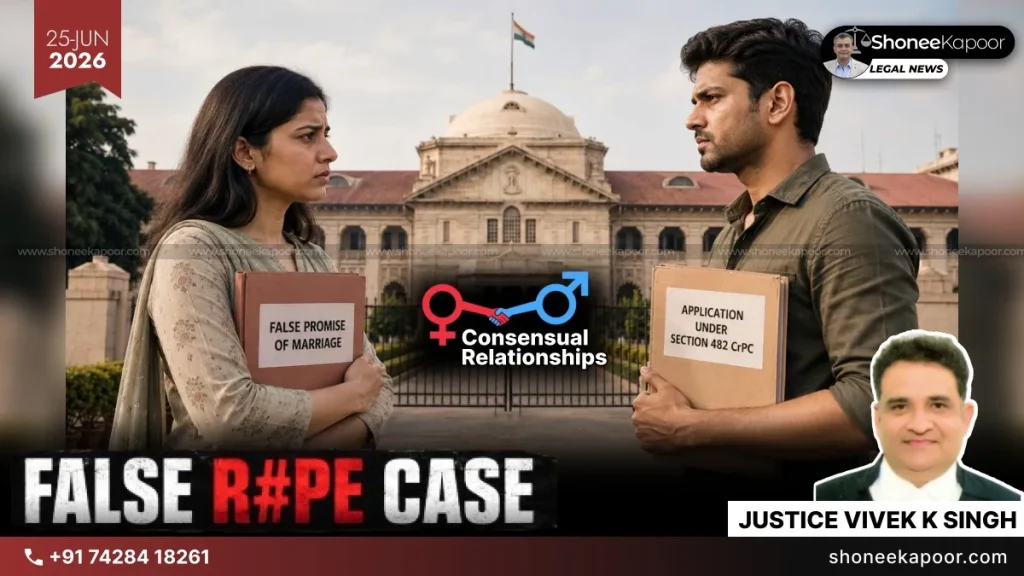
Is every broken promise of marriage rape? Allahabad High Court made it clear that every breach of promise to marry cannot be treated as rape unless false intention existed from the very beginning.
PRYAGRAJ: The Allahabad High Court, through Justice Vivek Kumar Singh, has quashed a rape case against a man after finding that the material on record showed a long consensual relationship, not a clear case of rape on false promise of marriage.
The case arose from an FIR lodged at Police Station Colonelganj, Prayagraj, under Sections 376, 323, 504 and 506 IPC. The woman alleged that the man had physical relations with her since 2014 on the false promise of marriage and later assaulted and threatened her when she asked him to marry her.
The man approached the High Court under Section 482 CrPC, seeking quashing of the chargesheet, summoning order and entire criminal proceedings. His case was that the woman was a major, educated and mature person, around 29 years old at the time of FIR, and had remained in contact with him for about five years.
The Court noticed that the FIR did not clearly mention the date, time or place of the alleged first incident of rape. It also noted that the medical report did not show any internal or external injury, and that no complaint had been made for five years despite the allegation that the relationship had started in 2014.
The Court noted that the long gap between the alleged first incident and the FIR was important. It held:
“The long gap of five years between the first alleged act of sexual intercourse and the continued relationship for five years until the filing of the first information report, convinces this Court that it is a clear case of a love relationship turned sour.”
The High Court explained that every failed relationship or broken promise of marriage cannot be treated as rape. For such an allegation to stand, it must be shown that the man had no intention to marry from the very beginning and used the promise only to obtain consent.
The Court also considered that after the FIR, the parties got married on 27.08.2019. This fact, according to the Court, indicated that the FIR appeared to have been used to put pressure on the man for marriage.
The Court held:
“She alleged that she consented for the marriage under pressure. In the light of foregoing circumstances, even upon a bare reading of the material on records, it is manifest that the relationship between the parties was consensual, therefore, no prima facie offence is made out against the applicant-accused.”
The Court further said:
“It is therefore, clear that the applicant-accused is not liable for the offence of rape if the prosecutrix has fully agreed to maintain sexual relations with the applicant.”
Making its finding clearer, the High Court observed that no offence of rape was made out and that the FIR was lodged because the woman was annoyed by the conduct of the man. It also noted that the marriage after the FIR showed that the criminal case was used to exert pressure.
The Court said:
“The victim after lodgement of the FIR, got married to the applicant on 27.08.2019 which again goes to show that the FIR was lodged in order to exert pressure upon the applicant so that marriage between the applicant and the victim could be solemnized.”
The High Court held that continuing the case would be a gross misuse of criminal law. It found that the allegations of assault, abuse and threat were also not supported by proper details.
Finally, the Allahabad High Court quashed the chargesheet dated 08.01.2020, the cognizance/summoning order dated 04.09.2021, and the entire proceedings in Case No. 793 of 2021 arising out of Case Crime No. 640 of 2019.
EXPLANATORY TABLE: LAWS AND SECTIONS INVOLVED
| Law / Section | Purpose | Relevance in This Case |
| Section 482 CrPC | Inherent power of High Court to prevent misuse of law and secure justice | Main provision used by the man to seek quashing of the criminal case |
| Section 528 BNSS | Equivalent inherent power under the new criminal procedure law | Court referred to this while discussing quashing power |
| Section 376 IPC | Rape | Main allegation against the man based on alleged false promise of marriage |
| Section 376(2)(n) IPC | Repeated rape on the same woman | Discussed through Supreme Court judgments on long consensual relationships |
| Section 323 IPC | Voluntarily causing hurt | Alleged because the woman claimed assault |
| Section 504 IPC | Intentional insult to provoke breach of peace | Alleged abuse/insult, but Court found lack of proper material particulars |
| Section 506 IPC | Criminal intimidation | Alleged threat, but Court found the allegation unsupported by details |
| Section 375 IPC | Definition of rape | Discussed for understanding consent and misconception of fact |
| Section 90 IPC | Consent given under fear or misconception is not valid consent | Important for deciding whether consent was truly vitiated by false promise |
| Section 161 CrPC | Statement recorded by police during investigation | Woman’s statement was recorded during investigation |
| Section 164 CrPC | Statement recorded before Magistrate | Woman’s Magistrate statement was considered by the Court |
| Section 173(2) CrPC | Police report / chargesheet after investigation | Earlier arrest protection was granted till submission of police report |
| Section 156(1) CrPC | Police power to investigate cognizable offence | Mentioned in Bhajan Lal guidelines cited by the Court |
| Section 155(2) CrPC | Magistrate permission for investigation in non-cognizable cases | Mentioned in Bhajan Lal guidelines cited by the Court |
| Section 313 CrPC | Accused’s statement during trial | Appeared in cited Supreme Court precedent |
| Section 417 IPC | Cheating | Mentioned in one cited Supreme Court case involving promise of marriage |
| Section 34 IPC | Common intention | Mentioned in cited precedent where family members were also accused |
| Section 377 IPC | Unnatural offence under old IPC framework | Mentioned in cited precedent, not part of the present FIR |
| Section 6 POCSO Act | Aggravated penetrative sexual assault against a child | Mentioned in a cited Supreme Court case, not part of the present FIR |
| SC/ST Act Sections 3(1)(r), 3(1)(s), 3(2)(5a), 3(2)(v) | Atrocities-related offences | Mentioned in a cited Supreme Court case, not part of the present FIR |
CASE DETAILS
- Case Title: Sanjay Saroj @ Sanjay Kumar vs State of U.P. and Another
- Court: High Court of Judicature at Allahabad
- Case Number: Application U/S 482 No. 752 of 2022
- Neutral Citation: 2026:AHC:127913
- Date of Judgment: 18.06.2026
- Counsels:
- For Applicant: Amit Daga, Senior Counsel assisted by Ramesh Chandra
- For Opposite Party No. 2: Arvind Kumar Bhardwaj
- For State: Rabindra Kumar Singh, AGA
KEY TAKEAWAYS
- A 5-year consensual relationship cannot be converted into rape just because marriage did not happen later.
- The woman was major, educated and mature, yet no complaint was filed for years. Delay mattered.
- The FIR lacked clear date, time and place of the alleged first rape. Vague allegations cannot destroy a man’s life.
- The Court saw it as “a clear case of a love relationship turned sour,” not a genuine rape case.
- Criminal law cannot be used as pressure tactics to force marriage after a relationship fails.
This Could Change Your Case-Get FREE Legal Advice-Click Here!
Disclaimer: The views and opinions expressed in this article are those of the Indian courts and do not necessarily reflect the official policy or position of “ShoneeKapoor.com” or its affiliates. This article is intended for informational and educational purposes only. The content provided is not legal advice, and viewers should not act upon this information without seeking professional counsel. Viewer discretion is advised.