
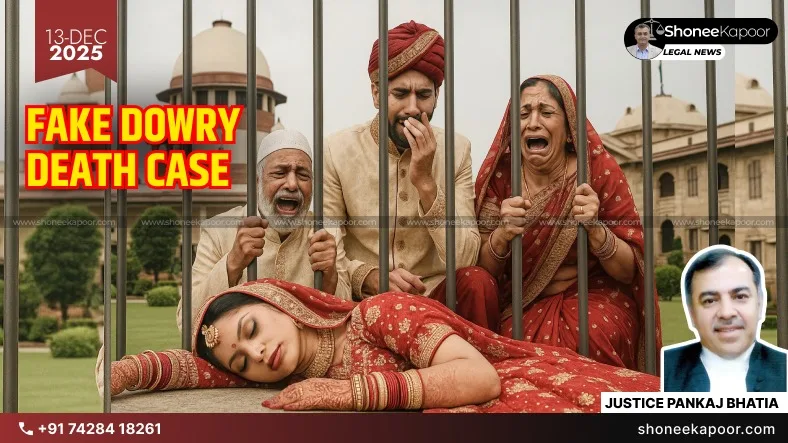
Fake Dowry Death Cases On Rise: Allahabad High Court Grants Bail After Informant Turns Hostile Despite Supreme Court’s Earlier Prima Facie Findings

Curated by NEWS DESK
Editorial DeskThe Allahabad High Court has granted bail in a fake dowry death case after key prosecution witnesses turned hostile, observing that “fake cases of demand of dowry are on the rise.”
The Court noted the “stark reality of the society” where allegations pressed before the Supreme Court were later withdrawn during trial.
Fake Dowry Death Cases On Rise: The Allahabad High Court, Lucknow Bench, has once again brought focus to the growing concern of false and exaggerated dowry-related cases while deciding a second bail application in a serious dowry death matter.
Granting bail to Mukhtar Ahmad, the father-in-law of the deceased, Justice Pankaj Bhatia observed that “fake cases of demand of dowry are on the rise” and described the conduct of the informant as reflecting the “stark reality of the society”.
The case arises out of FIR No. 0032 of 2024 registered at Police Station Kotwali Nagar, Sultanpur, under Sections 498-A and 304-B of the Indian Penal Code along with Sections 3/4 of the Dowry Prohibition Act. This was the applicant’s second bail plea.
His first bail had been granted by the High Court in May 2024 but was later set aside by the Supreme Court.
While cancelling the earlier bail, the Supreme Court had taken a serious view of the allegations and medical evidence. The Apex Court had stressed that courts must be cautious in dowry death cases, observing:
“When a young bride dies under the suspicious circumstances merely within two years of marriage, the judiciary must reflect heightened vigilance and seriousness”.
The Supreme Court further underlined:
“The social message from the judicial orders cannot be overstated in such cases and we had found prima facie material indicating dowry demand and domestic violence.”
The Supreme Court judgment dated 3 March 2025 relied heavily on the post-mortem report, which indicated “asphyxia due to ante-mortem strangulation” along with traumatic injuries. It also noted the seriousness of the allegations, stating:
“The gravity of the allegations, ranging from demands for costly gifts to the infliction of brutal injuries, demonstrates a strong prima facie case against them”.
On these findings, the Apex Court cancelled the bail of the father-in-law and mother-in-law and directed them to surrender, warning that allowing prime accused to remain on bail could undermine public confidence in the justice system.
In compliance with the Supreme Court’s directions, Mukhtar Ahmad surrendered before the trial court on 17 March 2025 and the trial commenced. However, during the course of evidence, the prosecution case began to weaken significantly. The informant, who is the brother of the deceased and was examined as PW-1, resiled from his earlier statements.
He stated before the trial court that the allegations regarding dowry demand were made “at the instance of the members of the society” and further stated that during the inquest proceedings he had mentioned that the deceased had committed suicide. On account of these statements, he was declared hostile.
The situation worsened for the prosecution when PW-2, the father of the deceased, also failed to support the case. He categorically stated that his daughter was “neither harassed for dowry nor was killed.” Other close relatives, including the maternal uncle and the elder sister of the deceased, also did not support the prosecution version and were declared hostile.
Taking note of this complete turnaround, Justice Pankaj Bhatia described the matter as a “very unfortunate case” where the informant had taken a strong stand before the Supreme Court but later completely retracted his allegations during trial.
The Court observed:
“Considering the said statements, it is essential to notice that fake cases of demand of dowry are on the rise, as is evident from the present case where the informant, challenged the order of grant of bail before the Supreme Court and thereafter has resiled from the said statements and have not supported the prosecution version, this fact cannot be ignored by this court.”
The Court further remarked:
“Such conduct indicates the stark reality of the society”.
Distinguishing the situation before it from the circumstances that existed when the Supreme Court cancelled the bail, the High Court held that continued incarceration of the applicant was no longer justified. It noted that the applicant had been in custody since 17 March 2025 and that all material prosecution witnesses had failed to support the allegations.
Accordingly, the High Court allowed the second bail application and directed that Mukhtar Ahmad be released on bail upon furnishing a personal bond and two reliable sureties of Rs. 20,000 each, subject to standard conditions including attendance before the court, non-tampering of evidence, and non-intimidation of witnesses.
The case relates to the death of Ms. Shahida Bano in January 2024, within two years of her marriage. She was found dead in her matrimonial home with a dupatta tied around her neck and attached to a ceiling fan. Based on the post-mortem findings suggesting forced strangulation, the police had registered the dowry death case against her husband and in-laws.
While the Supreme Court earlier emphasised the need for stricter scrutiny in such cases, the High Court’s latest order highlights how hostile witnesses and retracted statements can fundamentally alter the course of a criminal trial, even in offences as grave as dowry death.
This order once again brings to the forefront the complex balance courts must maintain between protecting genuine victims and preventing misuse of stringent dowry laws, a concern that the High Court itself acknowledged by referring to the increasing number of “fake cases of demand of dowry”
Explanatory Table: Laws & Sections Involved in the Case
| Law / Section | Name of Provision | What It Means (Simple Explanation) | How It Applied in This Case |
| Section 304B IPC | Dowry Death | Applies when a married woman dies within 7 years of marriage under unnatural circumstances and there is evidence of dowry harassment soon before death | FIR was registered alleging dowry death after the woman was found dead within two years of marriage |
| Section 498-A IPC | Cruelty by Husband or Relatives | Criminalises cruelty, mental or physical harassment, by husband or in-laws, often linked with dowry demands | Allegations were made that the deceased was harassed for dowry |
| Section 3, Dowry Prohibition Act | Penalty for Giving or Taking Dowry | Punishes giving, taking, or demanding dowry | Invoked based on alleged dowry demands |
| Section 4, Dowry Prohibition Act | Penalty for Demanding Dowry | Specifically targets the act of demanding dowry | Added due to claims of demand of costly gifts |
| Bail Jurisdiction (CrPC) | Power to Grant Bail | Courts assess custody, evidence, witness conduct, and likelihood of misuse | Bail granted after prosecution witnesses turned hostile |
| Supreme Court SLP (Crl.) | Special Leave Petition (Criminal) | Allows the Supreme Court to intervene in criminal matters | Earlier bail was cancelled by the Supreme Court citing prima facie evidence |
Case Summary
- Case Title: Mukhtar Ahmad vs State of U.P. Thru. Addl. Chief Secy. Home, Lucknow
- Court: High Court of Judicature at Allahabad, Lucknow Bench
- Case Number: Criminal Misc. Bail Application No. 10767 of 2025
- Related FIR: Case Crime No. 0032 of 2024 Police Station Kotwali Nagar, District Sultanpur
- Date of Order: 13 November 2025
- Hon’ble Judge: Justice Pankaj Bhatia
Counsels
For the Applicant:
Sri R.B.S. Rathaur
Ms. Anu Kumari
Sri Anurag Singh Rathaur
For the State: G.A. (Government Advocate)
Key Takeaways
- This case exposes how easily dowry and cruelty laws can be invoked, pushed up to the Supreme Court, and then quietly abandoned when the truth comes out during trial.
- When key family witnesses themselves turn hostile, it raises serious questions about the misuse of Sections 498A and 304B as pressure tools rather than justice mechanisms.
- The High Court’s observation that “fake cases of demand of dowry are on the rise” officially acknowledges what men have been suffering silently for years.
- Arrest, jail, and social stigma happen immediately to men, while accountability for false allegations is almost non-existent once allegations collapse in court.
- This judgment reinforces the urgent need for safeguards, penalties for false cases, and truly gender-neutral matrimonial laws to restore balance and fairness.
This Could Change Your Case-Get FREE Legal Advice-Click Here!
Disclaimer: The views and opinions expressed in this article are those of the Indian courts and do not necessarily reflect the official policy or position of “ShoneeKapoor.com” or its affiliates. This article is intended for informational and educational purposes only. The content provided is not legal advice, and viewers should not act upon this information without seeking professional counsel. Viewer discretion is advised.
Related Articles
Supreme Court Guidelines That Protect Men From False 498A Arrests in India
The Supreme Court has ruled that arrest under Section 498A is not automatic and personal liberty under Article 21 app...
Real Court Cases Where False Allegations Backfired On Wife
Real Indian court cases where false 498A, dowry, cruelty and defamatory allegations against husbands backfired, leadi...
Anticipatory Bail Application Format Under Section 482 BNSS: PDF & Affidavit
Download anticipatory bail application format under Section 482 BNSS with affidavit, grounds, court procedure, condit...
Share Your Thoughts
Comments are moderated before publication.