
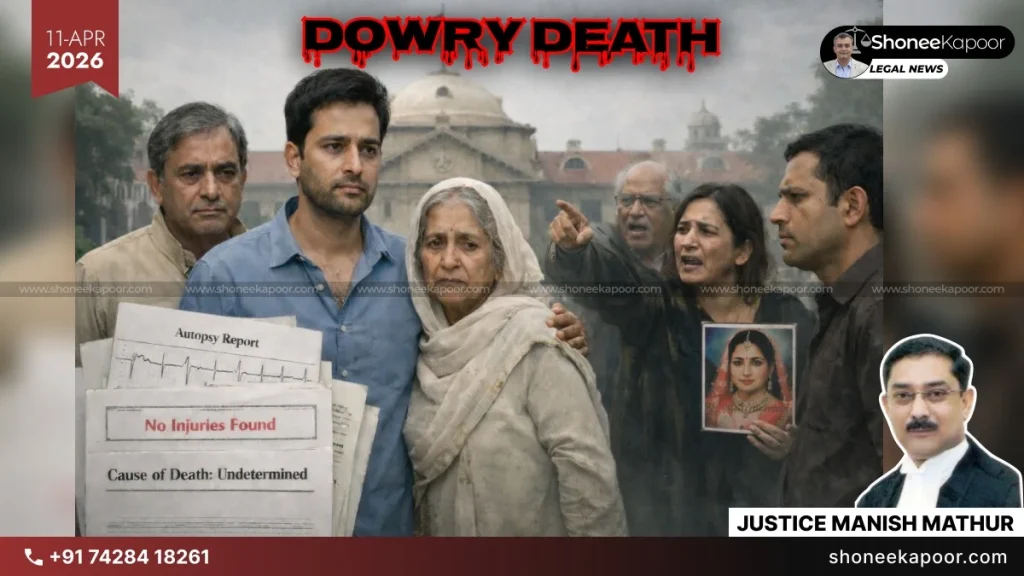
The Allahabad High Court overturned the conviction, highlighting gaps in the evidence of dowry death case. When evidence was so weak, on what basis was conviction recorded in the first place?
PRAYAGRAJ: In a judgment dated 31 March 2026, Justice Manish Mathur of the Allahabad High Court acquitted the accused in a dowry death case, holding that criminal conviction cannot be based on assumptions or incomplete evidence. The case involved allegations under Section 304B IPC and Section 498A IPC, but the Court found major gaps in proof.
The prosecution claimed that the woman died within seven years of marriage and faced dowry harassment. However, medical evidence did not support this claim. There were no external injuries, no poison found, and even the doctor could not determine the cause of death, raising serious doubt about whether it was an unnatural death.
The Court clearly observed:
“For applicability of Section 304-B IPC, it is essential that factum of death of a woman being caused by burns or bodily injury or otherwise than in the normal circumstances be established by evidence.”
It further held:
“Mere demand for articles or valuables does not have any nexus with any harassment or cruelty which resulted in death, provisions of Section 304-B & Section 498-A IPC read with Section 113-B Evidence Act would be inapplicable.”
On legal principles, the Court emphasised that for dowry death charges, there must be clear proof of unnatural death, timing within marriage, and a direct link between harassment and dowry demand.
It also reiterated:
“Prosecution, in a case of offence under Section 304B IPC cannot escape from the burden of proof that the harassment or cruelty was related to the demand for dowry and also that such cruelty or harassment was caused soon before her death.”
The Court found that witness statements were vague and did not show any specific incident of cruelty connected to dowry demand. There was no clear link between alleged harassment and the woman’s death.
Holding that the trial court relied on assumptions rather than solid evidence, the High Court set aside the conviction and acquitted the husband and his relatives.
Explanatory Table: Laws & Sections Involved
| Section / Law | Purpose | How Applied In This Case |
| Section 304B IPC | Deals with dowry death when a woman dies under suspicious conditions within 7 years of marriage | Main charge; Court found key conditions not proved |
| Section 498A IPC | Covers cruelty or harassment by husband or his relatives | Alleged, but no clear evidence of cruelty |
| Section 3 Dowry Prohibition Act | Penalises giving/taking dowry | Applied but fell with main charges |
| Section 4 Dowry Prohibition Act | Punishes demand for dowry | Not sustained due to weak evidence |
| Section 113B Evidence Act | Allows court to presume guilt if conditions are proved | Court held conditions not met, so presumption not applicable |
| Section 437A CrPC | Requires accused to furnish bond after acquittal | Procedural compliance ordered |
Case Details
- Case Title: Mewa Lal and 2 Others vs State of U.P.
- Court: High Court of Judicature at Allahabad, Lucknow Bench
- Case Number: Criminal Appeal No. 2148 of 2004
- Bench: Hon’ble Justice Manish Mathur
- Neutral Citation: 2026:AHC-LKO:22648
- Date of Judgment: 31 March 2026
- Counsels:
- For Appellants: M.L. Syal, Ashok Kumar, Ram Naresh Singh, Shailesh Kumar Singh, Shashi Kiran Arya
- For State: Vishwas Saraswat, Additional Government Advocate
Key Takeaways
- Allegations alone are not evidence—courts must demand strict proof before branding a man guilty in dowry death cases.
- If even the cause of death is unclear, calling it a dowry death becomes legally unsustainable.
- General and vague claims cannot replace specific evidence of cruelty or harassment.
- There must be a clear and direct connection between any alleged demand and the incident in question.
- Serious criminal laws cannot be used as pressure tools—they must stand the test of strict evidence.
This Could Change Your Case-Get FREE Legal Advice-Click Here!
Disclaimer: The views and opinions expressed in this article are those of the Indian courts and do not necessarily reflect the official policy or position of “ShoneeKapoor.com” or its affiliates. This article is intended for informational and educational purposes only. The content provided is not legal advice, and viewers should not act upon this information without seeking professional counsel. Viewer discretion is advised.