
Can One Statement Before Death Decide The Fate Of An Entire Family?
The Allahabad High Court held that in matrimonial death cases, a single trustworthy dying declaration can become sufficient to convict the husband and his family.
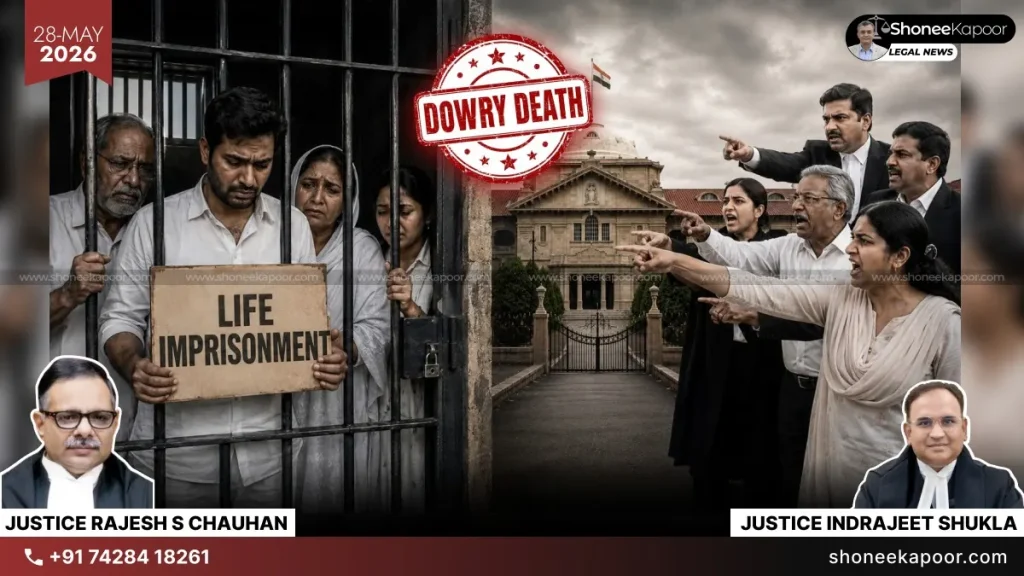
LUCKNOW: The Allahabad High Court, Lucknow Bench, comprising Justice Rajesh Singh Chauhan and Justice Indrajeet Shukla, upheld the conviction of a husband, mother-in-law and father-in-law in a dowry death case after finding strong evidence against them, including the dying declaration of the deceased woman.
The Court observed that dowry death continues to remain a serious social problem and held that a truthful dying declaration can, by itself, become sufficient evidence for conviction.
According to the prosecution, soon after marriage, the woman was allegedly harassed for additional dowry, including demand for a motorcycle, fan and money. Her family claimed that they were financially weak and unable to fulfil those demands. They further stated that the woman repeatedly complained about beatings, abuse and harassment whenever she visited her parental home.
On 13 May 2012, the family received information that the woman had suffered severe burn injuries and was admitted to Civil Hospital, Lucknow. The prosecution alleged that after admitting her to the hospital, the accused persons fled from there.
The most important evidence in the case was the dying declaration recorded by the SDM while the victim was undergoing treatment. Before recording the statement, the doctor certified that she was fully conscious and mentally fit.
In her dying declaration, the victim stated:
“My mother-in-law Ramrati poured kerosene oil on me and set me on fire. These people were demanding a vehicle in dowry and used to regularly demand money from me. I am giving this statement voluntarily and truthfully without any pressure or force.”
The prosecution also relied upon statements of the deceased’s parents and relatives who consistently alleged dowry harassment. The postmortem report showed that the victim had suffered around 90% burn injuries and later died due to septicemia caused by ante-mortem burns.
The defence argued that the woman had committed suicide and that the family members had actually tried to save her. However, the High Court rejected this defence version and accepted the prosecution case.
While discussing the importance of dying declarations, the Court observed:
“‘Dying Declaration’ having passed the muster of law are admissible by virtue of legal sanctity envisaged u/s 32 (1) Indian Evidence Act, such declarations being exception to the hearsay rule carry immense weight in criminal trials.”
The Court further observed:
“There cannot be an absolute rule of law that the dying declaration cannot form the sole basis of conviction unless it is corroborated.”
The Bench also clarified:
“If a dying declaration has been recorded in a proper manner by a competent authority and the court is satisfied of its truthfulness, it is a “substantive piece of evidence” sufficient to sustain a conviction on its own and cannot be regarded as a weak piece of evidence.”
The High Court ultimately held that the prosecution successfully proved cruelty and dowry harassment soon before the death of the victim. Accordingly, the Court upheld conviction under Sections 304-B and 498-A IPC along with provisions of the Dowry Prohibition Act. The husband and mother-in-law were sentenced to life imprisonment, while the father-in-law was awarded 20 years rigorous imprisonment.
Explanatory Table: Laws & Sections Involved
| Section / Law | Purpose | Role In This Case |
| Section 304-B IPC | Dowry Death | Applied because the woman died due to burn injuries within 7 years of marriage and allegations of dowry harassment existed soon before death. |
| Section 498-A IPC | Cruelty By Husband Or Relatives | Used for allegations of physical and mental harassment related to dowry demands. |
| Section 3 Dowry Prohibition Act | Penalty For Giving Or Taking Dowry | Applied because unlawful dowry demands were alleged. |
| Section 4 Dowry Prohibition Act | Punishment For Demanding Dowry | Used due to allegations of repeated demands for motorcycle, fan and money. |
| Section 113-B Indian Evidence Act | Presumption As To Dowry Death | Once cruelty related to dowry was shown, the Court legally presumed involvement of husband and in-laws unless rebutted. |
| Section 32(1) Indian Evidence Act | Dying Declaration | Allowed the victim’s statement before death to be treated as admissible evidence. |
| Section 302 IPC | Murder | Alternative charge framed during trial though conviction mainly remained under dowry death provisions. |
| Section 313 Cr.P.C. | Examination Of Accused | Accused were questioned regarding evidence and allegations against them during trial. |
| Sections 374 & 386 Cr.P.C. | Criminal Appeal Powers | Governed the High Court’s powers while hearing appeal against conviction. |
Case Details
- Case Title: Smt. Ram Rati and 2 Others vs State of U.P.
- Court: High Court of Judicature at Allahabad, Lucknow Bench
- Case Number: Criminal Appeal No. 2275 of 2019
- Neutral Citation: 2026:AHC-LKO:38099-DB
- Date Of Judgment: 22.05.2026
- Bench: Hon’ble Justice Rajesh Singh Chauhan | Hon’ble Justice Indrajeet Shukla
- Counsels:
- For Appellant: Nand Lal Sharma, Dilip Kumar Singh, Jyoti Rajpoot, K.K. Sharma, Kaustubh Singh, Manoj Kumar Yadav, Prem Shankar, Rajendra Prasad, Rakesh Kumar
- For Respondent: Government Advocate
Key Takeaways
- One dying statement can completely change the fate of an entire family, even without eyewitnesses.
- Once dowry harassment allegations are accepted, the legal burden shifts heavily against the husband and his family.
- Dying declarations have become one of the strongest weapons in matrimonial criminal cases.
- Defence claims like suicide, accident, or rescue attempts often get overshadowed after serious allegations are made.
- Matrimonial criminal cases increasingly operate on reverse burden principles, where the accused family struggles to prove innocence.
This Could Change Your Case-Get FREE Legal Advice-Click Here!
Disclaimer: The views and opinions expressed in this article are those of the Indian courts and do not necessarily reflect the official policy or position of “ShoneeKapoor.com” or its affiliates. This article is intended for informational and educational purposes only. The content provided is not legal advice, and viewers should not act upon this information without seeking professional counsel. Viewer discretion is advised.