
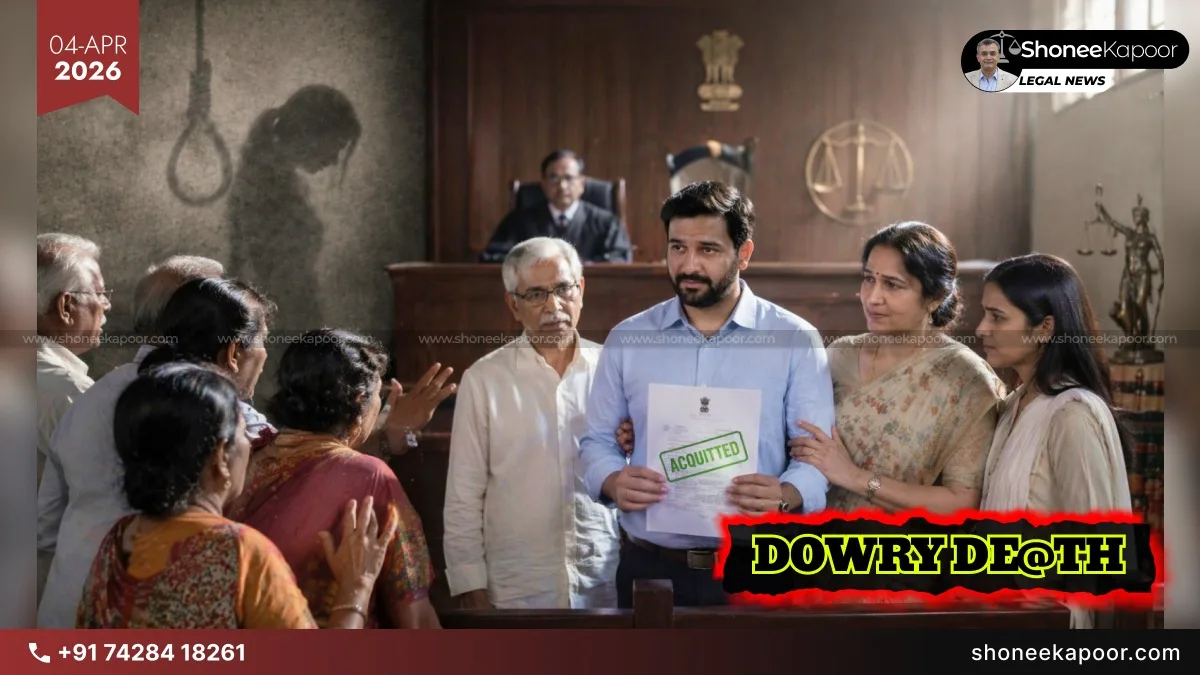
Dowry Death Case | No Proof, No Conviction: Delhi Court Acquits Husband And Family, Highlights Wife’s Suicidal Tendencies And No Evidence Of Immediate Harassment

Written and analysed by Shonee Kapoor
Legal Consultant, Author & Men's Rights ActivistIn a Delhi court case involving a young bride’s death within two months of marriage, where the court found no proof of immediate harassment.
How easily can husbands and in-laws be dragged into serious criminal cases based on unverified and general allegations?
NEW DELHI: In a judgment by Additional Sessions Judge Nipun Awasthi, the case concerned the death of a newly married woman within just two months of her marriage, leading to allegations of dowry harassment against her husband and in-laws, with the court closely examining whether the strict legal requirements of proof in such cases were actually satisfied.
The couple married on 06.12.2017 and died on 16.02.2018 after allegedly hanging herself in her matrimonial home, and since the death happened within seven years of marriage, the case was treated as a dowry death, but the court made it clear that legal presumption alone is not enough unless supported by evidence showing that the deceased “was subjected to cruelty and harassment” in connection with dowry demands.
The family alleged harassment for dowry, including the demand of money and a vehicle, and claimed that some money was transferred to the husband’s account, while the accused denied all allegations and stated that they were falsely implicated, which led the court to carefully examine whether such allegations were consistent and reliable or merely based on assumptions.
The court observed that the prosecution case was largely based on statements of interested witnesses like close family members, and such evidence must be tested carefully for contradictions and exaggerations, especially when no strong independent corroboration is available.
It further observed that the material on record indicated that the deceased was emotionally disturbed and was dealing with persistent negative thoughts, which reflected a fragile mental state. It also emerged that she had a history of such distress, pointing towards an internal struggle rather than external pressure.
The evidence suggested that her condition was not a result of any specific act attributable to the accused but was linked to her own mental health issues.
The Court noted:
From the material available on record, it is proved that the accuseds cannot be imputed with any conduct of cruelty or harassment towards the deceased and it is also proved that deceased was troubled by negative feelings and suicidal tendencies.
It was further emphasized that in cases of alleged dowry death, the prosecution must prove a clear and live link between cruelty and death, and not just general allegations, as the law specifically requires that such harassment should exist “soon before her death”.
The judge also highlighted that every instance of cruelty does not automatically amount to dowry death unless it is directly connected with dowry demand, and vague or omnibus allegations against all family members without specific roles weaken the case.
Additionally, the court stressed that a criminal conviction cannot be based on suspicion or emotional claims alone, and there must be clear, cogent and trustworthy evidence showing that the accused persons acted “in furtherance of your common intention” to harass the deceased for dowry.
The court held that despite serious allegations, there was no legally admissible and reliable evidence to prove dowry-related harassment “soon before death,” and since the case was based on vague and uncorroborated claims, the accused were given the benefit of doubt and acquitted.
Explanatory Table: Laws & Sections Involved
| Law / Section | Purpose | How Applied in This Case |
| 498A IPC | To punish cruelty or harassment by husband or his relatives | Allegation that the wife was harassed for dowry demands like money and vehicle |
| 304B IPC | To deal with dowry death within 7 years of marriage | Applied as the death occurred within 2 months of marriage under suspicious circumstances |
| 406 IPC | To punish misuse or non-return of stridhan (wife’s property) | Allegation that dowry articles were misappropriated by husband and family |
| 34 IPC | To fix joint liability when act is done with common intention | Used to implicate all family members together for alleged acts |
| 174 CrPC | Inquest in case of unnatural death | Proceedings conducted as death occurred within 7 years of marriage |
| 294 CrPC | Admission/denial of documents | Certain documents like FIR, postmortem, CDR were admitted without formal proof |
Case Details
- Case Title: State Vs. Daman Deep & Ors.
- Court: Tis Hazari Courts
- Judge: Sh. Nipun Awasthi, DHJS
- FIR No.: 106/2018
- Police Station: Rajouri Garden
- Case No.: SC No. 330/2018
- CNR No.: DLWT010047392018
- Date of Judgment: 30-03-2026
- Counsels:
- For State: Ms. Shubhra Goyal, Addl. Public Prosecutor
- For Accused: Sh. Mukesh Kalia, Advocate
Key Takeaways
- Serious charges like 498A and 304B can be triggered within days of marriage, putting entire families under immediate criminal scrutiny without preliminary verification.
- Most prosecution cases rely heavily on statements of interested witnesses (family members), making independent evidence crucial to prevent misuse.
- The legal requirement of proving harassment “soon before death” is the strongest safeguard against false implication and must be strictly enforced.
- Vague and omnibus allegations against multiple family members weaken the case and highlight the risk of entire families being unnecessarily dragged into litigation.
- Courts reaffirm that conviction cannot be based on emotions or allegations alone, and absence of clear, consistent, and corroborated evidence must result in benefit of doubt to the accused.
This Could Change Your Case-Get FREE Legal Advice-Click Here!
Disclaimer: The views and opinions expressed in this article are those of the Indian courts and do not necessarily reflect the official policy or position of “ShoneeKapoor.com” or its affiliates. This article is intended for informational and educational purposes only. The content provided is not legal advice, and viewers should not act upon this information without seeking professional counsel. Viewer discretion is advised.
Related Articles
Real Court Cases Where False Allegations Backfired On Wife
Real Indian court cases where false 498A, dowry, cruelty and defamatory allegations against husbands backfired, leadi...
498A FIR in India While Husband Is in Canada: What an NRI Husband Must Do Immediately Before Police, LOC or NBW Pressure Begins
An NRI husband in Canada facing 498A IPC or Section 85 BNS FIR in India must preserve evidence, check jurisdiction, a...
The Silent Crisis: Men Destroyed by False Allegations in India – How Laws Meant for Protection Are Destroying Innocent Men
Laws Meant for Protection Are Destroying Innocent Men. An FIR is filed and a man’s life collapses before any evidence...
Share Your Thoughts
Comments are moderated before publication.