
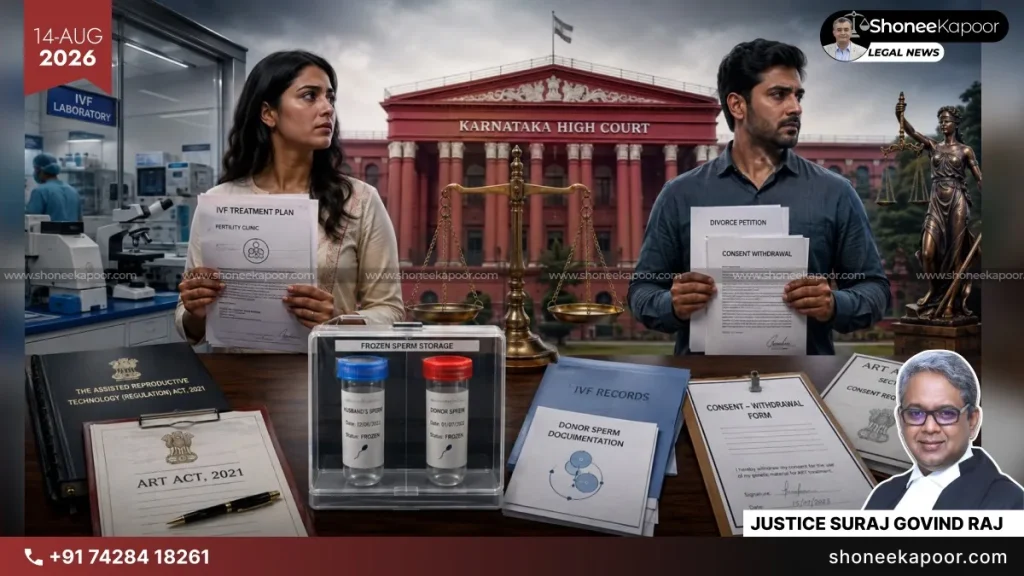
Can a married woman use donor sperm while her husband is alive, fertile and opposing the process? The Karnataka High Court is examining a sensitive IVF dispute where reproductive choice clashes with the husband’s consent and possible legal responsibility.
BENGALURU: A 41-year-old Bengaluru woman has approached the Karnataka High Court in an ongoing dispute concerning IVF, donor sperm and reproductive consent. The latest development came after the Centre reportedly told the Court that a wife can use donor sperm only where the husband is proved infertile.
The woman and her husband married in 2022. Both were in their second marriage. After they were unable to conceive naturally, they approached an IVF clinic and underwent several treatment cycles. The husband had earlier deposited his sperm with the clinic. However, matrimonial disputes later arose; the couple separated, and the husband filed for divorce on the ground of cruelty. He subsequently withdrew his consent for further use of his frozen sperm.
The wife then approached the High Court seeking permission to continue her attempt at motherhood. Her counsel had earlier argued:
“My eggs and his sperm are with the clinic, and I am impaired without his consent. I cannot even have another donor, and I cannot use the husband’s sperm because of the consent mandated under law.”
Her counsel further submitted:
“This Act has created a lot of social and legal issues. This case before the court is also a social and legal issue, and the court should set a precedent where my right to have a child should be considered.”
He also argued that although the husband had initially agreed to IVF and provided his sperm, the couple later became estranged and he withdrew that consent. The wife’s case was that this later withdrawal should not prevent her from pursuing motherhood through the IVF process already started.
But Section 22 of the Assisted Reproductive Technology (Regulation) Act, 2021 creates an important protection. ART treatment cannot ordinarily proceed without written informed consent of the persons concerned. More importantly, Section 22(4) expressly permits either member of a commissioning couple to withdraw consent before the embryo or gametes are transferred into the woman’s uterus.
This means the husband’s earlier consent cannot automatically be treated as permanent merely because he once deposited sperm for IVF. His subsequent decision concerning his own genetic material remains a serious legal consideration.
The Centre had earlier opposed the woman’s request to proceed independently with ART treatment because her marriage was still legally subsisting. It argued that since she and her husband had originally approached the clinic as a commissioning couple and no divorce had yet been granted, she could not simply be treated as a single woman under the ART framework.
The Centre further argued that the ART Act does not permit a married woman to continue the existing marriage while simultaneously seeking conception through donor sperm. It submitted that there must be a specific legal provision authorising such a procedure before it can be allowed.
Justice Suraj Govindaraj had earlier recognised that the case involves more than a technical interpretation of the statute:
“These are not purely legal issues so we can’t look at it technically; here is a situation where a divorce petition is filed by the husband, she is contesting it. These are problems which come up, and we need to solve them.”
The Court further observed:
“The object of the Act is for the citizens. We know the system; how long a divorce matter can take; can she wait for that long a period?”
And added:
“New issues keep coming; we will have to solve them and give them some recourse. Where they are not at fault.”
The husband’s concern was not limited to the use of sperm. His counsel, Chinmay J Mirji, also raised the possibility that if a child is born while the marriage is still legally subsisting, the husband could later face questions relating to child maintenance, paternity and succession rights in his property.
This concern is important because Section 31 of the ART Act gives a child born through ART the legal status and rights of a biological child of the commissioning couple, while the sperm donor does not retain parental rights.
When the Court specifically asked whether the husband could later face maintenance or succession claims for a child conceived using donor sperm, the woman’s counsel stated that no such claim was being sought for the child, although she would continue to claim her own rights as the legally wedded wife.
The Court then observed:
“We need to see that it is as per applicable law and how it will fit in.”
The High Court has not finally decided the dispute. It is examining how the woman’s reproductive interests can be addressed without overriding the statutory consent requirement or placing unintended paternity, maintenance, inheritance or succession liabilities upon an estranged husband.
EXPLANATORY TABLE OF LAWS AND SECTIONS
| LAW / SECTION | WHAT IT MEANS | APPLICATION IN THIS CASE |
| Assisted Reproductive Technology (Regulation) Act, 2021 | Regulates IVF clinics, ART banks, gametes, donors and commissioning parties. | Governs the entire dispute concerning frozen sperm and donor-assisted conception. |
| Section 2(1)(e), ART Act – Commissioning Couple | Covers an infertile married couple approaching an ART clinic for treatment. | The parties originally approached the clinic as husband and wife. |
| Section 21, ART Act | Requires ART clinics to ensure eligibility and comply with statutory safeguards. | The clinic cannot simply proceed outside the prescribed ART framework. |
| Section 22(1), ART Act | Requires written informed consent before ART treatment or procedure. | The husband has withdrawn consent to use his sperm. |
| Section 22(3), ART Act | Human reproductive material cannot be used to create an embryo without specific written consent of concerned persons. | Protects control over the husband’s reproductive material. |
| Section 22(4), ART Act | Either member of a commissioning couple may withdraw consent before transfer of gametes or embryos to the uterus. | Directly supports the legal significance of the husband’s withdrawal of his earlier consent. |
| Rule 13, ART Rules, 2022 | Prescribes consent forms for ART procedures, including donor semen. | Consent requirements become important if the wife seeks donor sperm while still married. |
| Form 8, ART Rules, 2022 | Prescribed consent for insemination using donor semen; contains provision for the husband’s declaration where applicable. | Shows why donor conception during an existing marriage has implications for the husband and resulting child. |
| Section 31, ART Act | Child born through ART is deemed the biological child of the commissioning couple and receives rights of a natural child; donor gives up parental rights. | Explains the husband’s concerns regarding parentage, maintenance and succession. |
CASE DETAILS
| PARTICULAR | DETAILS |
| Court | High Court of Karnataka |
| Case Title | X v. Union of India & Ors. |
| Case Number | W.P. No. 34426/2024 (GM-RES) |
| Nature of Case | Petition concerning IVF, frozen sperm, donor sperm and consent during pending matrimonial proceedings |
| Petitioner | Woman |
| Respondent / Husband | Estranged husband |
| Bench | Justice Suraj Govindaraj |
| Petitioner’s Counsel | Mir Parveez Ahamed / Parveez Ahamed MR |
| Husband’s Counsel | Chinmay J Mirji |
| Counsel for Central Government | Sadhana S Desai |
KEY TAKEAWAYS
- A man’s consent is not a permanent licence over his body or genetic material just because he once agreed to IVF.
- His sperm cannot become someone else’s reproductive entitlement after he has clearly withdrawn consent.
- If the wife uses donor sperm while the marriage still legally exists, the husband cannot be kept waiting for future paternity, maintenance or inheritance claims to explode later.
- Choice cannot mean freedom for the woman and liability for the man. Reproductive autonomy must work both ways.
- No man should be turned into a legal father, financial provider or succession gateway for a child he never agreed to conceive.
This Could Change Your Case-Get FREE Legal Advice-Click Here!
Disclaimer: The views and opinions expressed in this article are those of the Indian courts and do not necessarily reflect the official policy or position of “ShoneeKapoor.com” or its affiliates. This article is intended for informational and educational purposes only. The content provided is not legal advice, and viewers should not act upon this information without seeking professional counsel. Viewer discretion is advised.