
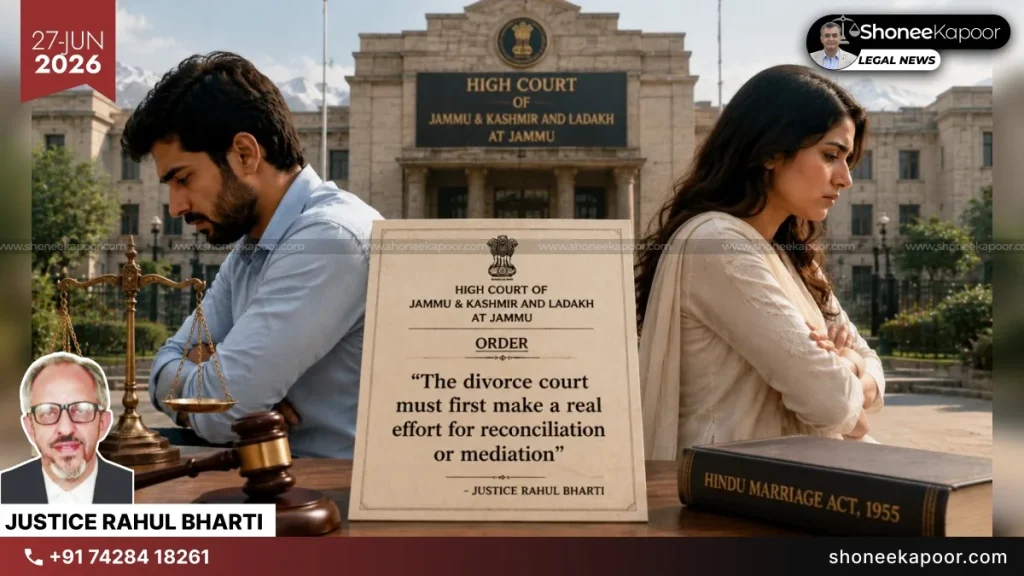
Can divorce petitions be treated like routine civil cases? Jammu & Kashmir and Ladakh High Court says No, holding that matrimonial disputes require a sensitive approach, and courts must first attempt reconciliation or mediation before pushing the parties into allegations, replies and objections.
JAMMU: The Jammu & Kashmir and Ladakh High Court, through Justice Rahul Bharti, held that a divorce court must first make a real effort for reconciliation or mediation before directing the respondent to file a reply in a matrimonial dispute.
The Court noted that the divorce petition was being treated as an ordinary civil case, in which the court was only following the usual process of appearance and reply. The High Court disapproved this approach because matrimonial disputes require a different and more sensitive handling.
The Court observed that:
“The trial court had proceeded without any intervening exercise at the first instance of mediation and reconciliation as is expected from the court.”
It further noted that Section 23(2) of the Hindu Marriage Act, 1955 and Order 32-A CPC require the court to make an effort at the first stage itself to help the parties reach an amicable settlement, depending on the facts of the case.
The High Court found that instead of first attempting reconciliation, the trial court kept insisting on reply and objections. It even gave a last opportunity and warned that the right to file reply could be closed.
The Court said that filing a reply in a divorce case means the respondent has to answer the allegations made in the petition. This can increase bitterness between husband and wife and may reduce the chance of settlement.
The Court clearly observed that:
“The reply is, thus, then not going to smoothen the strained relationship obtaining between the two.”
And any later reconciliation attempt may become “nothing but a meaningless venture.”
The High Court further clarified that reconciliation can be tried at any stage, but the first and most important attempt must be made at the beginning of the matrimonial case, when the respondent first appears.
The Court also pointed out a separate error in the trial court’s order, where the court designation was wrongly referred to as Principal Sessions Judge. The High Court said a divorce petition under the Hindu Marriage Act is a civil matrimonial matter, not a criminal jurisdiction matter.
The High Court directed the trial court to first undertake reconciliation or mediation. Only if that process fails can the divorce case proceed on merits, and only then can the respondent be asked to file reply or objections.
EXPLANATORY TABLE: LAWS AND SECTIONS INVOLVED
| Law / Section | Purpose | How It Applied In This Case |
| Article 227, Constitution of India | Gives High Court supervisory power over subordinate courts | Wife invoked this power because the divorce court was allegedly proceeding mechanically without first attempting reconciliation |
| Section 13, Hindu Marriage Act, 1955 | Provides grounds for divorce | Husband had filed the divorce petition under this section before the Principal District Judge, Samba |
| Section 23(2), Hindu Marriage Act, 1955 | Requires court to make effort for reconciliation in matrimonial cases, wherever possible | High Court held that the trial court should have first explored amicable reconciliation before asking for reply/objections |
| Order 32-A, Code of Civil Procedure, 1908 | Deals with family matters and requires courts to try settlement efforts in suitable cases | High Court said the trial court ignored the spirit of this provision by treating the divorce petition like a routine civil case |
CASE DETAILS
- Case Title: Kanchan Devi vs Amit Sharma
- Court: High Court of Jammu & Kashmir and Ladakh at Jammu
- Case Number: CM(M) No. 85/2026, CM No. 2776/2026
- Bench: Hon’ble Mr. Justice Rahul Bharti
- Date of Order: 06.05.2026
- Petitioner’s Counsel: Mr. Amit Gupta, Senior Advocate with Mr. Rajeev Chargotra, Advocate
KEY TAKEAWAYS
- Divorce cases cannot be run like routine civil suits; courts must first try reconciliation or mediation.
- Forcing replies too early turns a matrimonial dispute into an allegation war and kills settlement chances.
- Section 23(2) HMA and Order 32-A CPC are safeguards, not empty formalities.
- Men also deserve a fair process where courts first test whether the marriage can be saved or settled.
- Matrimonial litigation must not become mechanical paperwork; judges must act with sensitivity from the first hearing.
This Could Change Your Case-Get FREE Legal Advice-Click Here!
Disclaimer: The views and opinions expressed in this article are those of the Indian courts and do not necessarily reflect the official policy or position of “ShoneeKapoor.com” or its affiliates. This article is intended for informational and educational purposes only. The content provided is not legal advice, and viewers should not act upon this information without seeking professional counsel. Viewer discretion is advised.