
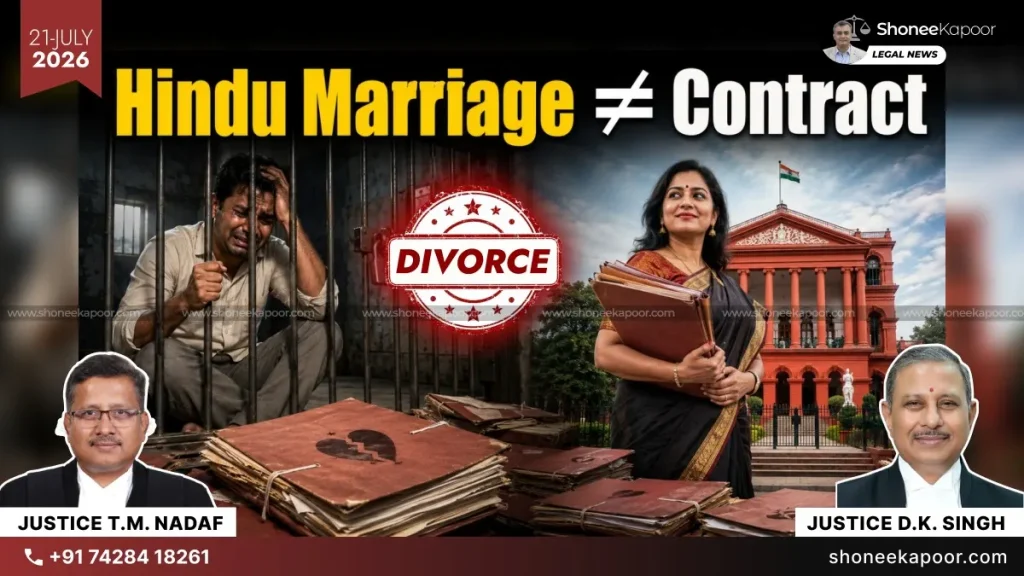
Can a husband seek divorce merely because he no longer wishes to continue the marriage? The Karnataka High Court examines the scope of divorce under the Hindu Marriage Act.
KARNATAKA: The Karnataka High Court has dismissed a husband’s appeal seeking divorce from his 21-year-old marriage, holding that mere loss of interest in one’s spouse does not constitute a valid ground for divorce under the Hindu Marriage Act. Reiterating the sanctity of Hindu marriage, the Court observed that a Hindu marriage is a sacrament and not a contractual relationship that can be dissolved solely because one spouse no longer wishes to continue the marriage.
The Division Bench of Justice D.K. Singh and Justice T.M. Nadaf upheld the judgment of the Family Court, observing that the husband was attempting to take advantage of his own wrong after voluntarily entering into an inter-caste love marriage, remaining married for over two decades, and fathering a daughter who is now almost a major.
Emphasising the nature of a Hindu marriage, the Court observed:
“The person who fell in love with the respondent and fathered a girl child who is now almost a major, has come before the Court stating that he is left with no interest in the marriage and therefore, decree of divorce be granted. The marriage under the Hindu Law is a sacrament, and it is not a contract. Once the parties are married, the marriage is for life, and one person cannot walk away from the marriage on the ground that he/she is left with no interest in the marriage with the other party.”
The marriage between the parties was solemnised in 2003 as an inter-caste love marriage. A daughter was born from the wedlock and is now almost a major.
The present proceedings arose after an earlier round of matrimonial litigation in which the husband had sought divorce, and the wife had filed a petition for restitution of conjugal rights. After the Family Court allowed the wife’s petition and rejected the husband’s plea, the husband subsequently filed a petition under Section 13(1A) of the Hindu Marriage Act relying on the non-resumption of cohabitation. seeking dissolution of marriage under Section 13(1A) of the Hindu Marriage Act, 1955, contending that despite a decree for restitution of conjugal rights passed in favour of the wife, the parties had not resumed cohabitation.
The husband also alleged cruelty under Section 13(1)(ia) of the Hindu Marriage Act.
However, the Family Court rejected the plea after holding that the allegation of cruelty had not been proved.
Aggrieved by the dismissal of his divorce petition, the husband preferred an appeal before the Karnataka High Court.
In support of his petition under Section 13(1A), the husband contended that despite his efforts, the respondent-wife had failed to resume matrimonial life even after the decree for restitution of conjugal rights.
The wife denied these allegations and submitted that she had never insisted on living separately and had never quarrelled with either the husband or his family.
After examining the Family Court records, the High Court found that during cross-examination, the husband himself admitted that he was “not interested” and had “no interest” in resuming marital life with the respondent.
The Bench held that the husband could not seek dissolution of the marriage merely because he had lost interest in continuing the relationship.
Rejecting the appeal, the Court observed:
“The appellant wants to take advantage of his own wrong. We find no ground to interfere with the impugned judgment and decree passed by the Family Court, and therefore, we dismiss this appeal.”
Finding no legal infirmity in the Family Court’s judgment, the Division Bench dismissed the appeal and affirmed the refusal to grant a decree of divorce.
EXPLANATORY TABLE OF LAWS AND SECTIONS
| Law / Section | Legal Meaning | Application in This Case |
| Section 9, Hindu Marriage Act, 1955 | Provides for restitution of conjugal rights where one spouse has withdrawn from the society of the other without reasonable excuse. | A decree for restitution of conjugal rights had earlier been passed in favour of the wife. |
| Section 13(1)(ia), Hindu Marriage Act, 1955 | Provides for divorce on the ground of cruelty. | The husband alleged cruelty by the wife. |
| Section 13(1A), Hindu Marriage Act, 1955 | Permits a party to seek divorce in certain circumstances following a decree under the Act, including non-resumption of cohabitation after restitution of conjugal rights. | The husband sought divorce relying on this provision. |
CASE DETAILS
| Particular | Details |
| Case Title | M v. B |
| Case Number | Miscellaneous First Appeal No. 4343 of 2026 |
| Neutral Citation | 2026:KHC:36045-DB |
| Court | Karnataka High Court |
| Bench | Justice D.K. Singh and Justice T.M. Nadaf |
KEY TAKEAWAYS
- A man may be forced to remain legally tied to a marriage even when affection, companionship and mutual willingness have completely disappeared.
- The law demands that a husband prove a specific matrimonial offence; merely showing that the marriage is emotionally dead may still not secure his freedom.
- While both spouses are legally bound by the same divorce provisions, men frequently continue carrying the financial burden of maintenance, litigation and family obligations during prolonged matrimonial disputes.
- A marriage cannot be meaningfully preserved by judicial compulsion. Forcing an unwilling spouse to remain married protects the legal shell of marriage, not the relationship itself.
- Men need a clear, gender-neutral right to exit irretrievably broken marriages. No person should be treated as a permanent financial provider merely because the other spouse refuses to end a marriage that has already collapsed.
This Could Change Your Case-Get FREE Legal Advice-Click Here!
Disclaimer: The views and opinions expressed in this article are those of the Indian courts and do not necessarily reflect the official policy or position of “ShoneeKapoor.com” or its affiliates. This article is intended for informational and educational purposes only. The content provided is not legal advice, and viewers should not act upon this information without seeking professional counsel. Viewer discretion is advised.