
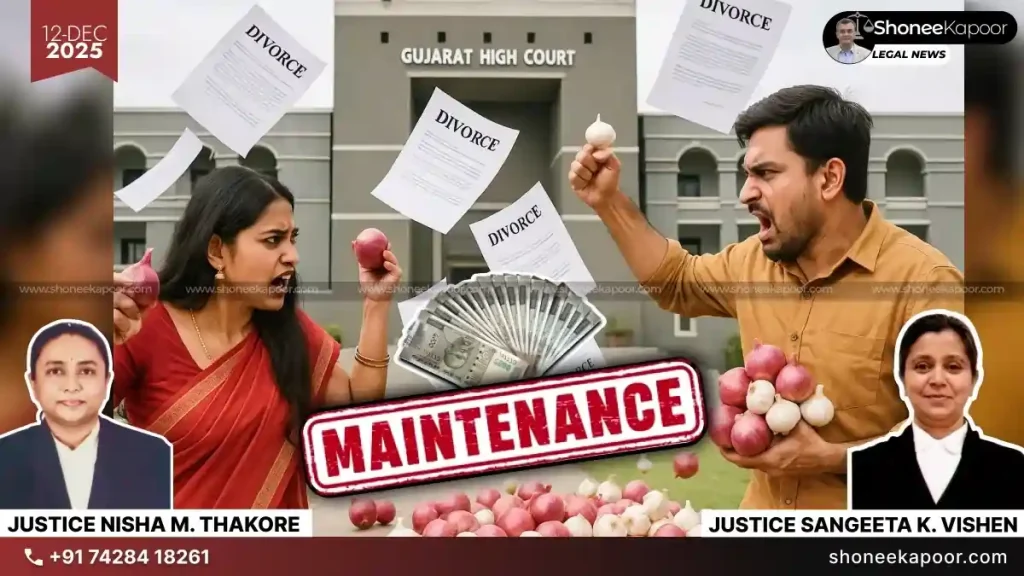
The Gujarat High Court upheld a divorce where the couple’s marriage broke down due to regular fight over the wife’s strict religious diet without onion and garlic. Both sides’ appeals for increasing and reducing maintenance were rejected, and the Family Court’s maintenance order was fully confirmed.
Ahmedabad: The Gujarat High Court upheld the divorce granted to a couple whose marriage had slowly fallen apart because of regular arguments over food cooked in the family home. The husband followed a normal diet, while the wife strictly avoided onion and garlic due to her Swaminarayan religious beliefs. These differences eventually became the core reason for the breakdown of their marriage.
The couple got married in March 2002. Soon after marriage, small issues began turning into major disputes, mainly around the wife’s strict vegetarian diet. The husband told the Court that his mother would cook two separate meals every day—one without onion and garlic for the wife, and one with onion and garlic for the rest of the family.
As recorded in the judgment:
“Following of the religion and consumption of onion and garlic was the trigger point of the differences between the parties.”
The wife argued that her religious practices and diet were known to the husband before marriage and that she had not hidden anything. She further claimed that she was not at fault and that the husband voluntarily left his responsibilities as a spouse.
Over the years, the couple tried to rebuild the marriage. They even signed a Memorandum of Understanding in 2007, promising to make efforts to stay together. However, the relationship continued to deteriorate, and eventually the husband filed for divorce on the grounds of cruelty and desertion under Section 13 of the Hindu Marriage Act.
The Family Court in Ahmedabad granted a divorce in May 2024. It also fixed monthly maintenance for the wife as follows:
- ₹8,000 per month from July 2013 to July 2020
- ₹10,000 per month from July 2020 onward
Both husband and wife approached the High Court—
- The wife wanted the maintenance amount increased.
- The husband wanted to avoid monthly payments and instead asked the Court to allow him to pay a one-time lump-sum amount as permanent alimony.
During the hearing, the husband offered to pay a lump-sum amount, which the Court noted as follows:
“The applicant – husband is ready and willing to pay a lumpsum amount of compensation towards permanent alimony instead of maintenance of Rs.10,000/- every month.”
However, the wife refused this proposal. As a result, the husband chose not to continue with his appeal, and it was dismissed as “not pressed.”
The Court then examined the wife’s request for increasing maintenance. She claimed the husband earned between ₹60,000 and ₹70,000 per month. But the Court found no evidence to support this. Instead, the official salary certificates on record showed the husband’s annual income was only:
“Rs. 62,718/- per annum.”
The Court also referred to the wife’s own earlier admission recorded in a criminal case:
“The admission of the appellant-wife recorded in Criminal Case no.492 of 2013, admitting that she is doing job.”
Based on this, the Court concluded that the wife had some earning capacity and the maintenance amount fixed by the Family Court was correct.
The Bench also took note of the husband’s family responsibilities:
- He lived in a small house with one room and kitchen.
- He was responsible for his elderly parents.
- His adult son was studying for a Master’s degree in Computer Engineering.
Because of this, the High Court found the Family Court’s order reasonable:
“No error can be said to have been committed in allowing the maintenance of Rs.10,000/- per month to the appellant-wife.”
Regarding arrears, the Court recorded the following:
“The total outstanding amount was Rs.13,02,000/- out of which, Rs.2,72,000/- was paid … an amount to the tune of Rs.10,30,000/- is still outstanding.”
The Court directed the husband to deposit the remaining amount and asked the wife to provide her bank details so the money could be transferred.
Finally, the High Court dismissed the wife’s appeal and confirmed the Family Court’s judgment dissolving the marriage and fixing maintenance:
“The captioned appeal … does not deserve to be entertained and is hereby, dismissed.”
Explanatory Table Of All Laws & Sections Mentioned
| Law / Section | Where It Appears in the Case | Purpose / Explanation (Simple English) | How It Was Applied in This Matter |
| Section 13, Hindu Marriage Act, 1955 | Husband filed for divorce under this provision. | Allows divorce on grounds such as cruelty or desertion. | Husband alleged cruelty and desertion by wife due to rigid religious behaviour and marital incompatibility (dietary restrictions). Family Court granted divorce; HC upheld it. |
| Section 25, Hindu Marriage Act, 1955 | Wife filed for permanent alimony under this section (Exh.20). | Allows court to grant permanent maintenance/alimony to either spouse, based on financial needs and earning capacity. | Wife sought ₹20,000 per month. Family Court instead fixed ₹8,000 (2013–2020) and ₹10,000 (2020 onwards). HC confirmed the same. |
| Application for Separate Residence (Exh.92) | Filed by wife claiming husband lived in joint family. | Used when a spouse seeks separate residence due to alleged ill-treatment or joint family issues. | Wife argued joint family situation required separate residence; Court considered but found no strong evidence supporting enhancement of alimony. |
| Criminal Case No. 492 of 2013 | Wife made admission she was employed. | Not a law section, but an important admission used for income assessment. | HC relied on her own earlier statement to reject her claim that she had no income. |
| Permanent Maintenance Principles (Judicially Developed) | Discussed by Family Court and upheld by HC. | Courts consider earning capacity, financial responsibilities, standard of living, and independent income. | HC found the husband’s income very low (₹62,718 per annum) and held maintenance amounts to be fair. |
Case Summary
- Case Title: XYZ vs ABC First Appeal No. 3109 of 2024 With First Appeal No. 2399 of 2024 (Arising out of judgment dated 08.05.2024 in Family Suit No. 921 of 2013)
- Bench: Honourable Ms. Justice Sangeeta K. Vishen, Honourable Ms. Justice Nisha M. Thakore
- Date of Judgment: 27/11/2025
Counsels Appearing
- For the Wife (Appellant in FA 3109/2024):
- Mr. Punam G. Gadhvi
- Ms. Krushangi R. Joshi
- For the Husband (Appellant in FA 2399/2024 / Respondent in FA 3109/2024):
- Mr. Bhunesh C. Rupera
Important Facts From Record
- Marriage solemnised on 02.03.2002 as per Hindu rites.
- Wife followed strict Swaminarayan dietary rules — no onion or garlic.
- The High Court recorded:
“Following of the religion and consumption of onion and garlic was the trigger point of the differences between the parties.” - Multiple reconciliation efforts failed; MoU signed in 2007.
- Husband filed for divorce alleging cruelty and desertion under Section 13.
- Family Court granted divorce and awarded maintenance.
- Wife challenged the amount; husband challenged monthly maintenance, offering lump sum.
- HC noted husband’s actual income as:
“Rs. 62,718/- per annum.” - Wife had earlier admitted she was working:
“Admission of the appellant-wife recorded in Criminal Case no.492 of 2013, admitting that she is doing job.” - HC confirmed the maintenance as reasonable.
Maintenance Structure Confirmed By High Court
| Period | Amount Ordered |
| 09.07.2013 – 08.07.2020 | ₹8,000 per month |
| From 09.07.2020 onwards | ₹10,000 per month |
Outstanding Maintenance (As Recorded By Court)
- Total outstanding: ₹13,02,000
- Paid earlier: ₹2,72,000
- Balance claimed: ₹10,30,000
- Husband deposited ₹4,27,000 during proceedings.
Court directed wife to give bank details for transfer and husband to deposit remaining amount.
Key Takeaways
- A simple dietary difference—onion and garlic—was enough to push a husband into years of conflict, showing how men are often blamed even when incompatibility is mutual.
- The husband endured long litigation since 2013, yet the wife still demanded higher maintenance despite admitting earlier that she was employed.
- Courts again placed financial responsibility entirely on the man, even though his annual income was barely Rs. 62,718 and he supported his parents and adult son.
- Even when the husband offered a lump-sum settlement to end disputes, the wife refused, prolonging the case and burdening him further.
- The case exposes a recurring pattern: marriages fail for many reasons, but the legal and financial consequences fall disproportionately on men, regardless of actual fault or economic reality.
This Could Change Your Case-Get FREE Legal Advice-Click Here!
Disclaimer: The views and opinions expressed in this article are those of the Indian courts and do not necessarily reflect the official policy or position of “ShoneeKapoor.com” or its affiliates. This article is intended for informational and educational purposes only. The content provided is not legal advice, and viewers should not act upon this information without seeking professional counsel. Viewer discretion is advised.