
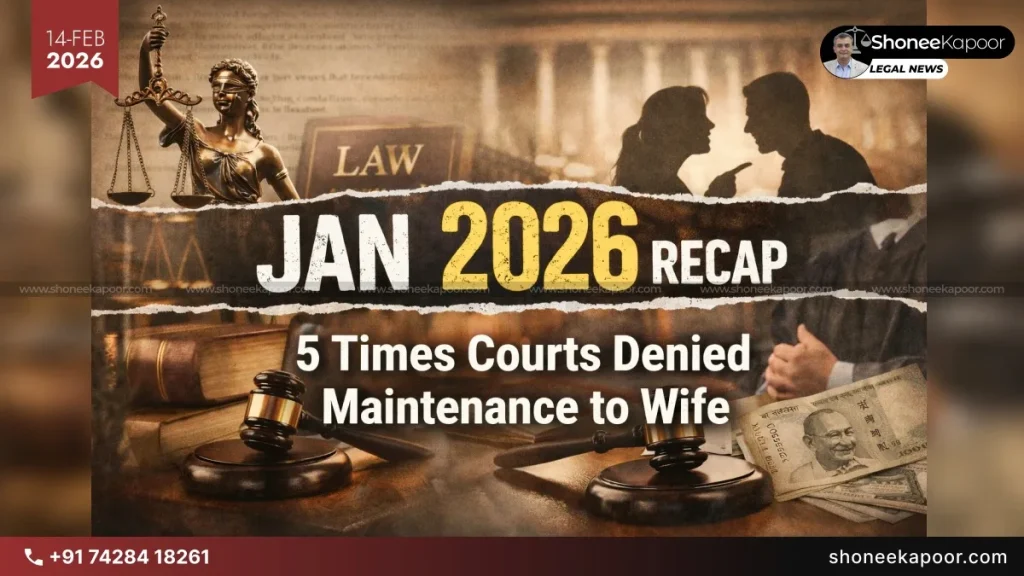
January 2026 saw multiple courts refusing or reducing maintenance where facts were suppressed, criminal conduct was involved, or legal requirements were not satisfied. These rulings reinforce that maintenance is not automatic and must be based on legality, honesty and real financial assessment.
Courts Denied Maintenance to Wife: Maintenance under Indian law has never been an automatic or unconditional right. Courts have consistently held that a claim for maintenance must be supported by full financial disclosure, lawful conduct and credible evidence. Entitlement flows from statutory provisions, but it is always subject to judicial scrutiny and factual verification.
January 2026 witnessed a clear judicial pattern: maintenance is not an automatic entitlement. Courts across jurisdictions reaffirmed that suppression of facts, criminal conduct, false pleadings, or legally invalid marital status cannot be rewarded under the garb of maintenance.
Below is the consolidated January 2026 recap of the five rulings covered.
Wife Maintenance Notary Divorce
Read Full Article –
In this matter, the Court examined whether a notarised divorce deed could, independently, dissolve a legally valid marriage and, consequently, determine maintenance rights. The Bench analysed the statutory framework governing dissolution under personal law and made it clear that a marriage solemnised in accordance with law cannot be terminated through informal documentation. Unless the dissolution satisfies mandatory statutory requirements and procedural safeguards, the marital bond legally continues.
The Court emphasised that maintenance claims cannot be based on a document lacking legal recognition. Where the alleged divorce lacked legal sanctity, any financial consequences flowing from it were equally unsustainable. The ruling reinforces the principle that matrimonial status is a matter of law, not a private arrangement, and maintenance entitlement must rest on a legally recognised marital status.
Key Principle: Informal notarised divorce deeds cannot determine maintenance rights or alter legal marital status.
Maintenance Wife Shot Husband
Read Full Article –
This case involved serious criminal allegations where the wife, accused of shooting her husband, sought maintenance during the pendency of proceedings. The Court was required to determine whether maintenance can be treated as an unconditional statutory entitlement even in the face of grave allegations of violence against the provider spouse.
The Bench clarified that maintenance provisions are welfare-oriented but not insulated from judicial scrutiny of conduct. Where criminal hostility against the husband is evident on record, courts are not compelled to ignore such circumstances while granting equitable relief. The decision reflects that maintenance cannot coexist with demonstrable and serious misconduct directed at the very person from whom support is claimed.
Key Principle: A spouse facing grave criminal allegations against the provider cannot automatically invoke maintenance.
Wife False Claim Cut Maintenance
Read Full Article –
In this ruling, the Court addressed exaggerated and misleading financial disclosures submitted in support of a maintenance claim. Detailed scrutiny of affidavits and supporting documents revealed inconsistencies in the wife’s assertions regarding her income, liabilities and financial dependency.
Upon finding that the financial narrative presented lacked credibility and factual support, the Court reduced the maintenance award. The Court reiterated that maintenance quantification must be grounded in verified financial evidence and accurate disclosure. Inflated projections, selective presentation of facts or strategic concealment undermine the equitable foundation of such proceedings.
Key Principle: False or exaggerated financial assertions justify judicial correction and reduction of maintenance.
Wife Hide Income Loses Maintenance
Read Full Article
In this matter, the Court examined the claimant spouse’s suppression of income and non-disclosure of employment details. Evidence placed on record demonstrated that the wife possessed earning capacity and had concealed relevant financial information while seeking maintenance.
The Bench held that concealment directly strikes at the foundation of equitable jurisdiction. Maintenance jurisprudence is premised on transparency, bona fide disclosure and clean conduct. Once suppression was established, the Court denied relief, reinforcing that courts will not reward non-disclosure or strategic silence regarding income.
Key Principle: Concealment of income or earning capacity disentitles a claimant from maintenance relief.
Husband Foreign Salary Not ATM
Read Full Article –
This decision addressed the recurring assumption that a husband earning abroad is automatically liable for disproportionately high maintenance merely because his salary appears large when converted into Indian currency. The Court rejected the simplistic equation of foreign salary with unlimited financial liability.
The Bench examined actual net income, statutory deductions, cost of living in the foreign jurisdiction, liabilities and realistic disposable income. It clarified that maintenance must be proportionate, sustainable and reflective of real financial capacity rather than headline currency conversion figures. Foreign employment does not transform a spouse into a perpetual financial instrument, regardless of practical realities.
Key Principle: Foreign posting and higher currency denomination do not justify disproportionate maintenance.
January 2026 Judicial Trend: Accountability Over Assumption
Across these five rulings, a consistent judicial pattern emerges. Courts have reinforced that maintenance is conditional, evidence-based and subject to legal scrutiny. It is neither mechanical nor immune from examination of conduct, disclosure and statutory compliance.
The High Courts have reaffirmed that suppression of material facts defeats equitable relief, criminal conduct can materially impact entitlement, invalid marital status cannot generate enforceable financial rights, and the earning capacity of both parties must be objectively evaluated. Financial relief is being calibrated through verified documentation rather than assumptions or narratives.
The broader shift is unmistakable. Maintenance jurisprudence is steadily moving from presumption to proof, from entitlement rhetoric to accountability standards, and from mechanical orders to proportionate, legally reasoned determinations. January 2026 stands as a clear marker of that transition.
This Could Change Your Case-Get FREE Legal Advice-Click Here!
Disclaimer: The views and opinions expressed in this article are those of the Indian courts and do not necessarily reflect the official policy or position of “ShoneeKapoor.com” or its affiliates. This article is intended for informational and educational purposes only. The content provided is not legal advice, and viewers should not act upon this information without seeking professional counsel. Viewer discretion is advised.