
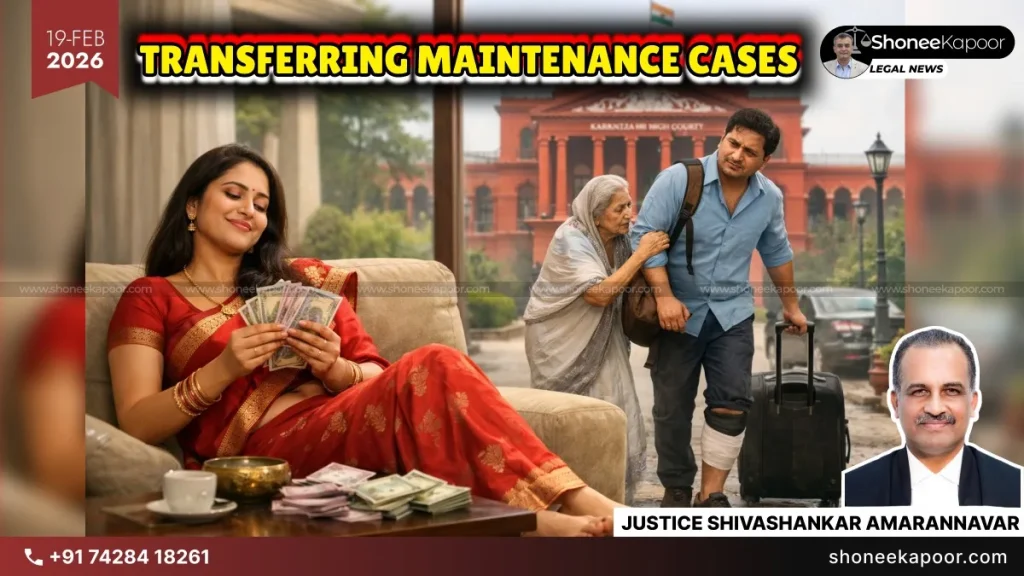
Can a husband seek transfer of a maintenance case because he must care for his widowed mother and travel from another city?
The Karnataka High Court’s answer may surprise many and raises serious questions about how “Wife’s convenience” is weighed in matrimonial disputes.
BENGALURU: The Karnataka High Court, in a Criminal Petition dated 10 February 2026, delivered an order by Hon’ble Mr. Justice Shivashankar Amarannavar. The husband had approached the Court seeking transfer of a maintenance case filed by his wife from the Principal Family Court at Chikkamagaluru to the Family Court at Bengaluru.
The marriage between the parties took place on 28.03.2024 at Chikkamagaluru. After marriage, the wife lived with the husband in Bengaluru. Later, disputes arose between them, and the wife went back to her parental home in Chikkamagaluru. She then filed a petition under Section 144 of BNSS seeking maintenance of Rs.50,000 per month.
The husband approached the High Court asking for the transfer of this maintenance case to Bengaluru. He argued that he is living in Bengaluru with his dependent, widowed mother. He said he cannot leave her alone and travel to Chikkamagaluru for every hearing. He also stated during arguments that he had met with an accident and suffered leg injuries.
However, the Court noted that no interim maintenance order had been passed by the Family Court and that no such request had been made at that stage. The High Court clearly observed that:
“It is the convenience of the wife which is to be looked into whenever transfer of the cases is sought.”
Justice Shivashankar Amarannavar further made it clear that the fact that the petitioner’s mother is a widowed, aged lady is not a valid ground for transfer. The Court emphasized that the wife was not employed and had no independent income, and shifting the case to Bengaluru would cause hardship to her.
Regarding the accident claim, the Court recorded that this ground was not even mentioned in the petition and therefore could not be considered.
Finally, the High Court held that no valid grounds were made out for transferring the maintenance case and dismissed the petition.
This case again highlights how courts consistently prioritize the wife’s convenience in matrimonial litigation. While the husband’s responsibilities and practical difficulties were placed before the Court, the legal principle applied was clear and settled: in transfer matters related to maintenance, the wife’s convenience generally prevails.
Explanatory Table: Laws And Sections Involved
| Law / Provision | Purpose | How Applied in This Case |
| Section 407, Code of Criminal Procedure (CrPC) | Empowers the High Court to transfer criminal proceedings from one court to another to secure ends of justice | Husband invoked this provision seeking transfer of the wife’s maintenance case from Chikkamagaluru to Bengaluru |
| Section 447, Bharatiya Nagarik Suraksha Sanhita (BNSS), 2023 | Successor provision corresponding to transfer powers under CrPC after procedural reform | Petition was also filed under this section as procedural law has transitioned from CrPC to BNSS |
| Section 144, Bharatiya Nagarik Suraksha Sanhita (BNSS), 2023 | Provides for maintenance claims by wife against husband for financial support | Wife filed Criminal Miscellaneous No.159/2024 under this section claiming Rs.50,000 per month as maintenance |
| Section 125, Code of Criminal Procedure (CrPC) (corresponding earlier provision) | Earlier statutory provision governing maintenance proceedings prior to BNSS | Though not directly invoked in this petition, Section 144 BNSS corresponds to the earlier Section 125 CrPC framework governing maintenance jurisprudence |
Case Details
- Case Title: Sri Sridutta S. vs Smt. Poojitha O.
- Court: High Court of Karnataka at Bengaluru
- Case Number: Criminal Petition No. 4556 of 2025
- Bench: Hon’ble Mr. Justice Shivashankar Amarannavar
- Neutral Citation: NC: 2026:KHC:7887
- Date of Order: 10 February 2026
- Counsels:
For Petitioner: Sri Manjunatha V., Advocate
For Respondent: Smt. Anusha Asundi, Advocate for Sri A. Madhusudhana Rao, Advocate
Key Takeaways
- In maintenance and matrimonial transfer cases, courts generally prioritize the wife’s convenience over the husband’s practical difficulties.
- Personal hardships of men, including responsibility to care for aged or widowed parents and even medical issues such as accidents or physical injuries, are often not treated as sufficient grounds for transfer.
- Even when no interim maintenance is granted, the absence of income on the wife’s side significantly influences judicial discretion.
- Any ground not specifically pleaded in the petition is typically disregarded, highlighting how procedural technicalities can determine litigation outcomes.
- The broader pattern indicates that men frequently bear the logistical and financial burden of litigation, underscoring the need for more balanced and gender-neutral procedural standards.
This Could Change Your Case-Get FREE Legal Advice-Click Here!
Disclaimer: The views and opinions expressed in this article are those of the Indian courts and do not necessarily reflect the official policy or position of “ShoneeKapoor.com” or its affiliates. This article is intended for informational and educational purposes only. The content provided is not legal advice, and viewers should not act upon this information without seeking professional counsel. Viewer discretion is advised.