
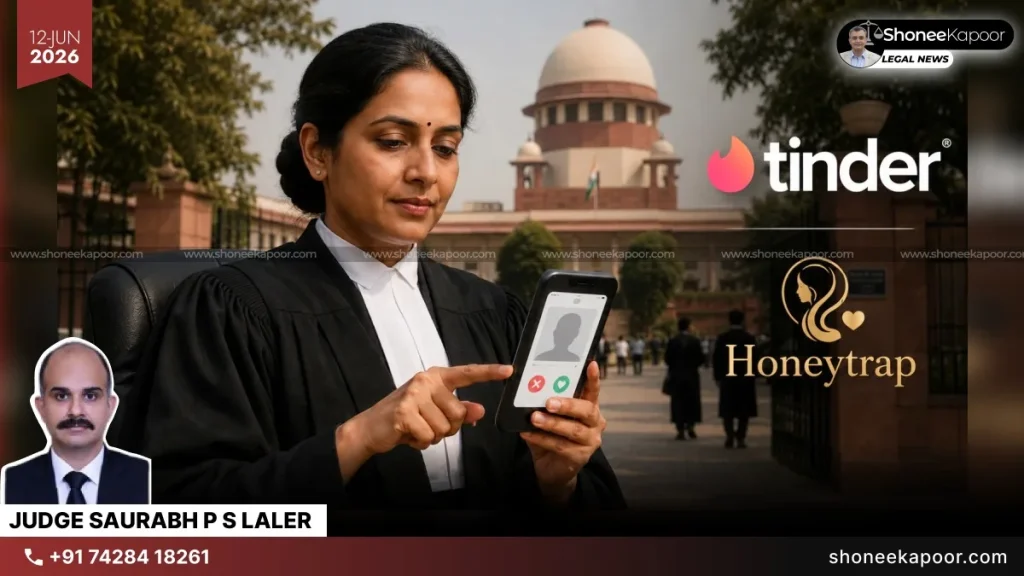
A judge allegedly lost ₹52 lakh after a Tinder romance turned into an alleged fraud. But why was the complaint filed in her maid’s name, and where are the missing chats? The court refused bail to the accused, saying crucial evidence is still missing and the complete truth is yet to come out.
NEW DELHI: A Delhi court has refused to grant bail to a man accused of cheating a Haryana judicial officer of more than ₹52 lakh through an alleged Tinder honeytrap. The Court observed that the case appeared to follow a pattern commonly seen in online romance scams and said the investigation was still incomplete.
Additional Sessions Judge Saurabh Partap Singh Laler was hearing the bail plea of the accused, who allegedly came into contact with the judicial officer through the dating application Tinder in November 2025.
According to the prosecution, the accused introduced himself as “Abhimanyu Vashishth” and claimed that he worked in a secret government department. The two later developed a relationship. During this period, the judicial officer allegedly transferred over ₹52 lakh to bank accounts linked to the accused after being persuaded to invest money with promises of high returns.
However, the promised returns never came, leading to allegations of cheating and fraud.
Interestingly, the FIR was not filed by the judicial officer herself. Instead, the complaint was lodged in the name of her domestic worker, who claimed that she had been cheated through an online dating application. The accused was arrested and sent to judicial custody. After a lower court rejected his bail plea, he approached the sessions court.
While examining the matter, the Court found that almost all the transactions under investigation had originated from the judicial officer’s bank accounts and not from the domestic worker’s account.
“The complaint as filed does not seem to reflect the true complainant,” the Court observed.
It further remarked:
“A judicial officer – a person who is herself entrusted with the solemn duty of dispensing justice, of upholding truth before the law, and of expecting others who appear before her to present the complete facts – has chosen to approach this court obliquely, through her maid’s name, rather than coming forward herself.”
The Court recognised that becoming a victim of an online romance scam could be personally embarrassing. However, it made it clear that embarrassment cannot become a reason to hide facts from investigators.
“The officer’s personal discomfort cannot be permitted to compromise the integrity of a criminal investigation.”
The Court also noted serious gaps in the investigation. Although the relationship allegedly started on Tinder, investigators had not collected the Tinder chats. The complete WhatsApp conversations of the judicial officer were also missing from the record. Call detail records had not been obtained either.
Emphasising the importance of transparency, the Court said:
“The victim, being a judicial officer, is better placed than most to understand that the path to justice requires candour. She should, at the earliest opportunity, come before the IO – or, if she so chooses, before the Ld. Magistrate and place on record the complete and unvarnished truth: her full WhatsApp communication history with the accused, her Tinder chat history, her own understanding of why she made the payments she made, and who directed, suggested, or induced those payments.”
The Court was equally critical of the accused. It observed that he had selectively produced WhatsApp messages allegedly sent by the judicial officer while withholding his own replies. The accused had also refused to provide access to his mobile phone.
“The accused is playing hide and seek,” the Court remarked.
The investigating officer was also criticised for failing to secure important electronic evidence and for not properly examining several aspects of the case, including the source of a ₹5 lakh cash deposit and the role of entities through which some of the money was allegedly routed.
After reviewing the chats and financial transactions placed before it, the Court said the facts prima facie appeared to fit the pattern of an online romance scam.
At the same time, the order underlined an equally important principle: the justice system functions effectively only when all parties place complete facts before investigators and courts. The expectation of honesty and transparency applies equally, irrespective of status or position. Concealing material facts or withholding evidence can weaken the search for truth and delay justice.
Since the investigation is still at an early stage and several crucial pieces of evidence remain to be collected, the Court declined to grant bail to the accused.
The Court also directed the investigating officer to obtain the complete Tinder and WhatsApp records of both parties, verify their alleged meetings, investigate the entities involved in the transfer of funds, and expedite the examination of the accused’s mobile phone.
EXPLANATORY TABLE OF LAWS AND SECTIONS INVOLVED
| LAW / SECTION | PURPOSE | HOW IT APPLIED IN THIS CASE |
| Section 318, Bharatiya Nyaya Sanhita, 2023 (Cheating) | Punishes dishonest inducement causing wrongful loss | The accused allegedly induced the judicial officer to transfer money by promising high investment returns. |
| Section 319, Bharatiya Nyaya Sanhita, 2023 (Cheating by Personation) | Punishes impersonation for cheating | The accused allegedly introduced himself as “Abhimanyu Vashishth” and claimed to be an officer in a secret government department. |
| Section 61(2), Bharatiya Nyaya Sanhita, 2023 (Criminal Conspiracy) | Covers agreements between persons to commit illegal acts | Investigators may examine whether others or entities knowingly facilitated the alleged fraud. |
| Sections relating to Electronic Evidence under Bharatiya Sakshya Adhiniyam, 2023 | Govern admissibility and collection of digital evidence | Tinder chats, WhatsApp conversations and call records were found missing from the investigation. |
| Sections 173/193 BNSS relating to Investigation and Collection of Evidence | Require fair and complete investigation by police | The Court criticised the Investigating Officer for failing to collect crucial electronic evidence. |
| Bail Principles under BNSS | Courts assess seriousness of allegations and stage of investigation | Bail was refused because the investigation remained incomplete and key evidence was yet to be collected. |
CASE DETAILS
| PARTICULARS | DETAILS |
| Case Type | Bail Application |
| Court | Court of Additional Sessions Judge, Delhi |
| Presiding Judge / Bench | Additional Sessions Judge Saurabh Partap Singh Laler |
| Nature of Case | Alleged Tinder honeytrap involving cheating of over ₹52 lakh |
| Alleged Victim | Haryana Judicial Officer |
| Accused | Name not disclosed in reports; allegedly used the identity “Abhimanyu Vashishth” |
| Dating Platform | Tinder |
| Amount Involved | More than ₹52 lakh |
| Period of Alleged Events | Relationship allegedly began in November 2025 |
| Outcome | Bail Rejected |
| Key Reason for Bail Rejection | Investigation incomplete and crucial electronic evidence missing |
COUNSELS
| SIDE | COUNSEL |
| Accused | Advocates Rahul Kumar and Pooja Chauhan |
| State | Additional Public Prosecutor Santosh Kumar |
KEY TAKEAWAYS
- Truth should never depend on status. Courts must expect complete disclosure from everyone, regardless of gender or position.
- Missing chats, selective evidence and proxy complaints raise serious concerns about fairness and transparency in criminal investigations.
- Men accused of fraud deserve the same demand for full evidence that women receive when they claim victimhood.
- Emotional narratives cannot replace electronic records, financial trails and objective proof.
- Equality means equal accountability. Sympathy should never become a shield against scrutiny.
This Could Change Your Case-Get FREE Legal Advice-Click Here!
Disclaimer: The views and opinions expressed in this article are those of the Indian courts and do not necessarily reflect the official policy or position of “ShoneeKapoor.com” or its affiliates. This article is intended for informational and educational purposes only. The content provided is not legal advice, and viewers should not act upon this information without seeking professional counsel. Viewer discretion is advised.