
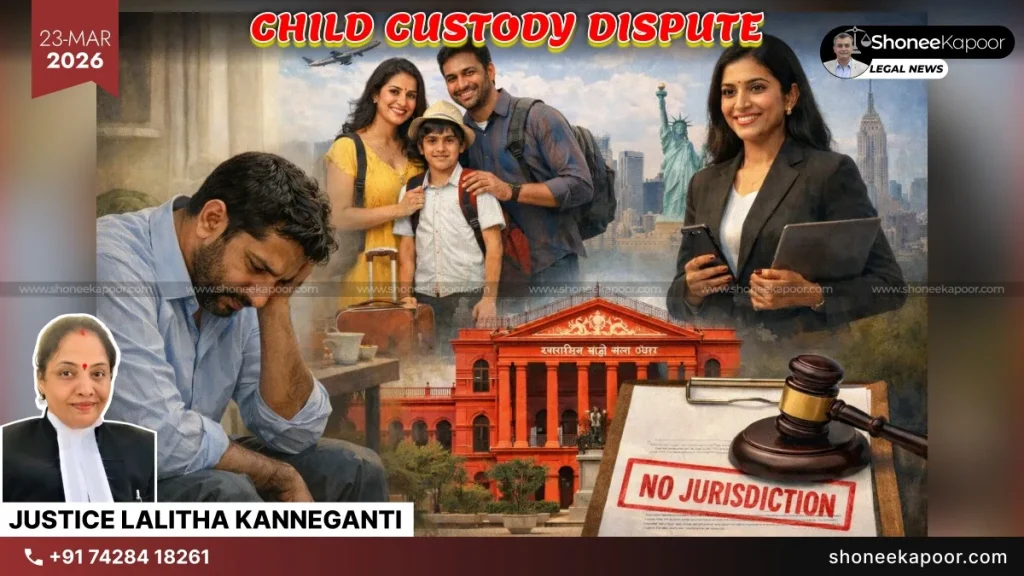
When both parents brought the child to India and the father continued caregiving for six years, can jurisdiction still shift back to a foreign country?
BENGALURU: In a custody dispute, the Karnataka High Court, presided over by Justice Lalitha Kanneganti, examined whether Indian courts had jurisdiction in a case where a child was brought from the United States to India and retained by the father. The case once again brings into focus how fathers often face an uphill battle in custody matters despite being primary caregivers.
The case involved a married couple who had been living in the US with their child. They came to India for a family ritual, after which the father decided to stay back to take care of his ailing father. The mother chose to return to the US to continue her career. The father, who ensured stability for the child, admitted him to a school in Bengaluru and continued raising him in India.
The mother challenged this and argued that the Indian Family Court did not have jurisdiction because the child’s ordinary residence was in the United States. However, the Family Court rejected her objection, stating that since the child was physically present in India at the time of filing, it had jurisdiction.
The High Court, however, took a different view and held that mere physical presence does not decide jurisdiction. It emphasized that ordinary residence is a legal concept and cannot be changed by unilateral actions.
At the same time, the case highlights a deeper issue—how fathers, even when they are actively raising the child and providing stability, are often viewed with suspicion in custody disputes. The Court observed:
“Custody litigation can never be permitted to become a strategic weapon in matrimonial warfare.”
While this principle is correct, it raises concern that fathers who step up to take responsibility are sometimes accused of wrongdoing simply for ensuring the child’s welfare.
The Court further stated:
“At any stretch of imagination, Bangalore cannot be the ordinary residence of the boy and the Family Court at Bangalore has no jurisdiction.”
This finding overlooks the ground reality that the child had been living in India with the father for years, studying, settling, and building his life here. It brings into question whether the concept of “ordinary residence” is being interpreted in a way that disregards the father’s role as a primary caregiver.
In a strong remark, the Court said:
“This is nothing but blackmailing the mother to come in terms with the expectations of the father.”
This judgment raises serious concerns. The Court appears to have overlooked key facts—that the child was admitted to school in India, was settled here, and, most importantly, the child’s initial stay in India was with the mother’s consent. Despite this, the father’s role as a primary caregiver was not given due weight.
While the Court rightly emphasized the mother’s career rights, it failed to equally recognize the sacrifices made by the father, who was raising the child and providing day-to-day stability. This creates an impression that fathers are often seen with suspicion, even when acting in the child’s interest.
Explanatory Table: Laws And Sections Involved
| Law / Provision | Purpose | How Applied In This Case |
| Articles 226 & 227 of Constitution of India | Give High Courts power to review lower court orders and ensure justice | Used by mother to challenge Family Court order |
| Guardians and Wards Act, 1890 | Main law governing custody and guardianship of minors in India | Core law under which custody dispute was filed |
| Section 9(1) – G uardians and Wards Act | Says custody case must be filed where the child “ordinarily resides” | Central issue—whether India or USA had jurisdiction |
| Habeas Corpus Jurisdiction | Legal remedy to produce a person (child) before court if illegally detained | Mother earlier used this to seek custody |
| Principle of “Ordinary Residence” | Determines which court has jurisdiction based on where child normally lives | Court held US was ordinary residence, not India |
| Doctrine of Welfare of Child | Child’s best interest is most important in custody matters | Applied but debated in interpretation |
| Principle of Comity of Courts | Respect for orders of foreign courts | Considered but not blindly followed |
| Supreme Court Precedents (Yashita Sahu case) | Ensures child maintains relationship with both parents | Used to emphasize visitation rights |
| V. Ravichandran Case | Deals with international child removal and return | Used to guide approach in cross-border custody |
| Ruchi Majoo Case | Clarifies “ordinary residence” depends on intention and facts | Key precedent for jurisdiction issue |
| Lahari Sakhamuri Case | Focuses on child welfare and foreign jurisdiction conflicts | Reinforced importance of child’s best interest |
Case Details
- Case Title: Smt. Sneha Harishchandra Sumithra vs Mr. Sudhir Das Venkata Das
- Court: High Court of Karnataka at Bengaluru
- Case Number: Writ Petition No. 25901 of 2024 (GM-FC)
- Bench: Hon’ble Smt. Justice Lalitha Kanneganti
- Neutral Citation: 2025:KHC:54706
- Date of Judgment: 19 December 2025
- Counsels:
- For Petitioner (Mother): Smt. S. Susheela, Senior Counsel; Smt. Jeevika, Advocate
- For Respondent (Father): Sri D.R. Ravishankar, Senior Counsel; Sri Manjunath S., Advocate
Key Takeaways
- Child was settled in India, studying in school, and living with the father for years, yet this stability was not given due importance.
- Child came to India with involvement and consent of both parents, but later the father’s continued care was treated with suspicion.
- Even when a father takes full responsibility of upbringing, courts tend to question his intent instead of recognising his role as primary caregiver.
- Strict interpretation of “ordinary residence” was applied without balancing real-life factors like education, environment, and continuity.
- Judgments like this highlight the ongoing imbalance where fathers’ sacrifices and caregiving efforts are not equally valued in custody disputes.
This Could Change Your Case-Get FREE Legal Advice-Click Here!
Disclaimer: The views and opinions expressed in this article are those of the Indian courts and do not necessarily reflect the official policy or position of “ShoneeKapoor.com” or its affiliates. This article is intended for informational and educational purposes only. The content provided is not legal advice, and viewers should not act upon this information without seeking professional counsel. Viewer discretion is advised.