
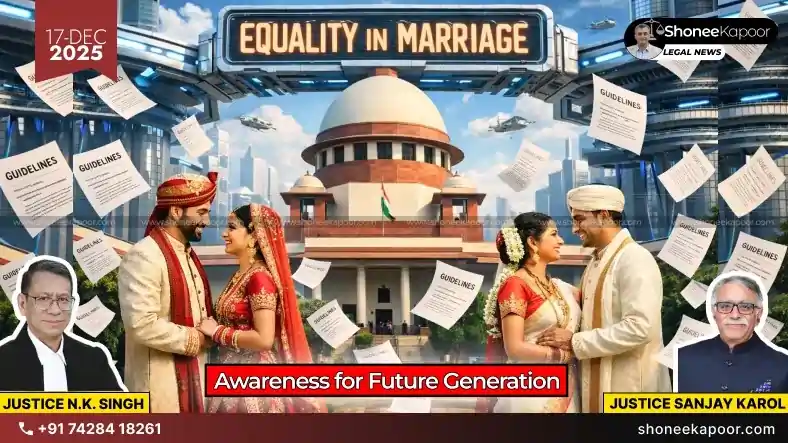
Equality in Marriage Should Be Sensitised Among Future Generations: Supreme Court Issues Strong Directions to Curb the Dowry Evil

Written and analysed by Shonee Kapoor
Legal Consultant, Author & Men's Rights ActivistThe Supreme Court has restored conviction in a dowry death case and issued nationwide directions to fight the dowry system. The Court stressed education, accountability, and awareness to end this deep-rooted social evil.
Supreme Court Issues Strong Directions Curb the Dowry Evil: The Supreme Court of India, while setting aside the acquittal of a husband and his mother in a dowry death case, has issued wide-ranging directions to address the continuing menace of dowry deaths and cruelty against married women in India.
The Court described dowry as a grave social evil and observed that mere existence of law is not enough unless society itself changes its mindset.
While delivering the judgment, the Court painfully noted the human cost of dowry demands and stated:
“In this case, a young girl, barely of twenty, when she was sent away from the world of the living by way of a most heinous and painful death, met this unfortunate end simply because her parents did not have the material means and resources to satisfy the wants or the greed of her family by matrimony. A coloured television, a motorcycle and Rs. 15,000/- is all she was apparently worth of.”
The Bench highlighted that dowry often continues under the disguise of gifts and that the practice has deep social roots. It emphasised that strict enforcement of law alone cannot eradicate dowry unless people, especially the younger generation, are educated about equality in marriage.
The Court observed:
“To ensure that the change brought in is able to make an impact on the efforts to eradicate this evil, it is to be ensured that the future generation, youngsters of today, are informed and made aware about this evil practice and the necessity to eschew it.”
The judgment was delivered by a Bench comprising Justice Sanjay Karol and Justice N.K. Singh. The Court acknowledged a long-standing problem faced by the judiciary while dealing with dowry laws, noting that courts often have to balance between ineffective implementation of the law and its misuse. Referring to earlier judgments, the Court pointed out that this tension needs urgent resolution.
The Court quoted earlier observations to underline this concern, stating:
“While on the one hand, the law suffers from ineffectiveness and so, the malpractice of dowry remains rampant, on the other hand, the provisions of this Act have also been used to ventilate ulterior motives along with Section 498-A, IPC. This oscillation between ineffectiveness and misuse creates a judicial tension which needs urgent resolution.”
At the same time, the Court made it clear that dowry cannot be eliminated overnight because of its deep-rooted presence in society.
It observed:
“While this urgent resolution cannot be stressed upon enough, at the same time it is necessary to be recognized that particularly when it comes to the giving and taking of dowry, this practice unfortunately has deep roots in society, hence, it not being a matter of swift change, instead needs concentrated effort on part of all the involved parties, be it Legislature, law enforcement, Judiciary, civil society organizations etc.”
In order to tackle the problem at multiple levels, the Supreme Court issued specific directions:
- The Court directed that States and the Union Government should consider changes in educational curricula to reinforce the constitutional principle that both parties in a marriage are equal and that no one is subordinate to the other due to exchange of money or articles at the time of marriage.
- The Court also stressed proper implementation of the Dowry Prohibition Act by directing appointment and effective functioning of Dowry Prohibition Officers. It directed that such officers must be adequately trained and their contact details must be widely publicised so that citizens are aware of whom to approach.
- Further, the Court directed regular training of police officers and judicial officers handling dowry-related cases. It stated that such training should help them understand the social and psychological aspects involved and enable them to distinguish genuine cases from those that are frivolous or abuse the legal process.
- Recognising that many people remain outside the formal education system, the Court stressed the need for grassroots awareness. It directed that District Administrations and District Legal Services Authorities should conduct regular workshops and awareness programs with the help of civil society groups and social activists to spread awareness that giving or taking dowry, as well as mental and physical cruelty, are criminal offences.
- Top Court requested all High Courts to take stock of pending cases under Sections 304-B and 498-A IPC and ensure their early disposal.
The Supreme Court also expressed serious concern over delays in trial of dowry death and cruelty cases. Referring to the present case which started in 2001 and concluded after 24 years, the Court observed:
“It is not lost on us that the instant case began in 2001 and could only be concluded 24 years later by way of this judgment. It is but obvious that there would be many such similar cases.”
The case before the Court related to the death of a young woman, Nasrin, who was married to Ajmal Beg. Evidence showed that Nasrin was repeatedly harassed for dowry demands of a coloured television, a motorcycle, and Rs. 15,000. On the day before her death, the demand was again reiterated. The next day, she was allegedly assaulted, kerosene was poured on her, and she was set on fire, leading to her death.
The Trial Court had convicted the husband and his mother for dowry death and cruelty, sentencing them to life imprisonment and other penalties. However, the Allahabad High Court had acquitted them in 2003. The Supreme Court, after examining the evidence, found that the High Court erred in ignoring consistent testimony of witnesses regarding dowry harassment.
The Court clearly held:
“The position of law being clear, as referred supra let us now consider the evidence. The demand for dowry, and in particular, a motorcycle, a colour TV and Rs.15,000/- in cash, have been established beyond reasonable doubt, with such a version not to have been shaken at all. Equally so, in no manner could it be disputed that the said demand had been reiterated just a day prior to the deceased passing away. This ties in with the fact that PW1(father) and PW2 (maternal uncle), both have testified to the effect of continuous harassment of the deceased.”
The Court further clarified that even if one witness stated that the deceased appeared happy at some point, it cannot override clear evidence of dowry harassment. It held:
“When the harassment for dowry is proved and so is the fact that such harassment was made soon before her death, then a mere statement of one of the witnesses that she was apparently happy, would not save the Respondents from guilt.”
Rejecting the High Court’s reasoning that poor families would not demand dowry, the Supreme Court remarked:
“Yet another reason given by the High Court for acquittal was that since Ajmal and his family members were poor, they could not have made such a demand because even if they managed to procure the same, they had no means of maintaining the said goods. Suffice it to say that this reason does not appeal to reason.”
Ultimately, the Supreme Court restored the conviction of the husband and sentenced him to life imprisonment. Considering humanitarian grounds, the Court refrained from sending the 94-year-old mother-in-law to prison.
The Court directed that copies of the judgment be circulated to all High Courts and Chief Secretaries of States and listed the matter for further monitoring of compliance with its directions
Explanatory Table of All Laws & Sections Mentioned in the Case
| Law / Statute | Section | Explanation / Purpose |
| Indian Penal Code, 1860 | Section 304-B | Defines and punishes “dowry death”. Applies when a woman dies under unnatural circumstances within 7 years of marriage and was subjected to dowry-related cruelty soon before her death. Minimum punishment is 7 years, extendable to life imprisonment. |
| Indian Penal Code, 1860 | Section 498-A | Deals with cruelty by husband or relatives of husband. Covers physical and mental cruelty, including harassment for unlawful demands such as dowry. |
| Indian Evidence Act, 1872 | Section 113-B | Creates a legal presumption of dowry death once cruelty for dowry “soon before death” is proved. Burden shifts to the accused to rebut the presumption. |
| Dowry Prohibition Act, 1961 | Section 2 | Defines “dowry” as any property or valuable security given or agreed to be given before, at, or any time after marriage, in connection with marriage. |
| Dowry Prohibition Act, 1961 | Section 3 | Punishes giving or taking of dowry. Provides minimum imprisonment and fine, subject to court’s discretion for special reasons. |
| Dowry Prohibition Act, 1961 | Section 4 | Punishes demand for dowry, whether direct or indirect, before or after marriage. |
| Dowry Prohibition Act, 1961 | Section 8-B | Provides for appointment of Dowry Prohibition Officers to ensure enforcement of the Act. |
| Code of Criminal Procedure, 1973 | Section 313 | Allows accused persons to explain circumstances appearing against them in evidence during trial. |
| Constitution of India | Article 136 | Gives Supreme Court power to grant special leave to appeal in criminal matters. |
| Constitution of India | Article 14 | Guarantees equality before law; cited to emphasise that dowry violates constitutional equality in marriage. |
Case Summary
- Case Title: State of Uttar Pradesh vs Ajmal Beg & Anr.
- Neutral Citation: 2025 INSC 1435
- Court: Supreme Court of India
- Jurisdiction: Criminal Appellate Jurisdiction
- Criminal Appeal Numbers: Criminal Appeal Nos. 132–133 of 2017
- Date of Judgment: 15 December 2025
- Bench:
- Justice Sanjay Karol
- Justice Nongmeikapam Kotiswar Singh
- Parties:
- Appellant – State of Uttar Pradesh
- Respondents – Ajmal Beg & Jamila Beg
Counsels: Counsel for the Appellant (State of U.P.): As recorded in the Supreme Court proceedings
Counsel for the Respondents: As recorded in the Supreme Court proceedings
Key Outcome: The Supreme Court set aside the Allahabad High Court’s acquittal, restored the Trial Court’s conviction for dowry death and cruelty, upheld life imprisonment of the husband, and issued nationwide directions to curb dowry practices, strengthen enforcement, ensure education on marital equality, and expedite pending dowry-related cases
Key Takeaways
- Supreme Court openly acknowledges misuse vs ineffectiveness
The Court itself admits dowry and 498A laws suffer from both poor enforcement and misuse, creating a “judicial tension” that demands urgent balance—not blind arrests or assumptions. - Proof still matters, not gender
Conviction was restored only because demand, harassment, and proximity to death were proved beyond doubt. This reinforces that guilt must rest on evidence, not on mere allegations. - Presumption under Section 113B is powerful and dangerous if misused
Once “soon before death” is shown, burden shifts to the accused. This highlights why false or exaggerated complaints can legally destroy innocent men if safeguards are ignored. - Court rejects emotional shortcuts and flawed logic
The Supreme Court corrected the High Court’s flawed reasoning, proving that courts must rely on law and evidence—not sympathy, poverty assumptions, or selective witness statements. - Systemic reform is needed, not gendered narratives
Education, trained police, accountable officers, and fast trials were stressed—showing the real solution is structural reform, not weaponisation of laws against one gender.
This Could Change Your Case-Get FREE Legal Advice-Click Here!
Disclaimer: The views and opinions expressed in this article are those of the Indian courts and do not necessarily reflect the official policy or position of “ShoneeKapoor.com” or its affiliates. This article is intended for informational and educational purposes only. The content provided is not legal advice, and viewers should not act upon this information without seeking professional counsel. Viewer discretion is advised.
Related Articles
Real Court Cases Where False Allegations Backfired On Wife
Real Indian court cases where false 498A, dowry, cruelty and defamatory allegations against husbands backfired, leadi...
498A FIR in India While Husband Is in Canada: What an NRI Husband Must Do Immediately Before Police, LOC or NBW Pressure Begins
An NRI husband in Canada facing 498A IPC or Section 85 BNS FIR in India must preserve evidence, check jurisdiction, a...
The Silent Crisis: Men Destroyed by False Allegations in India – How Laws Meant for Protection Are Destroying Innocent Men
Laws Meant for Protection Are Destroying Innocent Men. An FIR is filed and a man’s life collapses before any evidence...
Share Your Thoughts
Comments are moderated before publication.