
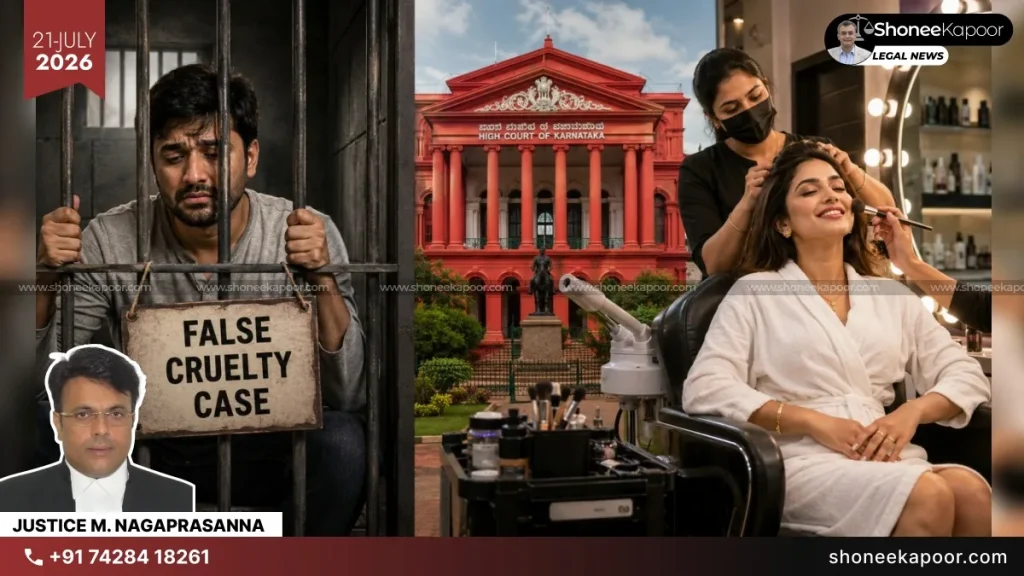
Can the same allegations be repeated in a fresh criminal case after an earlier domestic violence matter is stayed? The Karnataka High Court has paused the cruelty FIR against the husband after noticing that both complaints were substantially similar.
BENGALURU: The Karnataka High Court on Friday, July 17, stayed the investigation and further inquiry in a cruelty case registered against a husband. The Court noticed that the allegations in the FIR appeared to be a translated version of an earlier domestic violence complaint that had already been stayed.
Justice M. Nagaprasanna passed the interim order while hearing a petition filed by a BESCOM employee. The husband was booked under Sections 85, 115(2), 351(2) and 352 of the Bharatiya Nyaya Sanhita, Section 498A of the Indian Penal Code and Sections 3 and 4 of the Dowry Prohibition Act.
The Court noted that the marital relationship had broken down and that several legal proceedings had been initiated by the wife against the husband.
“The petitioner is the husband, the second respondent the wife. Floundering of relationship between the two, has resulted in the wife registering several crimes against the husband,” the Court observed.
The couple married on April 14, 2011. The husband later filed divorce proceedings, which are currently at the stage of cross-examination.
According to the husband, the wife filed a case under the Protection of Women from Domestic Violence Act, 2005, on June 23, 2025, as a counterblast to the pending matrimonial dispute.
In the earlier proceedings, the husband argued that the main allegation against him was that he had stopped his wife from visiting a beauty parlour or getting her eyebrows done.
While referring to that case, the High Court recorded:
“The allegation of the wife in the domestic violence proceedings was that the petitioner stopped her from going to the beauty parlour and getting her eyebrows done or complaining that she was dark in complexion. That matter comes to be stayed at the hands of this Court as the allegations were on the face of it frivolous.”
The Court noted that soon after the domestic violence proceedings were stayed, Crime No. 110/2026 was registered against the husband.
After examining the fresh complaint, the Court found that the allegations were largely the same as those raised in the domestic violence case. This raised concerns about repeated criminal proceedings based on substantially identical accusations, forcing the husband to defend himself in multiple cases arising from the same matrimonial dispute.
“A perusal of the complaint against the petitioner in the subject crime is a translated version of the complaint made in the domestic violence case, as the allegations remain the same.”
Considering these facts, the Karnataka High Court stayed all investigation and inquiry in Crime No. 110/2026 against the husband until the next date of hearing.
EXPLANATORY TABLE OF ALL LAWS AND SECTIONS MENTIONED
| Law and Section | What It Covers | Maximum or Prescribed Punishment | Relevance in This Case |
| Section 85, Bharatiya Nyaya Sanhita, 2023 | Cruelty committed against a married woman by her husband or his relative | Imprisonment up to three years and fine | The principal matrimonial-cruelty provision invoked against the husband. “Cruelty” is defined separately under Section 86 BNS. |
| Section 115(2), Bharatiya Nyaya Sanhita, 2023 | Voluntarily causing hurt | Imprisonment up to one year, fine up to ₹10,000, or both | Indicates an allegation that physical hurt was voluntarily caused. The interim order does not discuss supporting medical or factual material. |
| Section 351(2), Bharatiya Nyaya Sanhita, 2023 | Ordinary criminal intimidation, including threats intended to cause alarm or compel conduct | Imprisonment up to two years, fine, or both | Relates to the alleged threatening or intimidating conduct attributed to the husband. |
| Section 352, Bharatiya Nyaya Sanhita, 2023 | Intentional insult intended or known to be likely to provoke a breach of peace | Imprisonment up to two years, fine, or both | Relates to an alleged intentional insult capable of provoking a disturbance or retaliatory act. |
| Section 3(5), Bharatiya Nyaya Sanhita, 2023 | Common intention: when several persons commit a criminal act in furtherance of their shared intention, each may be held liable as though they individually committed it | It does not prescribe an independent punishment; liability follows the main offence | Used to attribute joint liability where more than one accused is alleged to have acted with a common intention. |
| Section 498A, Indian Penal Code, 1860 | Cruelty by the husband or his relative, including grave wilful conduct or dowry-linked harassment | Imprisonment up to three years and fine | The order records Section 498A of the earlier IPC regime in addition to BNS provisions. The provision is substantially analogous to Sections 85 and 86 BNS. |
| Section 3, Dowry Prohibition Act, 1961 | Giving, taking or abetting the giving or taking of dowry | Ordinarily, imprisonment of at least five years and fine of at least ₹15,000 or the value of the dowry, whichever is higher; exceptions apply to qualifying marriage presents | Invoked in relation to the alleged giving, taking or facilitation of dowry. |
| Section 4, Dowry Prohibition Act, 1961 | Directly or indirectly demanding dowry from the bride’s or bridegroom’s parents, relatives or guardian | Six months to two years’ imprisonment and fine up to ₹10,000; a lower sentence may be imposed for recorded special reasons | Invoked in relation to an alleged dowry demand. |
| Section 482, Code of Criminal Procedure, 1973 | Preserved the inherent powers of the High Court to prevent abuse of court process and secure the ends of justice | Procedural power; no criminal punishment | Shown in the case classification because the husband approached the High Court for intervention against the criminal proceedings. |
| Section 528, Bharatiya Nagarik Suraksha Sanhita, 2023 | Current provision preserving the High Court’s inherent powers to pass necessary orders, prevent abuse of process and secure justice | Procedural power; no criminal punishment | Modern equivalent of Section 482 CrPC and the jurisdiction under which the High Court could stay investigation and inquiry. |
| Protection of Women from Domestic Violence Act, 2005 | Provides civil and protective remedies against domestic violence, including protection, residence and monetary orders | Consequences depend on the particular relief or breach alleged | The earlier proceedings reportedly contained similar allegations and had already been stayed by the High Court. No specific section of this Act is mentioned in the uploaded order. |
CASE DETAILS
| PARTICULAR | DETAILS |
| Case Title | Sri Hemanth Kumar B. v. State of Karnataka and Another |
| Court | High Court of Karnataka |
| Case Number | Criminal Petition No. 10091 of 2026 |
| Court Registration Number | KAHC010466822026 |
| Filing Number | CRL.P No. 10049 of 2026 |
| Date of Filing | July 8, 2026 |
| Time of Filing | 1:08:07 PM |
| Petitioner | Sri Hemanth Kumar B. |
| Respondent No. 1 | State of Karnataka |
| Respondent No. 2 | Wife of the petitioner; her name is not shown in the uploaded PDF |
| Counsel for Petitioner | Sadanand G. Shastri |
| Counsel for State | Learned High Court Government Pleader; individual counsel’s name is not mentioned |
| Counsel for Respondent No. 2 | Not mentioned; emergent notice was ordered |
| Bench | Single Bench |
| Judge | Justice M. Nagaprasanna |
KEY TAKEAWAYS
- The High Court stayed the investigation against the husband after finding repeated allegations.
- The fresh FIR was described as a “translated version” of the earlier complaint.
- The earlier allegations were found “on the face of it frivolous.”
- A husband should not be forced to fight multiple cases based on substantially identical claims.
- Legal protection cannot become a weapon to keep a man trapped in endless criminal proceedings.
This Could Change Your Case-Get FREE Legal Advice-Click Here!
Disclaimer: The views and opinions expressed in this article are those of the Indian courts and do not necessarily reflect the official policy or position of “ShoneeKapoor.com” or its affiliates. This article is intended for informational and educational purposes only. The content provided is not legal advice, and viewers should not act upon this information without seeking professional counsel. Viewer discretion is advised.