
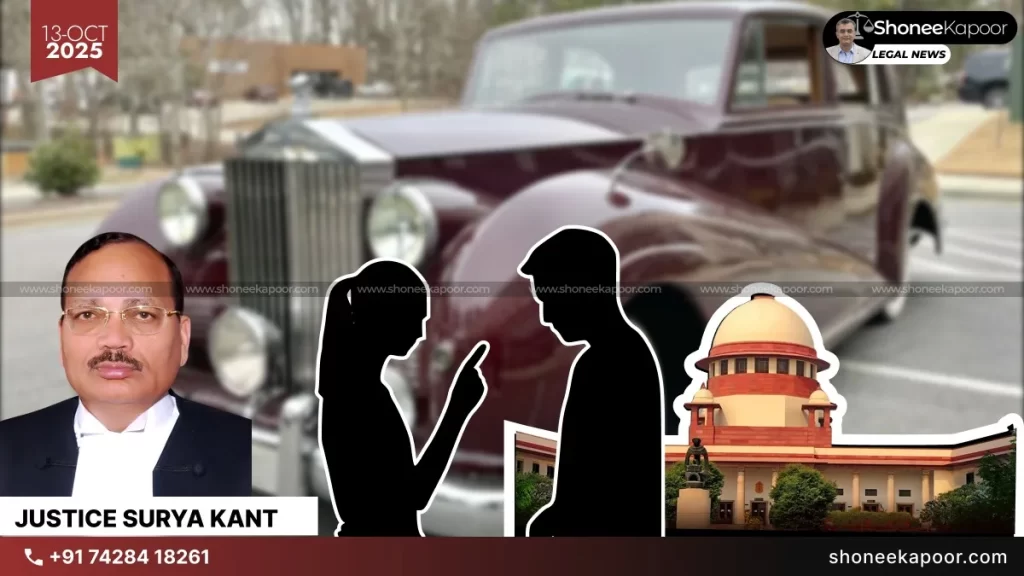
The Supreme Court dissolved a Royal marriage after a dowry dispute involving a 1951 Rolls Royce once linked to Jawaharlal Nehru. The husband agreed to pay ₹2.25 crore in a full and final settlement.
NEW DELHI: A high-profile marital battle filled with royal claims, dowry allegations, and a vintage Rolls Royce car has finally come to an end. On August 29, 2025, the Supreme Court of India officially dissolved the marriage between Katyayani Angre and Arjun Singh Kak. The court used its special powers under Article 142 of the Constitution to bring peace to a relationship that had turned into a long legal war.
The case grabbed attention because of its dramatic details — a marriage said to have royal roots, and a dowry dispute involving a 1951 Rolls Royce car once reportedly ordered by Jawaharlal Nehru for the Maharani of Baroda.
A bench of Justices Surya Kant, Joymalya Bagchi, and Vipul M. Pacholi approved the settlement, under which the husband agreed to pay ₹2.25 crore to the wife. The court confirmed that both sides had accepted all terms and conditions of the settlement.
The court said:
“In exercise of the power conferred upon us by Article 142 of the Constitution of India, we dissolve the marriage between the petitioner and respondent No.1. There shall be no relationship, matrimonial or otherwise, between them hitherto.”
As per the agreement, the woman will keep all gifts she received from her husband and his family. The man, in return, agreed to return certain items, including the engagement ring, achkan buttons, and a 10-gram ginni.
He handed over a bank draft of ₹1 crore and all gifts in court on the same day, promising to pay the remaining ₹1.25 crore by November 30, 2025.
Both sides also signed a written declaration confirming this was a full and final settlement. They promised that no further legal or personal claims would be made against each other. They also agreed not to defame each other, including on social media.
All pending criminal and civil cases between them were quashed by the court, marking a complete closure.
The wife had earlier approached the Supreme Court against a December 5, 2023 order of the Gwalior Bench of the Madhya Pradesh High Court, which had quashed her dowry and cruelty complaint. She had alleged that her husband and in-laws harassed her for the antique Rolls Royce and a flat in Mumbai.
According to her, the 1951 Rolls Royce was a rare handmade model by H.J. Mulliner & Co, originally ordered on behalf of Maharani Chimna Bai Sahib Gaekwad by Jawaharlal Nehru, and later passed down through her family.
She claimed her husband and father-in-law were fascinated by the car and wanted it as a dowry gift. When this demand wasn’t met, she said, she was denied entry to her marital home and was defamed.
She further added that her family descended from an admiral of Chhatrapati Shivaji Maharaj, who was once declared ruler of the Konkan region, making the marriage seem like a “high-status royal alliance.”
The husband, however, denied all allegations. He said that the April 20, 2018 marriage in Rishikesh was only a symbolic ritual, done for astrological reasons on her family guru’s advice. He claimed that the couple never lived together, the marriage was never consummated, and that the registration at Gwalior was fake.
He even accused the wife and her relatives of forgery in creating a false marriage certificate. He further stated that he never demanded the Rolls Royce or any flat in Mumbai.
In November 2024, the Supreme Court directed both parties to try mediation and appointed Senior Advocate R. Basant as mediator. After several rounds of talks, they finally reached a mutual understanding.
This mediation brought closure to a saga that mixed royal titles, a legendary vintage car, dowry accusations, disputed marriage validity, and multiple court cases.
What started as a so-called “royal marriage” ended in a courtroom settlement — showing that even the grandest alliances can collapse when ego, heritage, and material disputes collide.

Through its extraordinary constitutional powers, the Supreme Court ensured a dignified end with a clear financial settlement and closure for both sides.
Explanatory Table of All Laws & Sections Cited
| Provision | Statute | Description / Legal Effect | Relevance in Case |
|---|---|---|---|
| Article 142 | Constitution of India | Empowers the Supreme Court to pass any decree or order necessary to do “complete justice” between the parties. | Used to dissolve the marriage directly despite pending cases. |
| Section 420 | Indian Penal Code, 1860 | Cheating and dishonestly inducing delivery of property. | Invoked in FIR No. 400/2019; quashed. |
| Section 466 | IPC | Forgery of record of Court or public register. | Quashed under settlement. |
| Section 468 | IPC | Forgery for purpose of cheating. | Quashed under settlement. |
| Section 470 | IPC | Forged document definition. | Quashed under settlement. |
| Section 120-B | IPC | Criminal conspiracy. | Quashed under settlement. |
| Mediation / Amicable Settlement | Supreme Court-guided mediation process | Alternative dispute resolution mechanism. | Resulted in mutual resolution dated 05.02.2025. |
List of All Connected Cases and FIRs
| S. No. | Proceeding Type | Case No. / FIR No. | Forum / Police Station | Sections / Subject | Status After SC Order |
|---|---|---|---|---|---|
| 1 | Divorce Petition | Case No. 1384/2022 | Family Court, Gwalior | Divorce proceeding | Disposed / Closed |
| 2 | Writ Appeal | No. 644/2022 | High Court of Madhya Pradesh, Gwalior Bench | Civil appeal | Quashed |
| 3 | Matrimonial Appeal | MAT. APP. (FC) No. 169/2022 | Delhi High Court | Appeal by husband | Disposed / Closed |
| 4 | FIR | No. 400/2019 | Police Station: University, Gwalior | Sections 420, 466, 468, 470, 120-B IPC | Quashed |
| 5 | FIR | No. 73/2021 | P.S. Mahila Thana, District Gwalior | Offences arising from matrimonial dispute | Quashed |
| 6 | Other Civil/Criminal Proceedings | Any other pending litigation between the parties | – | – | All deemed closed |
Case Summary
- Case Title: Katyayini Angre v. Arjun Singh Kak & Ors.
- Citation: Criminal Appeal No. ___ of 2025 (arising out of SLP (Crl.) No. 13685 of 2024)
- Court: Supreme Court of India
- Bench: Justice Surya Kant, Justice Joymalya Bagchi, Justice Vipul M. Pancholi
- Date of Judgment: 29 August 2025
- Jurisdiction: Criminal Appellate Jurisdiction
- Mediation Report Date: 05 February 2025
- Settlement Amount: ₹2,25,00,000 (Two Crore Twenty-Five Lakh Rupees)
- Payment Schedule: ₹1 crore by 31.08.2025 and ₹1.25 crore by 30.11.2025
- Interest Clause: 12% per annum on any delay
- Settlement Type: Full and final; includes non-defamation and withdrawal of all pending litigations
- Marriage Dissolution: By exercise of Article 142 of the Constitution of India
- Mediator: (Not named; referred to as “learned Mediator”)
- Mode of Verification: Petitioner in Court; Respondent via virtual appearance
Counsel Details
- For Petitioner (Katyayini Angre): Ms. Vibha Datta Makhija, Sr. Adv.; Mr. Raju Sharma, Adv.; Mr. Dushyant Singh Chauhan, Adv.; Ms. Nehol, Adv.; Mr. Abhinav Parihar, Adv.; Mr. Vikrant Singh Bais, AOR
- For Respondents (Arjun Singh Kak & Ors.): Mr. Prosenjeet Banerjee, Adv.; Mr. Nishant Rao, Adv.; Mr. Anshuman Srivastava, AOR; Ms. Nidhi Mohan Parashar, AOR; Mr. Vikrant Kumar, Adv.; Mr. Amar Bajpayee, Adv.; Mr. Sarthak Bhardwaj, Adv.; Mr. Aditya Singh, Adv.; Mr. Yashraj Singh Bundela, AOR; Mrs. Pratima Singh, Adv.; Ms. Saloni Singh, Adv.; Mr. Arpit Garg, Adv.

Disclaimer: The views and opinions expressed in this article are those of the Indian courts and do not necessarily reflect the official policy or position of “ShoneeKapoor.com” or its affiliates. This article is intended for informational and educational purposes only. The content provided is not legal advice, and viewers should not act upon this information without seeking professional counsel. Viewer discretion is advised