
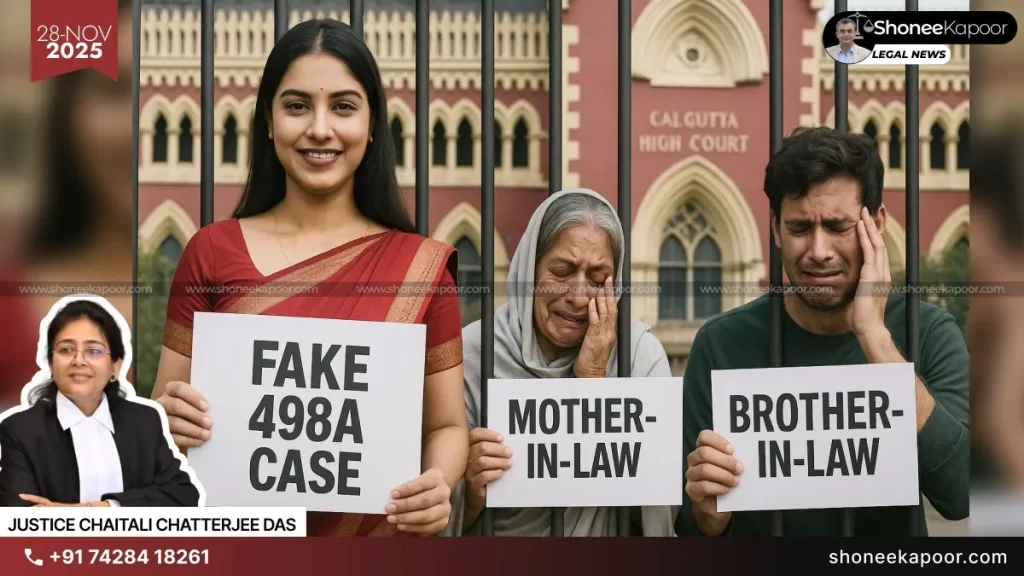
The Calcutta High Court Acquits a mother-in-law and brother-in-law in a False 498A case after finding contradictions in the family’s statements and no reliable proof of cruelty. Hostile neighbours and missing evidence further weakened the prosecution.
WEST BENGAL: The Calcutta High Court overturned the conviction of a mother-in-law and brother-in-law who were earlier sentenced for cruelty under Section 498A IPC.
Justice Chaitali Chatterjee Das passed the judgment on 24 November 2025. The trial court had convicted them in 2003 and sentenced them to two years of rigorous imprisonment, even though it had already acquitted them of dowry death under Section 304B IPC.
The case was based on a complaint by the victim’s brother, who claimed that his sister was tortured for dowry after her marriage. He also alleged she was burnt inside the bathroom with the door locked. A police case was registered, charges were framed, and the trial began.
This case highlights the complexities surrounding false accusations in the context of False 498A claims, emphasizing the need for careful scrutiny in similar legal battles.
However, while reading the entire record, the High Court found serious gaps in the prosecution’s story. The Court noticed that the victim’s siblings claimed that she repeatedly returned home due to harassment, yet none of them could give any specific dates, specific incidents, or any earlier complaint to the authorities.
They said torture happened many times, but they could not even recall when those events took place. The Court said these inconsistencies “certainly creates cloud” over the prosecution’s version.
The Court further observed:
“The evidence not sufficient to prove the ingredients to attract Section 498A beyond a reasonable doubt because no clear or consistent facts were presented by the family members.”
An unusual fact also weakened the prosecution: one of the victim’s brothers admitted inviting the accused family to his own wedding nearly three years after the alleged harassment.
The Court noted:
“This clearly manifest no inimical relationship existed between the parties, which concludes directly against the claim that the in-laws had been cruel and dangerous.”
Three neighbours, who lived right next door, became hostile witnesses. They told the Court that the victim was never ill-treated at home, and on the day of the incident, none of the accused were present.
They also stated that the victim herself said the fire happened because of a gas cylinder. Their version made the Court conclude:
“The local witnesses did not support the prosecution in any manner”.
The autopsy doctor informed the Court that the burn injuries “seems to be suicidal in nature”, although he added that it needed circumstantial confirmation. The inquest mentioned kerosene, but the Investigating Officer did not seize any kerosene can, bottle, or any article that could prove kerosene was used.
The High Court noted that “no article was seized to substantiate use of kerosene” and even the post-mortem report did not mention kerosene at all.
Another major lapse highlighted by the Court was that the prosecution did not charge or examine the husband, even though he was the most important witness. The Court said he would have been “the best person to narrate the entire situation”, and this omission “weakens the prosecution case further”.
Referring to repeated Supreme Court rulings, the High Court reminded that vague and general allegations against in-laws cannot be the basis of criminal conviction. The evidence must be strong, clear, and free from doubt.
Since all the evidence together failed to show any steady pattern of cruelty or dowry harassment, the Court concluded:
“No unambiguous conclusion can be arrived at that she was subjected to cruelty by her in-laws.”
With this finding, the High Court set aside the conviction and the sentence. The appeal was allowed, and the accused were discharged from their bail bonds.
Explanatory Table Of All Laws / Sections Mentioned In The Case
| Section / Law | What the Law Means (Simple Indian English) | How It Applies in This Case |
| Section 498A IPC | Punishes cruelty by husband or in-laws, including harassment for dowry or cruelty leading a woman to harm herself. | Trial court convicted under 498A, but High Court set aside because evidence was inconsistent, vague, and not proved beyond reasonable doubt. |
| Section 304B IPC | Dowry death—if a woman dies within 7 years of marriage under suspicious circumstances and was harassed for dowry before death. | Trial court acquitted the accused under 304B. High Court noted no evidence supported dowry death allegations. |
| Section 306 IPC | Abetment of suicide—someone encouraging or provoking a woman to take her life. | High Court said the prosecution produced no evidence proving abetment, and even the trial court did not find ingredients of 306 IPC. |
| Criminal Appeal (CRA 14 of 2004) | A criminal appeal filed against conviction before a higher court. | The appellants challenged their 498A conviction before the Calcutta High Court. |
| Role of Prosecution Burden of Proof | Prosecution must prove every charge beyond reasonable doubt. | High Court held the prosecution failed to provide reliable, consistent evidence. |
| Principle on Vague Allegations (Supreme Court rulings) | Courts must not convict in-laws based on general, non-specific accusations. | High Court repeated that vague and omnibus allegations cannot sustain conviction. |
Case Summary
- Case Title: Ranjit Saha vs. The State of West Bengal & Anr.
- Case Number: CRA 14 of 2004
- Bench (Judge): Hon’ble Justice Chaitali Chatterjee Das
- Date Of Hearing: 13 November 2025
- Date Of Judgment: 24 November 2025, Uploaded on same date.
Counsels Appearing:
- For the Appellants:
- Mr. Dipankar Aditya, Advocate
- Mr. Bidyut Baran Biswas, Advocate
- Ms. Aishwarya Priya Laha, Advocate
- For the State:
- Mr. Avishek Sinha, Advocate
- Trial Court Details:
- Learned Additional Sessions Judge, 4th Court, Nadia
- Convicted under Section 498A IPC
- Acquitted under Section 304B IPC
- Sentence: 2 years RI + ₹5000 fine (2003 judgment)
Fact Summary (As Per Record):
- Marriage was 1½ years old.
- Allegation of mental and physical torture for dowry.
- Claim that she was burnt inside bathroom.
- Neighbours said she told them it was a gas cylinder accident.
- Neighbours turned hostile; none supported torture claim.
- No specific dates of harassment given by siblings.
- They never lodged prior complaints.
- Husband was not made accused, nor examined.
- Autopsy doctor said burns “seems to be suicidal in nature”.
- IO seized no kerosene evidence, despite claims.
- Family invited the accused to a wedding 3 years later—showing no hostility.
Key Takeaways
- The High Court ruled that vague and general allegations against in-laws cannot be used to punish men or their families.
- Hostile neighbours and contradictory family statements destroyed the prosecution’s story, proving how easily false narratives can be built.
- The husband was never examined, yet the family kept blaming the in-laws highlighting how men are often targeted without proper investigation.
- No evidence of dowry demand, no seized kerosene, and no consistent timeline showed that the case lacked basic proof required for criminal conviction.
- The Court reaffirmed that without clear, specific, and credible evidence, 498A cannot be used to harass or implicate men and their relatives.
This Could Change Your Case-Get FREE Legal Advice-Click Here!

Disclaimer: The views and opinions expressed in this article are those of the Indian courts and do not necessarily reflect the official policy or position of “ShoneeKapoor.com” or its affiliates. This article is intended for informational and educational purposes only. The content provided is not legal advice, and viewers should not act upon this information without seeking professional counsel. Viewer discretion is advised.