
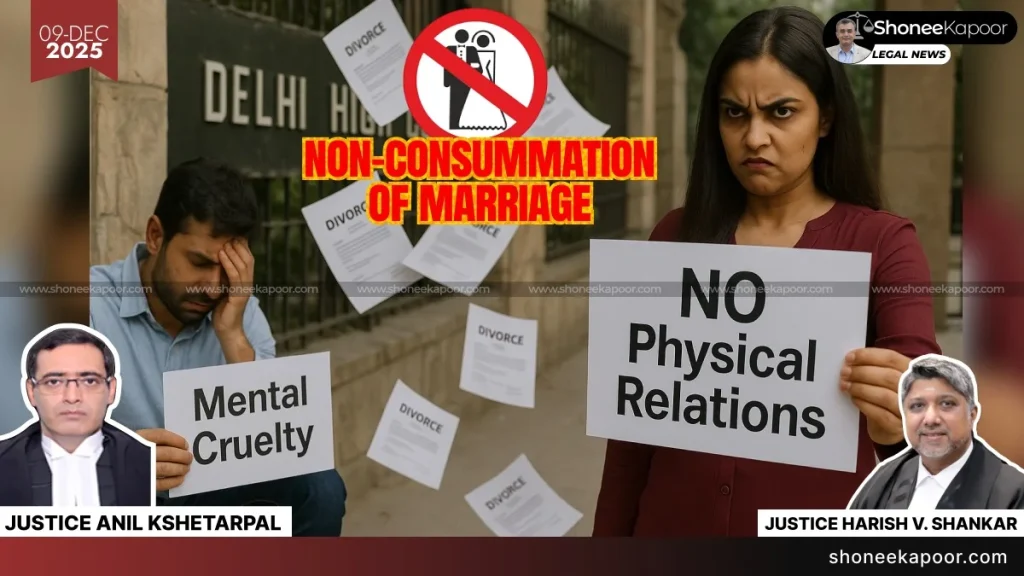
The Delhi High Court upheld a Family Court decree granting divorce after finding that the marriage was never consummated and the wife had wilfully refused physical intimacy. The Court held that such refusal amounts to mental cruelty and long separation shows the marriage had broken early.
NEW DELHI: The Delhi High Court upheld a divorce granted to a husband after concluding that the marriage between the parties (names masked) was Non-Consummation and that the wife’s conduct amounted to mental cruelty.
The Court observed that the couple lived together only briefly after their marriage on 06.05.2017 and had been living apart since 26.06.2017, which clearly showed that the relationship had broken down very early.
The Division Bench of Justice Anil Kshetarpal and Justice Harish Vaidyanathan Shankar repeated the Family Court’s finding:
“Long, continuous separation, particularly from the very inception of marriage, constitutes a material circumstance supporting the conclusion that the matrimonial relationship had fractured irreparably at an early stage.”
The wife had challenged the Family Court’s order, which had allowed the husband’s divorce petition under Section 13(1)(ia) of the Hindu Marriage Act. The husband had stated that from day one the marriage remained unconsummated, and the wife was unwilling to participate in physical relations or general marital responsibilities. The wife denied this allegation and claimed she always wanted to stay with her husband, alleging instead that she was mistreated and subjected to dowry demands.
The High Court examined the record and noted that the Family Court had correctly rejected the wife’s dowry allegations because she gave no clear dates, incidents or proofs to support them. The Court also upheld the Family Court’s conclusion regarding the wife’s own written statement where she had used the phrase “almost consummated.” The Bench noted that the Family Court did not rely on these words alone but analysed them together with other evidence, explaining:
“The record shows that the Family Court did not rely upon this phrase in isolation. It considered it in conjunction with: i. The Respondent‟s consistent allegations of refusal of physical intimacy; ii. The WhatsApp and email communications placed on record, and iii. The testimonies and the overall conduct of the parties.”
According to the Court, the wife’s later claim that consummation had taken place did not balance or neutralise her own earlier statements, especially when the surrounding evidence supported the husband’s consistent stand. The High Court also agreed that the electronic communication, although not complete, was still admissible because the wife never objected to it nor provided any contrary material. The Court found that these messages showed hesitation and unwillingness from the wife’s side during the initial days of marriage.
The Court also noted that the wife’s claim of multiple reconciliation attempts was not proven with reliable evidence, while the husband’s statement that she left the matrimonial home on 26.06.2017 and never returned stood consistent.
The Court reiterated the Family Court’s view that her allegations of dowry harassment were vague and unsupported, whereas the husband’s allegations—including denial of intimacy, abusive behaviour, threats of false complaints, and abrupt departure—were proven through testimony and documents.
The Court again highlighted the earlier observation:
“Long, continuous separation, particularly from the very inception of marriage, constitutes a material circumstance supporting the conclusion that the matrimonial relationship had fractured irreparably at an early stage.”
The wife also raised a clerical error in the Family Court decree, where unrelated names were mistakenly typed. The High Court called this an accidental drafting mistake and clarified that it would be corrected by the Family Court under procedural law.
The Court then stated that the divorce was not granted on the ground of desertion, but on cruelty, so the statutory desertion period was irrelevant. It also held that even if allegations of the husband’s remarriage during the appeal were true, they had no impact on the correctness of the original divorce decree because remarriage after the decree is a separate issue in law.
The Bench referred to Supreme Court rulings to emphasise that marriage contracted during an appeal is not void unless expressly stated by law.
Ultimately, the Court held there was no reason to interfere with the Family Court’s findings. The Court accepted the view that the wife’s refusal of physical relations was persistent and deliberate, and therefore amounted to mental cruelty. The Court agreed that the marriage had become dead early due to the wife’s conduct.
As a result, the High Court dismissed the appeal and confirmed the divorce, directing the Family Court only to correct the clerical error in the decree.

Explanatory Table Of All Laws & Sections Mentioned
| Law / Section | Full Name / Act | How It Applies in This Case |
| Section 13(1)(ia), Hindu Marriage Act, 1955 | Cruelty as a ground for divorce | Husband filed for divorce claiming mental cruelty due to non-consummation and refusal of physical intimacy. Divorce granted. |
| Section 13(1)(ib), Hindu Marriage Act, 1955 | Desertion as a ground for divorce | Wife argued the divorce petition was premature for desertion. Court clarified divorce was not granted on desertion, so this section was irrelevant. |
| Section 23(1)(a), Hindu Marriage Act | Court must ensure petitioner does not take advantage of his own wrong | Wife argued husband was at fault; court rejected this and held husband did not take advantage of any wrongdoing. |
| Section 15, Hindu Marriage Act | When divorced persons may remarry | Wife alleged husband remarried during appeal. Court said even if true, remarriage does not invalidate the earlier decree. |
| Section 152, Code of Civil Procedure (CPC) | Correction of clerical mistakes | Used to correct the Family Court’s error of mistakenly typing unrelated parties’ names. |
| Section 125, CrPC | Maintenance proceedings | Wife had filed separate maintenance case; Court said it does not affect cruelty findings. |
| Section 12, Protection of Women from Domestic Violence Act, 2005 | DV complaint | Wife filed DV proceedings later; Court held these later actions do not change husband’s earlier allegations. |
| Section 498A, Indian Penal Code | Cruelty by husband/relatives | Wife filed FIR No. 233/2024. High Court said later criminal cases don’t negate husband’s earlier version or change the cruelty findings. |
| Samar Ghosh v. Jaya Ghosh (2007) 4 SCC 511 | Landmark SC judgment defining mental cruelty | Family Court relied on its parameters to conclude wife’s conduct amounted to mental cruelty. |
| Lila Gupta v. Laxmi Narain (1978) 3 SCC 258 | SC ruling on remarriage during appeal | Cited to dismiss wife’s objection about alleged remarriage. |
| Anurag Mittal v. Shaily Mishra Mittal (2018) 9 SCC 691 | Similar ruling on remarriage legality | Reinforced that remarriage does not make the divorce decree void unless statute says so. |
Case Summary
- Case Title: SK vs RR (MAT.APP.(F.C.) 30/2024)
Counsels
- For Appellant-Wife: Mr. Satish Pandey, Advocate
- For Respondent-Husband: Mr. Sanjeev Sharma & Mr. Ankit Kashyap, Advocates
Bench
- Hon’ble Mr. Justice Anil Kshetarpal
- Hon’ble Mr. Justice Harish Vaidyanathan Shankar
Important Dates
- Judgment Reserved: 24.11.2025
- Judgment Pronounced: 06.12.2025
- Family Court Divorce Decree: 15.12.2023
Background Facts
- Marriage solemnised on 06.05.2017
- Wife left matrimonial home on 26.06.2017
- Parties never resumed cohabitation
- Husband filed divorce petition on 17.07.2018
- Husband claimed non-consummation, refusal of intimacy, threats of false cases
- Wife alleged dowry demands, mistreatment, and claimed marriage was consummated
High Court’s Key Findings
- Marriage was never consummated
- Wife’s refusal of intimacy was wilful & persistent
- This conduct amounts to mental cruelty
- Dowry allegations were vague and unproved
- Long separation from the very beginning proved marriage had collapsed early
- Clerical error in decree to be corrected under Section 152 CPC
- Alleged remarriage of husband irrelevant to appeal
Final Outcome
- Appeal dismissed
- Divorce upheld
- Family Court directed to correct clerical error
- Decree affirmed
Key Takeaways
- Delhi High Court made it clear that when a wife wilfully refuses intimacy from day one, it is mental cruelty and a valid ground for divorce.
- Long and continuous separation right after marriage shows the relationship was broken because of the wife’s conduct, not the husband’s.
- False or vague dowry allegations without proof cannot be used as a shield to escape accountability.
- Courts will not punish husbands for incomplete chats or technicalities when the overall conduct clearly shows denial of marital obligations.
- Later cases filed by the wife under 125 CrPC, DV Act or 498A cannot erase her earlier cruelty or force the husband to stay in a dead marriage.
This Could Change Your Case-Get FREE Legal Advice-Click Here!

Disclaimer: The views and opinions expressed in this article are those of the Indian courts and do not necessarily reflect the official policy or position of “ShoneeKapoor.com” or its affiliates. This article is intended for informational and educational purposes only. The content provided is not legal advice, and viewers should not act upon this information without seeking professional counsel. Viewer discretion is advised.