
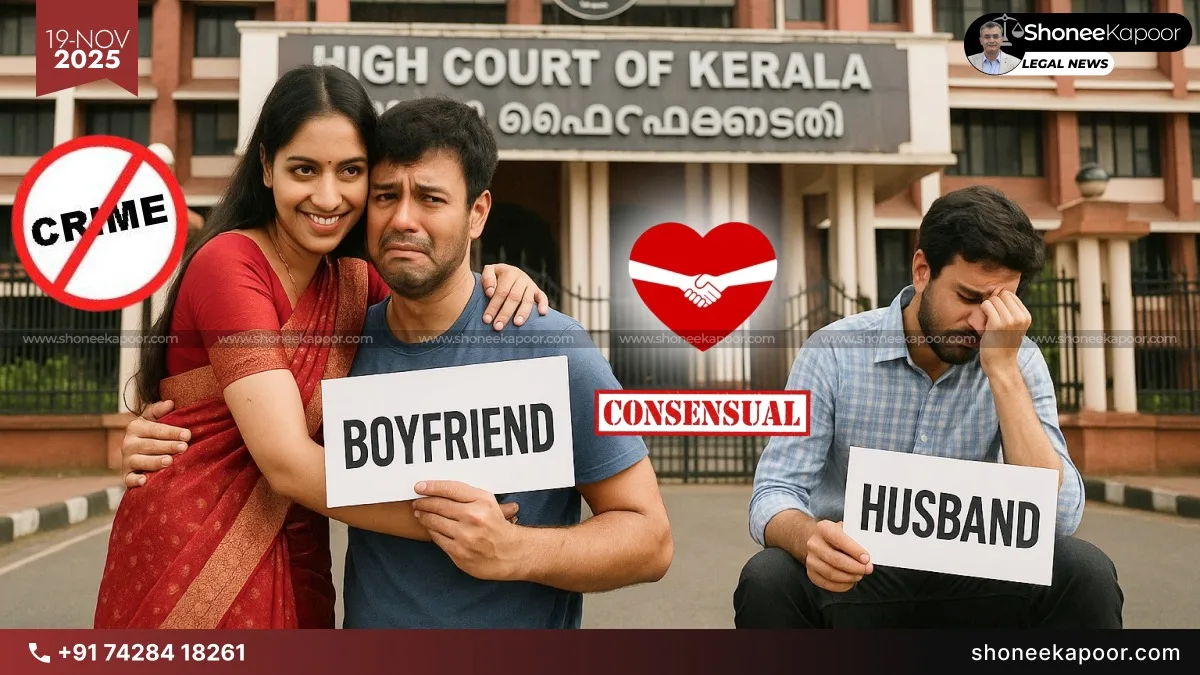
Landmark Ruling | Consensual Affair With Married Woman on Assurance of Marriage Doesn’t Constitute Rape: Kerala High Court Slams Misuse of Law

Written and analysed by Shonee Kapoor
Legal Consultant, Author & Men's Rights ActivistThe Kerala High Court ruled that a long-term intimate relationship cannot be treated as rape when the woman continued it voluntarily for years. The Court said the man’s later marriage did not convert their earlier consensual affair into a criminal offence.
Consensual Affair With Married Woman: The Kerala High Court has quashed the entire criminal case against a 38-year-old man accused of rape, cheating and fake marriage, saying that the eight-year relationship between him and the complainant woman was clearly consensual and not based on any false promise of marriage.
Justice G. Girish examined the full case records and concluded that the woman had voluntarily maintained a long intimate relationship with the accused, even when her husband was alive and also for several years after his death, which showed that the relationship was never forced or created through deception.
The Court clearly stated that:
“It is not possible to accept the contention of the de facto complainant that she had extended consent for sexual relationship with the petitioner at a time when her husband was alive, believing the offer made by the petitioner to marry her.”
The Court also added that her behaviour showed a stable relationship and not one based on a misunderstanding, explaining that
“The subsequent conduct of the de facto complainant maintaining the relationship with the petitioner for about four years after the death of her husband, also show that the sexual relationship between the petitioner and the de facto complainant cannot be classified as rape.”
Another major point considered by the Court was the fact that the accused later married another woman. The judge made it absolutely clear that a later marriage by itself cannot convert an old consensual relationship into rape.
As the judgment said:
“The fact that the accused went in search of greener pasture for giving vent to his promiscuous sexual urge, and started a new relationship in the nature of marriage with another lady, by itself will not bring his prior relationship with the victim with in the meaning of rape. Hence, the proceedings initiated against the accused in connection with the commission of rape, is primafacie unsustainable.”
The prosecution had alleged that the man first contacted the woman in 2009 while she was married. He used to support her financially and gradually entered a physical relationship with her after allegedly promising to marry her. Her husband passed away in October 2013.
After that, the accused continued to live with her and have sexual relations. She said that he even tied a knot on her chain in front of a candle and lamp to make her believe they were married. Later, she found out that the man had married another woman.
Even then, he reportedly told her that she was the only woman he considered his wife, and the relationship continued for years. The relationship finally broke only after she confronted the man’s legal wife.
Based on her complaint, a case was registered under Sections 493 (deceitful marriage), 496 (fraud marriage) and 376 (rape). The man approached the High Court saying that the relationship was consensual and none of these offences applied in this situation.
The Court first explained that charges under Sections 493 and 496 IPC can only be taken up when an aggrieved person files a formal complaint before a magistrate. They cannot be made part of a police chargesheet, so these two offences were anyway not legally maintainable.
On the rape charge under Section 376 IPC, the Court relied on well-settled legal principles. The law is clear that a mere promise to marry, even if not fulfilled later, is not automatically rape. To make it rape, the prosecution must prove that the promise was false from the very beginning and was made only to obtain sexual consent.
The Court said:
“The consent given by the prosecutrix to sexual intercourse with a person with whom she is deeply in love on a promise that he would marry her on a later date, cannot be said to be given under a misconception of fact. A false promise is not a fact within the meaning of the Code.”
The Court relied on the Supreme Court’s detailed explanation in Uday v. State of Karnataka, where the Supreme Court had held:
“It therefore appears that the consensus of judicial opinion is in favour of the view that the consent given by the prosecutrix to sexual intercourse with a person with whom she is deeply in love on a promise that he would marry her on a later date, cannot be said to be given under a misconception of fact.
A false promise is not a fact within the meaning of the Code. We are inclined to agree with this view, but we must add that there is no straitjacket formula for determining whether consent given by the prosecutrix to sexual intercourse is voluntary, or whether it is given under a misconception of fact.
In the ultimate analysis, the tests laid down by the courts provide at best guidance to the judicial mind while considering a question of consent, but the court must, in each case, consider the evidence before it and the surrounding circumstances, before reaching a conclusion, because each case has its own peculiar facts which may have a bearing on the question whether the consent was voluntary, or was given under a misconception of fact.
It must also weigh the evidence keeping in view the fact that the burden is on the prosecution to prove each and every ingredient of the offence, absence of consent being one of them.”
The judgment also quoted the Supreme Court’s observations in Deepak Gulati v. State of Haryana, including:
“Consent may be express or implied, coerced or misguided, obtained willingly or through deceit. Consent is an act of reason, accompanied by deliberation, the mind weighing, as in a balance, the good and evil on each side.
There is a clear distinction between rape and consensual sex and in a case like this, the court must very carefully examine whether the accused had actually wanted to marry the victim, or had mala fide motives, and had made a false promise to this effect only to satisfy his lust, as the latter falls within the ambit of cheating or deception.
There is a distinction between the mere breach of a promise, and not fulfilling a false promise. Thus, the court must examine whether there was made, at an early stage a false promise of marriage by the accused; and whether the consent involved was given after wholly understanding the nature and consequences of sexual indulgence.”
Another Supreme Court ruling, Dhruvaram Murlidhar Sonar v. State of Maharashtra, was quoted for the principle:
“Thus, there is a clear distinction between rape and consensual sex. The court, in such cases, must very carefully examine whether the complainant had actually wanted to marry the victim or had mala fide motives and had made a false promise to this effect only to satisfy his lust, as the latter falls within the ambit of cheating or deception.
There is also a distinction between mere breach of a promise and not fulfilling a false promise. If the accused has not made the promise with the sole intention to seduce the prosecutrix to indulge in sexual acts, such an act would not amount to rape.”
The Court also relied on the Supreme Court’s recent judgment in Naim Ahamed v. State (NCT of Delhi) where the top court had observed, regarding a married complainant, that:
“The prosecutrix who herself was a married woman having three children, could not be said to have acted under the alleged false promise given by the appellant or under the misconception of fact while giving the consent to have sexual relationship with the appellant.”
After applying all these legal tests to the present case, the Kerala High Court concluded that the woman’s consent was never obtained by fraud or by a false promise of marriage. The couple lived together like partners for over eight years. She continued the relationship even after discovering that he had married someone else.
Therefore, the Court held that this relationship clearly had the nature of consensual intimacy and not rape. The judge finally ruled that the police chargesheet and all related proceedings were legally unsustainable and must be quashed.

Explanatory Table Of All Laws & Sections Mentioned
| Section / Law | Act | Meaning in Simple English | Why Court Said It Does NOT Apply in This Case |
| Section 493 IPC | Indian Penal Code | Deceitfully making a woman believe she is lawfully married to a man | Court said this offence can only be taken on a private complaint by the aggrieved person, not by police chargesheet. Hence the charge was invalid. |
| Section 496 IPC | Indian Penal Code | Fraudulent marriage (pretending to marry someone without a real marriage) | Same reason — only a Magistrate can take cognizance on a direct complaint, not through a police chargesheet. Charge was legally defective. |
| Section 376 IPC | Indian Penal Code | Punishment for rape | Court held the entire 8-year relationship was consensual. No coercion, no false promise made at the beginning, and she continued even after knowing he married someone else. |
| Section 90 IPC | Indian Penal Code | Defines when consent is invalid due to misconception of fact | Court held that a “promise to marry” is not a “fact”, so consent cannot be treated as invalid. |
| Section 198 CrPC | Code of Criminal Procedure | Restriction on courts taking cognizance of certain offences relating to marriage unless there is a direct complaint | Since Sections 493 & 496 fall under this rule, police report cannot be the basis for prosecution. |
| Section 173(2) CrPC | Code of Criminal Procedure | Final report/chargesheet filed by police after investigation | Court said police cannot include 493/496 IPC in this report as the law prohibits it. |
| Section 482 CrPC | Code of Criminal Procedure | High Court’s inherent powers to quash cases to prevent misuse of law | Used by the accused to request quashing, which the High Court allowed. |
| Case Laws Cited: Uday v. State of Karnataka (2003) | Supreme Court | Explained that a promise to marry is not “misconception of fact” unless it was false from the start | Court applied this to show consent here was genuine. |
| Deepak Gulati v. State of Haryana (2013) | Supreme Court | Clarified difference between breach of promise vs false promise made only for sex | Applied to prove relationship was voluntary. |
| Dhruvaram Sonar v. State of Maharashtra (2019) | Supreme Court | Consensual relationship cannot be called rape unless promise was deceitful from Day 1 | Court used this reasoning. |
| Naim Ahamed v. State (NCT of Delhi) (2023) | Supreme Court | Even a married woman with full understanding cannot claim rape on long voluntary relationship | Court used this to show complainant was mature and aware. |
Case Summary
Case Title: Pradeep v. The Station House Officer & Another (Crl.M.C No. 5348 of 2019)
Bench: The Honourable Mr. Justice G. Girish (Kerala High Court, Ernakulam)
Date Of Order: 17 November 2025 (Final hearing on 11 November 2025)
Court Details: High Court of Kerala at Ernakulam Order passed in a petition under Section 482 CrPC.
Crime Details
- Crime No. 3053/2017
Fort Police Station, Thiruvananthapuram - Case pending as S.C No. 802/2019
Additional Sessions Court–IX, Thiruvananthapuram
Petitioner / Accused: Pradeep, 38 years S/o Wilson Address: Pradeep Bhavan Veedu, Kottukalkonam, Thiruvananthapuram
Respondents
- The Station House Officer, Fort Police Station, Thiruvananthapuram
- Victim (Name withheld)
Counsels
- For Petitioner: Adv. B. Mohanlal
- For Respondent 2 (Victim): Adv. Ajith Krishnan
- For the State: Smt. Seena C., Public Prosecutor
Offences Alleged In FIR
- Section 493 IPC – Deceitful marriage
- Section 496 IPC – Fraud marriage
- Section 376 IPC – Rape
Result
Petition ALLOWED. All proceedings in S.C No. 802/2019 QUASHED.
Disclaimer: The views and opinions expressed in this article are those of the Indian courts and do not necessarily reflect the official policy or position of “ShoneeKapoor.com” or its affiliates. This article is intended for informational and educational purposes only. The content provided is not legal advice, and viewers should not act upon this information without seeking professional counsel. Viewer discretion is advised.
Related Articles

Delhi’s Crime Drop Didn’t Happen by Chance: How Our Men’s Rights Legal Activism Challenging Misuse, Forced Policing Reform (2024–2025)
Delhi’s improved crime metrics followed sustained legal pressure through RTIs, police engagement, and strategic litig...

Men’s Rights Truth: Sympathy Destroys Innocent Men Trapped in False 498A and Rape Cases
Many men trapped in false cases look for sympathy, not solutions. They seek validation for their helplessness. Real j...
Share Your Thoughts
Comments are moderated before publication.