
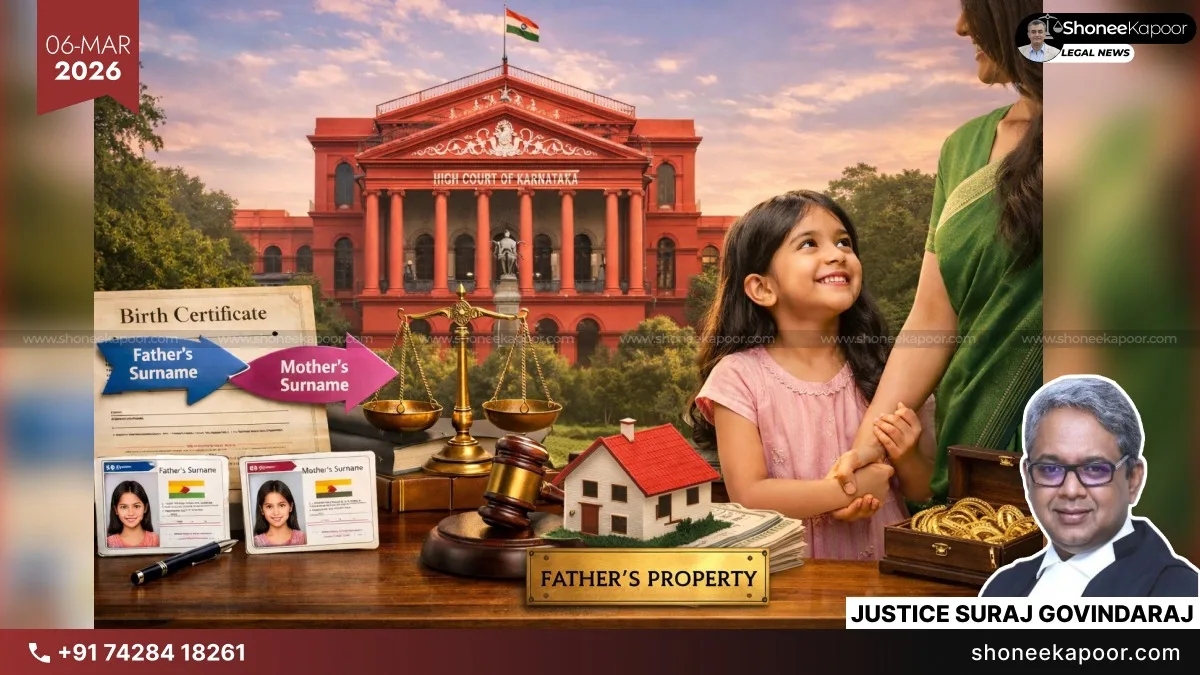
Father Remains Responsible, But His Identity Becomes Optional: Karnataka High Court Allows Alteration of Child’s Surname to Reflect Mother’s Lineage

Curated by NEWS DESK
Editorial DeskCan a child surname reflect the mother’s lineage even when the biological father continues to legally exist?
The Karnataka High Court said it can, noting that the father’s legal relationship and the child’s rights remain intact even if the child’s surname reflects the maternal family.
BENGALURU: Justice Suraj Govindaraj of the Karnataka High Court decided an important case involving the name of a minor child born from a live-in relationship.
The case was filed by a mother who asked the court to allow correction of her daughter’s name in the birth certificate so that it could include the mother’s family surname instead of only the father’s identity.
According to the facts of the case, the child was born in Bengaluru in 2017 when the parents were in a live-in relationship. After the birth of the child, the relationship ended, and the father left for Nepal. Since then, he has not stayed in contact with the mother or the child and has not contributed to the child’s upbringing or welfare.
The mother later approached the Births and Deaths Registrar asking for correction of the child’s name. She wanted to add her own family name so the child could carry the identity of the maternal family with whom she is actually living and growing up. However, the authority refused the request, saying they did not have the power to make such a change.
Because of this refusal, the mother approached the High Court. The court examined whether such a change is legally allowed and whether it affects the rights of the biological father.
Justice Suraj Govindaraj observed that the authorities had wrongly refused the request and clarified that the Registrar has the power to correct entries in birth records when justified.
While explaining the issue of identity and surname, the judge made an important observation. The court said:
“A surname is a social identifier. It signifies lineage or familial association but does not, by itself, create or extinguish legal rights.”
The court also clarified that legal rights like maintenance, inheritance or succession arise from the parent-child relationship and not from the surname used by the child.
The judge also made a broader constitutional remark on naming practices.
The court stated:
“The Constitution does not mandate that a child must invariably bear the father’s surname.”
At the same time, the court made an important clarification that the judgment clearly stated that the biological relationship of the father will continue to remain recorded and that the order-
“shall not affect the biological parentage… and shall not extinguish any rights that the child may have vis-à-vis the biological father including rights of inheritance, succession, and maintenance.”
After considering the facts and the welfare of the child, the High Court allowed the petition and directed the authorities to correct the child’s name in the birth certificate and issue a fresh certificate after completion of formalities.
The judgment highlights a growing concern that, while the father’s legal responsibilities remain intact, recognition of paternal identity in family matters is increasingly treated as optional, leaving fathers with obligations while gradually reducing their social recognition in the child’s identity.
Explanatory Table: Laws And Sections Involved
| Law / Section / Provision | Explanation in Simple Words | Role in This Case |
| Article 226 – Constitution of India | Gives High Courts power to issue directions or orders to government authorities when they fail to perform their legal duties | The High Court used this power to direct the Registrar to correct the birth certificate |
| Registration of Births and Deaths Act, 1969 | Central law that regulates how births and deaths are recorded and maintained in official records | The case involved correction of entries in a birth certificate under this law |
| Section 22 – Registration of Births and Deaths Act, 1969 | Allows authorities to correct entries in the birth register if the entry is erroneous in form or substance | The court held that the Registrar has the authority under this section to correct the child’s name |
| Article 21 – Constitution of India | Protects the right to life and dignity, which includes the right to identity and personal recognition | The court considered the child’s identity and welfare while allowing the name correction |
Case Details
- Case Title: Petitioners vs Chief Registrar, Births and Deaths, Bengaluru & Anr
- Court: High Court of Karnataka at Bengaluru
- Case Number: Writ Petition No. 33465 of 2025 (LB-BMP)
- Bench: Hon’ble Mr. Justice Suraj Govindaraj
- Neutral Citation: 2026:KHC:9735
- Date of Judgment: 17 February 2026
- Counsels:
- For Petitioners: Sri. Thangminlial Haokip, Advocate
- For Respondents: Sri. Pawan Kumar, Advocate
Key Takeaways
- A father may continue to carry legal responsibilities toward the child even when his identity or surname is no longer reflected in the child’s official name.
- Legal systems are increasingly recognising maternal lineage in official records, which changes long-standing social norms where children traditionally carried the father’s surname.
- The balance between a child’s welfare and the recognition of paternal identity is becoming a major issue in family law discussions.
- When a father is not present in the child’s life, authorities and courts are more willing to allow changes in identity records based on the child’s living family environment.
- These developments raise a broader debate about whether legal responsibility and social recognition of fatherhood should continue to go hand in hand.
This Could Change Your Case-Get FREE Legal Advice-Click Here!
Disclaimer: The views and opinions expressed in this article are those of the Indian courts and do not necessarily reflect the official policy or position of “ShoneeKapoor.com” or its affiliates. This article is intended for informational and educational purposes only. The content provided is not legal advice, and viewers should not act upon this information without seeking professional counsel. Viewer discretion is advised.
Related Articles
Chef Kunal Kapur Divorce Case: Inside the Courtroom Battle, Allegations, and the Legal Victory That Redefined Matrimonial Cruelty
Celebrity chef Kunal Kapur fought a long and intense courtroom battle to prove mental cruelty.The Delhi High Court’s ...
India vs Canada Divorce: Which Court Has Jurisdiction, and Will India Recognise a Canadian Divorce?
Married in India, living in Canada, or fighting divorce across both countries? Here is the real legal position on jur...
Delhi’s Crime Drop Didn’t Happen by Chance: How Our Men’s Rights Legal Activism Challenging Misuse, Forced Policing Reform (2024–2025)
Delhi’s improved crime metrics followed sustained legal pressure through RTIs, police engagement, and strategic litig...
Share Your Thoughts
Comments are moderated before publication.