
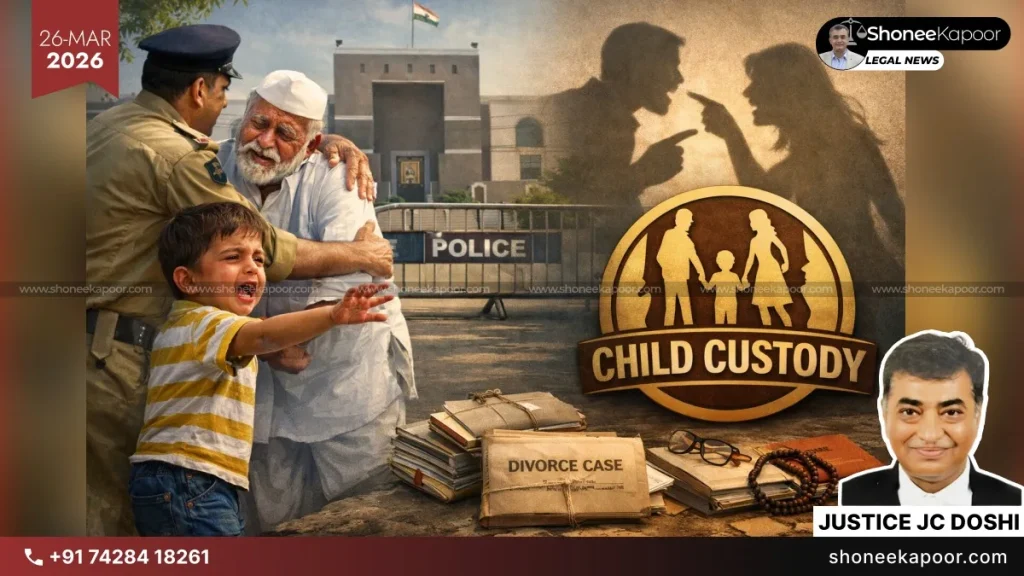
Can a toddler be forced to sit in court for 6 hours every week just for visitation? Gujarat High Court steps in, questions the system, and prioritises the child’s welfare over rigid legal orders.
AHMEDABAD: The Gujarat High Court has held that forcing a two-and-a-half-year-old child to spend six hours every week in court for meeting his grandfather is unjust and unreasonable.
The case arose from a family court order which directed the mother to bring the child every Thursday from 11:00 am to 5:00 pm to facilitate visitation with the paternal grandfather. The arrangement required both parties to sit together during the meetings, restricted the mother from bringing her second husband, and mandated cooperation.
Challenging this, the mother approached the High Court, arguing that such an order ignored the child’s age, emotional needs, and dependency on her.
Justice JC Doshi, while setting aside the order, made strong observations on the approach adopted by the family court.
“This court finds that the view and approach of the learned Family Court is unfathomable. Barely two and half years aged minor has become the subject matter in a custody dispute and whereby, has become victim of inhuman approach,”
The High Court emphasised that child custody matters are not about legal rights alone but about the welfare of the child, which must remain the primary consideration.
“The family court is expected to adopt a sensitive, humane and child-centric approach in a child custody matter, keeping in mind that such proceedings concern the welfare and future of a minor rather than the legal victory of fighting litigants. The court acts in the capacity of parens patriae and must exercise discretion with empathy, patience and sensitivity to the emotional needs of the child,”
The Court further clarified that while deciding custody and visitation, multiple factors must be carefully evaluated, rather than imposing rigid conditions.
“The Court should evaluate the age and gender of the child, emotional bonding with each parent, stability of the home environment, educational and developmental needs and the wishes of the child, if of sufficient maturity,”
The case also highlighted a deeper conflict. After the death of his son, the grandfather claimed he was completely denied access to the child when the mother remarried and shifted to another household. He argued that the family court’s order was justified to maintain his relationship with the child.
However, the High Court found that the method adopted by the family court was excessive and insensitive, especially given the young age of the child and the interim nature of the proceedings.
“This kind of harsh and obdurate approach of the court is unacceptable. All that could be noticed that these kind of orders are passed at interim stage, without reading the evidence. The point of view of the learned Family court may not be biased, but at the same time, no less than parti pris. Under the circumstances, present petition deserves consideration,”
Ultimately, the High Court allowed the mother’s plea and set aside the family court’s order.
Explanatory Table – Laws & Sections Involved
| Law / Section | Explanation in Simple Terms | Role in This Case |
| Article 227, Constitution of India | Gives High Courts power to supervise lower courts and correct wrong orders | Used by the mother to challenge the Family Court’s order |
| Section 12, Guardian and Wards Act, 1890 | Deals with temporary custody and interim arrangements for minors during proceedings | Grandfather filed application under this section seeking custody |
| Guardian and Wards Act, 1890 (Overall) | Governs custody, guardianship, and welfare of minors | Core law guiding custody dispute and court’s reasoning |
| Parens Patriae Jurisdiction | Court acts as guardian of the child and protects child’s welfare above all | High Court emphasized this duty while setting aside order |
| Welfare Principle (Sec. 13 conceptually applied) | Child’s welfare is the highest priority, above rights of parents or relatives | Central reasoning for quashing the Family Court order |
| Supreme Court Precedents | Binding interpretations of custody law and welfare principles | Used to show Family Court ignored settled law |
Case Details
- Case Title: Mansiben W/o Dharmendrabhai Keshavjibhai Ghetiya D/o Bhagvanjibhai Ganeshbhai Bhimani vs Keshavjibhai Damjibhai Ghetiya
- Court: High Court of Gujarat at Ahmedabad
- Case Number: R/Special Civil Application No. 15369 of 2025
- Date of Judgment: 23 March 2026
- Bench: Honourable Mr. Justice J. C. Doshi
- Coram: Single Judge Bench – Justice J. C. Doshi
- Counsel for Petitioner (Mother): Mr. Premal S. Rachh
- Counsel for Respondent (Grandfather): Mr. Henil M. Shah
Key Takeaways
- Courts are finally acknowledging that mechanical custody orders harm children, but they still ignore how paternal families are systematically sidelined.
- After the father’s death, the grandfather had to approach court just to see his own blood — this is the ground reality men’s families face.
- Remarriage of the mother often leads to complete erasure of the father’s side, with no structured safeguards for continued access.
- Instead of balanced visitation frameworks, courts either overcorrect or delay — leaving men and their families in prolonged legal uncertainty.
- The system talks about “child welfare” but fails to recognise that cutting off the paternal side is also emotional harm to the child.
This Could Change Your Case-Get FREE Legal Advice-Click Here!
Disclaimer: The views and opinions expressed in this article are those of the Indian courts and do not necessarily reflect the official policy or position of “ShoneeKapoor.com” or its affiliates. This article is intended for informational and educational purposes only. The content provided is not legal advice, and viewers should not act upon this information without seeking professional counsel. Viewer discretion is advised.