
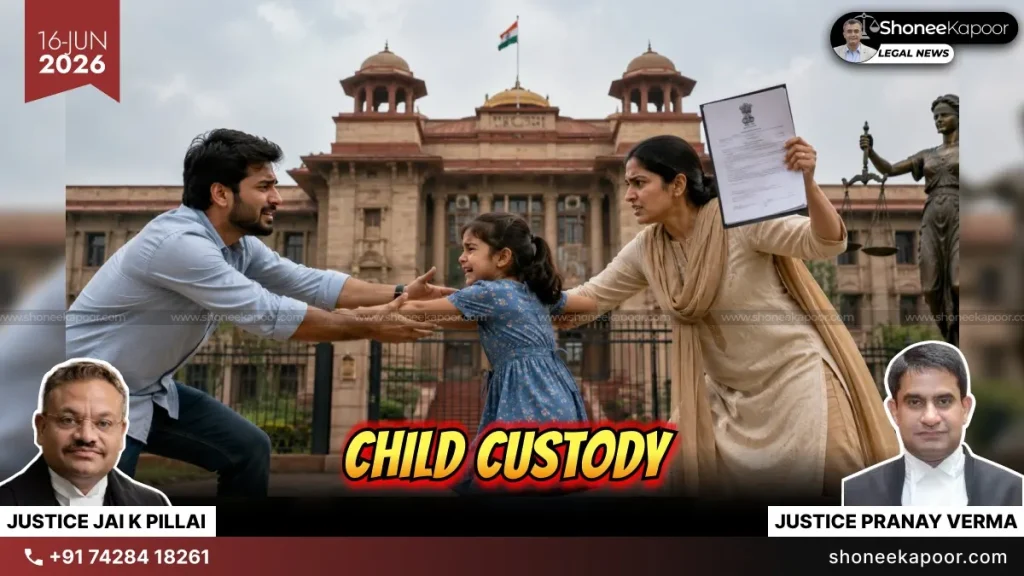
Does a child’s willingness to accompany one parent make that parent’s custody legal? The MP High Court held that even if the child willingly went with the father, continued custody cannot be treated as lawful in the absence of a valid court order.
JABALPUR: The Madhya Pradesh High Court at Jabalpur, comprising Justice Pranay Verma and Justice Jai Kumar Pillai, ordered that a seven-year-old girl child custody be immediately restored to her mother after finding that the father was keeping her without any legal custody order in his favour.
The case came before the Court through a habeas corpus petition filed by the mother. She approached the Court seeking the production and return of her minor daughter. According to the mother, her daughter had been living with her continuously since birth and had never stayed with the father, who was respondent No. 4 in the case.
The mother told the Court that on 27 May 2026, the father visited her residence in Jabalpur. The next day, he took the child with him on the pretext of spending some time with her and assured the mother that he would bring the child back shortly.
However, after taking the child, he did not return her and allegedly continued to keep the child in his custody against the mother’s wishes. Therefore, she requested the High Court to direct that the child be returned to her.
The father personally appeared before the Court. He did not deny that the child had been living with the mother ever since her birth. He also admitted that there was no court order granting him custody of the child. However, he argued that the child had voluntarily accompanied him to his house because she wanted to meet her grandmother. According to him, it was not a case of forceful abduction.
During the hearing, the child was produced before the Court by the State authorities. The judges personally interacted with the seven-year-old girl to understand her wishes. The Court recorded that the child clearly and firmly expressed her desire to stay with her mother.
The Court observed:
“The corpus is seven years of age and has unequivocally stated that she wishes to reside with her mother and does not wish to reside with respondent No.4.”
The judges further noted that even if the father’s explanation was accepted, it still could not justify his continued custody of the child because there was no legal order permitting him to keep her.
The Court stated:
“Even if the explanation of respondent No.4 is considered then also it cannot be said that he has obtained the custody of corpus legally which hence cannot be permitted to continue.”
Taking into account the child’s welfare, her long-standing residence with the mother, and her own clear preference, the High Court directed the State authorities to hand over the custody of the child to the mother on the same day.
At the same time, the Court also protected the father’s interests and ensured that his relationship with the child would not be completely disrupted. The judges directed that the mother should facilitate communication between the child and the father whenever he wished to speak with her.
The High Court also clarified that the father was free to pursue any remedies available to him under the law if he wished to seek custody or visitation rights through appropriate legal proceedings.
The Court observed:
“It shall also be open for the petitioner to resort to such legal remedies as may be available to him under the law in respect of the corpus.”
With these directions, the habeas corpus petition was disposed of.
EXPLANATORY TABLE: LAWS AND LEGAL PROVISIONS
| Law / Provision | Purpose | How Applied In This Case |
| Habeas Corpus Petition | A constitutional remedy used to produce a person alleged to be under illegal detention before the Court. | The mother approached the High Court seeking production and return of her minor daughter, alleging illegal custody by the father. |
| Article 226 of the Constitution of India | Gives High Courts power to issue writs, including habeas corpus, for enforcement of legal rights. | The Madhya Pradesh High Court exercised its extraordinary jurisdiction to examine whether the child’s custody was lawful. |
| Child Welfare Principle | The welfare and best interests of the child are the paramount consideration in custody matters. | The Court considered the child’s welfare, her continuous residence with the mother, and her expressed wishes. |
| Preference of the Child | Courts may consider the wishes of a child who is mature enough to express an informed preference. | The seven-year-old child clearly stated that she wanted to stay with her mother, which significantly influenced the decision. |
| Legal Custody Requirement | A parent claiming custody ordinarily requires legal authority or an appropriate court order. | Since the father had no custody order in his favour, the Court held that his continued custody could not be permitted. |
CASE DETAILS
- Case Title: PS v. State of Madhya Pradesh and Others
- Case Number: Writ Petition No. 19596 of 2026
- Court: High Court of Madhya Pradesh, Jabalpur Bench
- Date of Decision: 01 June 2026
- Neutral Citation: 2026:MPHC-JBP:40570
- Bench: Hon’ble Shri Justice Pranay Verma | Hon’ble Shri Justice Jai Kumar Pillai
- Counsels:
- For Petitioner: Shri Shashwat Awasthi
- For State: Shri Ajay Ojha, Government Advocate
- For Respondent No. 4: Shri Hemant Namdeo
KEY TAKEAWAYS
- In child custody disputes, fathers often find that habeas corpus petitions filed by them are treated as matters for Family Courts, while similar petitions by mothers are more readily entertained.
- The inconsistent approach in custody cases raises concerns about whether both parents truly receive equal access to urgent judicial remedies.
- Fathers cannot assume that their status as a biological parent will automatically translate into effective legal protection of their parenting rights.
- Men must proactively secure custody and visitation orders because delayed legal action can significantly weaken their position.
- Cases like these revive the larger debate on whether the family justice system applies the same standards to mothers and fathers when deciding emergency custody claims.
This Could Change Your Case-Get FREE Legal Advice-Click Here!
Disclaimer: The views and opinions expressed in this article are those of the Indian courts and do not necessarily reflect the official policy or position of “ShoneeKapoor.com” or its affiliates. This article is intended for informational and educational purposes only. The content provided is not legal advice, and viewers should not act upon this information without seeking professional counsel. Viewer discretion is advised.