
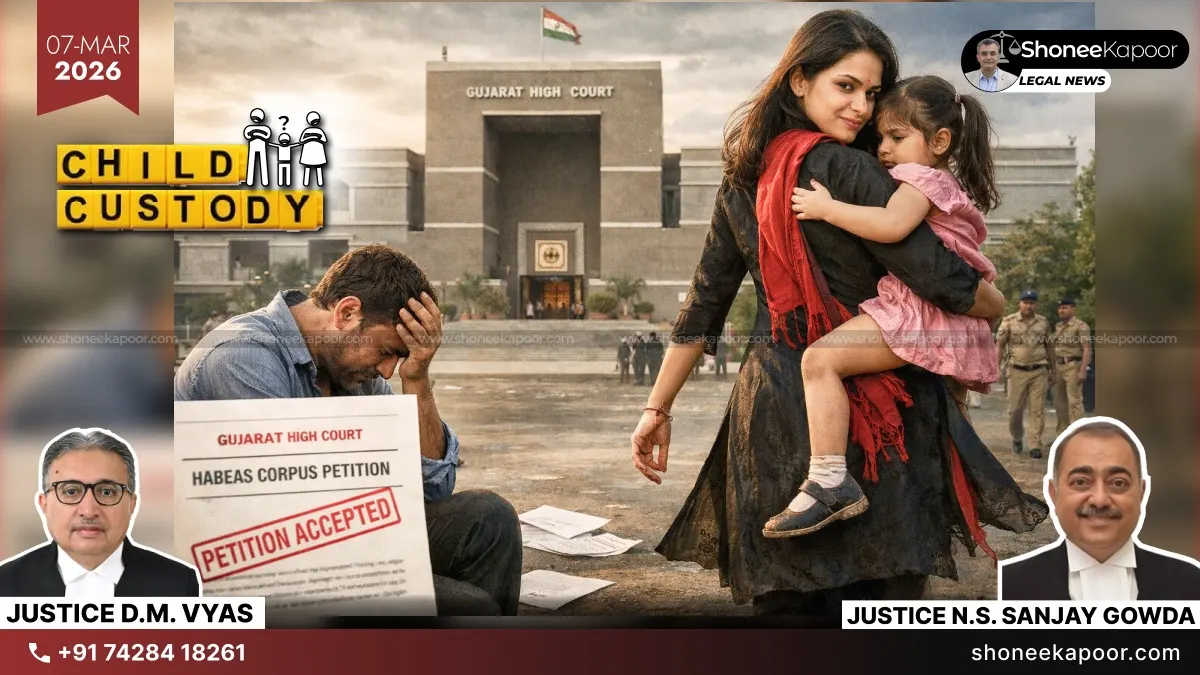
Child Custody | Mother’s Habeas Corpus Petition Allowed: Gujarat High Court Says Girl Child Below 5 Is Best Taken Care Of By Mother Only, Not Father

Written and analysed by Vaibhav Ojha
Head Of Legal CommunicationsThe Gujarat High Court allowed a mother’s habeas corpus petition for custody of her 4-year-old daughter, observing that a girl below five is best taken care of by the mother.
Such observations again raise a serious question—why do fathers repeatedly become the victims of this presumption and struggle to get equal consideration in child custody disputes?
AHMEDABAD: In an important custody dispute, the Gujarat High Court at Ahmedabad allowed a habeas corpus petition filed by a mother seeking custody of her four-year-old daughter.
The Bench of Justice N. S. Sanjay Gowda and Justice D. M. Vyas examined whether the father’s custody of the child could be considered lawful and whether the High Court could intervene through habeas corpus jurisdiction. The Court ultimately restored custody to the mother while granting the father limited visitation rights.
The case arose after marital disputes led to the couple’s separation in May 2024. The child had been living with the mother since then. Later, the father claimed that custody was voluntarily handed over to him under a separation deed executed in July 2025. The mother disputed this claim and alleged that her signature on the document had been obtained through fraud and pressure.
While examining whether the habeas corpus petition was maintainable in a custody dispute, the Court referred to settled Supreme Court principles and emphasized that:
“The High Court always has the discretion not to exercise the writ jurisdiction depending upon the facts of the case. It all depends on the facts of individual cases;”
The Court found that the separation deed relied upon by the father contained inconsistencies which made the document doubtful. It also noted that under the Hindu Minority and Guardianship Act, custody of a child below five years ordinarily remains with the mother.
The Court stated:
“The law, basically, recognizes that a girl child who is yet to complete 5 years of age can effectively and practically be taken care of only by the mother and not by the father.”
The Court further observed that the child had already spent more than a year continuously with the mother and a strong emotional bond had developed.
It further stated:
“Therefore, to separate the mother from her girl child, who is just about 4 years old, and who had been brought up only by the mother for about 1 year 2 months, would not be in the interest of the child and would cause trauma to the child.”
Considering these factors, the Gujarat High Court held that the father’s custody could not be treated as lawful and allowed the habeas corpus petition.
The Court restored custody of the four-year-old child to the mother while granting the father weekend visitation rights and liberty to approach the Family Court for appropriate custody proceedings.
Explainatory Table: Laws And Provisions Involved
| Law / Provision | Purpose | How Applied in This Case |
| Article 226 of the Constitution of India | Empowers High Courts to issue writs including Habeas Corpus for protection of fundamental rights and personal liberty | The mother approached the High Court under this provision seeking production and custody of her minor child |
| Writ of Habeas Corpus | A constitutional remedy used to challenge unlawful detention or custody of a person | The Court examined whether custody of the child with the father amounted to unlawful custody |
| Hindu Minority and Guardianship Act, 1956 – Section 6(a) | Defines natural guardians of a Hindu minor; generally father first, then mother | The proviso states that custody of a child below five years ordinarily remains with the mother |
| Hindu Minority and Guardianship Act, 1956 – Section 13 | Declares that the welfare of the minor shall be the paramount consideration in guardianship decisions | The Court relied heavily on this principle while deciding custody |
| Guardians and Wards Act, 1890 – Section 17 | Provides factors courts must consider while appointing guardians, especially the welfare of the minor | Reinforces that child welfare overrides parental claims |
| Hindu Marriage Act, 1955 – Section 13B | Governs divorce by mutual consent between spouses | A proposed mutual consent divorce petition between the parties indicated custody would change only after divorce |
Case Details
- Case Title: Kinjal D/o Hareshkumar Panchal v. State of Gujarat & Ors.
- Case Number: R/Special Criminal Application (Habeas Corpus) No. 471 of 2026
- Court: High Court of Gujarat at Ahmedabad
- Date of Judgment: 11 February 2026
- Neutral Citation: 2026:GUJHC:12448-DB
- Bench: Justice N. S. Sanjay Gowda & Justice D. M. Vyas
- Counsels:
- For Petitioner: Mr. Dharm K. Raval
- For Respondents (Private Parties): Mr. Hari K. Brahmbhatt
- For State: Mr. Chintan Dave, APP
Key Takeaways
- In child custody disputes, the welfare principle is often interpreted in a way that automatically favours the mother, leaving fathers struggling to prove their role as equal caregivers.
- The legal presumption that very young children must remain with the mother continues to influence decisions, even when fathers are capable and willing to raise their children.
- Fathers frequently face a higher burden of proof to establish lawful custody or meaningful parenting rights, while mothers’ claims are more readily accepted.
- Habeas corpus petitions filed by fathers for access to their children are often treated cautiously, whereas similar petitions by mothers are more likely to succeed.
- A fair custody system should evaluate parenting ability and the child’s best interests without gender bias, recognizing that a child needs both parents, not just one.
This Could Change Your Case-Get FREE Legal Advice-Click Here!
Disclaimer: The views and opinions expressed in this article are those of the Indian courts and do not necessarily reflect the official policy or position of “ShoneeKapoor.com” or its affiliates. This article is intended for informational and educational purposes only. The content provided is not legal advice, and viewers should not act upon this information without seeking professional counsel. Viewer discretion is advised.
Related Articles
Karisma Kapoor – Sunjay Kapur Case Explained: Marriage, Divorce, 498A, Death & the Delhi High Court Property War
From a celebrity wedding to IPC 498A allegations, a Supreme Court-linked divorce settlement, and now a Delhi High Cou...
How to get Child Custody as a Father in India: Laws, Strategy & Complete Guide
Indian law does not give automatic custody to the mother. A father can legally get child custody if he proves the “We...

Child Custody Legal Guide: Can School Remove Father’s Name From Records?
Can a school remove a biological father’s name from child records after divorce or custody dispute? Read Indian law, ...
Share Your Thoughts
Comments are moderated before publication.