
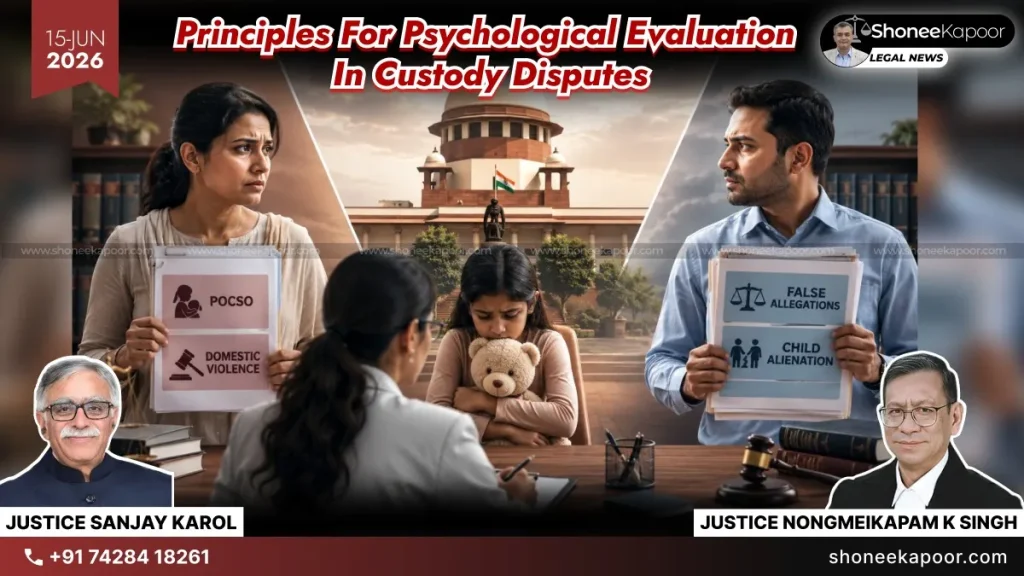
The Supreme Court ruled that a child cannot become an object of continuous forensic scrutiny in litigation between parents, especially when allegations under the POCSO Act are pending.
NEW DELHI: The Supreme Court Bench of Justice Nongmeikapam Kotiswar Singh and Justice Sanjay Karol has held that children caught between bitter child custody battles and allegations of sexual abuse should not become victims of the legal process itself.
The Court said that while parents may fight over visitation rights and custody, the child’s welfare, dignity and mental health must remain the most important consideration.
The case involved the parties, who married in 2015 and later moved to the United States. Their daughter was born in New Jersey in 2016. According to the mother, she suffered physical abuse during the marriage and the child was sexually abused by her father when she was around two years old. After an alleged domestic violence incident in December 2019, she returned to India with the child.
The father denied all allegations and claimed that the accusations were made because of matrimonial disputes. He repeatedly sought access to his daughter and requested that an independent child psychologist assess the child so that the father-daughter relationship could be restored.
However, the mother opposed the request, arguing that the child was already undergoing therapy and that serious criminal proceedings under the POCSO Act were pending against the father. She feared that forcing the child to repeatedly interact with experts would worsen her trauma.
The Family Court in Pune agreed with the mother’s concerns and refused to appoint an independent psychiatrist. But the Bombay High Court later directed that an independent expert be appointed. It subsequently modified its own order and changed the direction from one expert to a “panel of experts“. Eventually, a four-member panel, including experts suggested by the father and one expert based abroad, was constituted to evaluate the child.
The mother then approached the Supreme Court.
The Supreme Court said this dispute was not just about custody or visitation. It involved a child who was already living through parental separation and was also an alleged victim in a pending POCSO case. Therefore, courts had an even greater responsibility to ensure that the judicial process itself did not become another source of suffering.
Quoting Nelson Mandela, the Court observed:
“There can be no keener revelation of a society’s soul than the way in which it treats its children”
The judges noted that the POCSO Act was designed not only to punish child sexual abuse but also to ensure that children are protected from further emotional harm during legal proceedings.
The Court observed:
“The significance of the POCSO Act lies not merely in the creation of substantive offences relating to child sexual abuse, but equally in its recognition that the justice delivery process itself must remain child-sensitive, trauma-informed, child friendly and protective of the psychological well-being of the child victim.”
The Court said that repeated exposure to investigations, evaluations and legal procedures can itself become traumatic for children.
“The statutory framework, when viewed holistically, thus reveals a consistent legislative intent to ensure that legal procedures involving child victims are child friendly and do not themselves become stressful and instruments of psychological distress.”
The judges found that the Bombay High Court had failed to examine how repeated interactions with four different experts could affect the child emotionally.
The Court pointed out that the High Court had not explained why one expert was insufficient, why four experts were necessary, or how such a process would protect the child from further emotional harm.
“The primary consideration before the Court ought to have been the likely impact such modification may have upon the child herself.”
The Supreme Court also expressed concern that most of the experts had been suggested by the father, who was facing allegations under the POCSO Act. It said that any assessment process involving children must remain neutral and child-centric.
“The child must not be placed in a position where the evaluative process assumes the appearance of an adversarial inquiry intended to validate or discredit allegations made against either parent.”
At the same time, the Court clarified that judges are not completely barred from seeking psychological assistance in custody disputes merely because a POCSO case is pending. However, such assistance must be sought carefully and only when genuinely required.
While balancing the rights of parents with the interests of children, the Supreme Court laid down important safeguards that courts must follow in future cases involving similar disputes.
The Supreme Court Guidelines:
• Psychological evaluations of children should not be ordered routinely and must be based on genuine necessity.
• Courts must follow the principle of minimum intrusion and avoid exposing children to repeated interactions that may re-traumatise them.
• Any evaluation process must maintain institutional neutrality and should not appear to support the case of either parent.
• Children should not be treated as evidence or subjected to repeated forensic scrutiny merely because parents are litigating.
• The emotional safety and psychological integrity of the child must remain paramount throughout the proceedings.
• Courts must distinguish between therapeutic intervention meant to help the child heal and litigation-driven assessments aimed at strengthening one parent’s case.
• Before directing further assessment of the child, courts should first consider assessing the psychological condition of the parents.
• Allegations of parental alienation should not be accepted casually without identifying specific instances of “alienating behaviour”.
The Court held:
“However, where such assistance is considered necessary, the process adopted by the Court must satisfy the requirements of demonstrable necessity, minimum intrusion, institutional neutrality, proportionality, and paramount consideration of the psychological well-being of the child.”
The Supreme Court eventually modified the Bombay High Court’s directions. It ordered that a court-appointed psychologist should first assess the mental and psychological condition of both parents. The psychologist should then interact with the therapist already treating the child and submit a report to the Family Court. Only after considering these reports should the Family Court decide whether any direct assessment of the child is necessary.
The Supreme Court also addressed the issue of parental alienation, a concept often raised in custody disputes. It cautioned courts against casually accepting such allegations without concrete evidence.
In the end, the Supreme Court made it clear that the “best interest of the child” extends beyond deciding who gets custody or visitation rights. It also governs the manner in which courts interact with children throughout the proceedings.
With this judgment, the Supreme Court has reinforced that judicial sensitivity is just as important as judicial fairness. Children trapped in family disputes must be protected not only from abuse but also from legal processes that may unintentionally deepen their emotional wounds.
EXPLANATORY TABLE: LAWS AND SECTIONS INVOLVED
| Law / Section | Purpose | How It Applied in This Case |
| Sections 376 & 376(2)(n) IPC | Punishment for rape and repeated rape | FIRs were registered against the father based on allegations of sexual abuse of the child. |
| Section 323 IPC | Punishment for voluntarily causing hurt | Invoked in the FIR arising from the allegations. |
| Section 504 IPC | Intentional insult with intent to provoke breach of peace | Included in the criminal case against the father. |
| Section 506 IPC | Criminal intimidation | Invoked in the FIR based on alleged threats. |
| Section 4, POCSO Act | Punishment for penetrative sexual assault | Applied due to allegations of sexual abuse of the minor child. |
| Section 5(l), POCSO Act | Aggravated penetrative sexual assault by a relative | Invoked because the accused was the child’s father. |
| Section 5(n), POCSO Act | Aggravated penetrative sexual assault in specified circumstances | Included in the FIR against the father. |
| Section 6, POCSO Act | Punishment for aggravated penetrative sexual assault | Prescribes punishment for offences under Section 5. |
| Section 24, POCSO Act | Child-friendly recording of statements | Supreme Court relied on this provision to emphasise trauma-sensitive procedures. |
| Section 33(5), POCSO Act | Child should not be repeatedly called during proceedings | Used to highlight the principle against repeated exposure and re-traumatisation. |
| Section 36, POCSO Act | Child should not be exposed to the accused during proceedings | Reinforced the need to protect the child’s psychological safety. |
| Section 39, POCSO Act | Support services and expert assistance for child victims | Highlighted the welfare-oriented approach of the POCSO framework. |
| Sections 12 & 17–23, Domestic Violence Act, 2005 | Protection and reliefs for victims of domestic violence | Proceedings were initiated by the mother in Pune. |
| Section 13(1)(ia), Hindu Marriage Act, 1955 | Divorce on the ground of cruelty | Invoked by the mother in matrimonial proceedings. |
| Section 13(1)(ib), Hindu Marriage Act, 1955 | Divorce on the ground of desertion | Also invoked in the divorce proceedings. |
| Section 151 CPC | Inherent powers of the Court | Father sought appointment of an independent expert under this provision. |
| Section 12, Family Courts Act, 1984 | Court’s power to secure assistance of experts | Supreme Court explained that Family Courts may seek expert assistance, but cautiously. |
CASE DETAILS
- Case Title: Sheetal Vasant Thakur v. Chirag Arora
- Court: Supreme Court of India
- Neutral Citation: 2026 INSC 638
- Case Number: Civil Appeal arising out of SLP (Civil) Nos. 18701-18702 of 2024)
- Date of Judgment: 11.06.2026
- Bench: Justice Nongmeikapam Kotiswar Singh | Justice Sanjay Karol
- Originating Court: High Court of Judicature at Bombay
KEY TAKEAWAYS
- Allegations alone cannot justify endless psychological scrutiny of a child. Courts must balance child welfare with fairness to the accused parent.
- Claims of “parental alienation” cannot be accepted at face value. Courts must look for specific evidence instead of assumptions.
- A Father facing allegations is not automatically shut out from seeking access or visitation rights. Due process still applies.
- Family Courts should assess the psychological condition of both parents, not place the entire burden of evaluation on the child.
- Custody battles should not become tools for litigation warfare. The child’s welfare is paramount, but judicial processes must also remain neutral, evidence-based and free from prejudice against either parent.
This Could Change Your Case-Get FREE Legal Advice-Click Here!
Disclaimer: The views and opinions expressed in this article are those of the Indian courts and do not necessarily reflect the official policy or position of “ShoneeKapoor.com” or its affiliates. This article is intended for informational and educational purposes only. The content provided is not legal advice, and viewers should not act upon this information without seeking professional counsel. Viewer discretion is advised.