
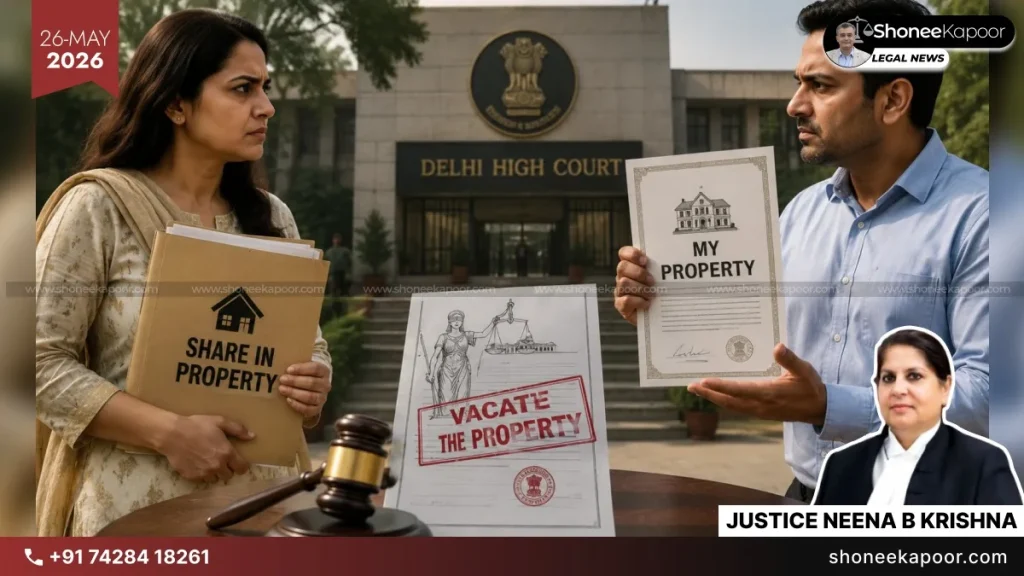
Can family use of property override a registered sale deed if the property was allegedly bought from family funds?
Delhi High Court held that mere claims of family contribution or joint family money cannot invalidate clear legal ownership when the Sale Deed has never been challenged before a court.
NEW DELHI: The Delhi High Court, through Justice Neena Bansal Krishna, dismissed an appeal filed in a dispute over a residential property situated in Mandakini Enclave, Alaknanda, New Delhi. The High Court upheld the earlier judgment directing the occupants (sister and her husband) to vacate the property and hand over possession to its legal owners.
As per the case, the occupants had returned from Australia in January 2020 and were allowed to stay in the property temporarily so they could spend time with their elderly mother. According to the owners, the arrangement was made purely out of family goodwill and humanitarian consideration. However, after the death of the mother in June 2020, the occupants allegedly refused to vacate the property despite repeated requests.
It was argued before the Court that the occupants were only-
“Bare licensee without any charges being the real sister and brother-in-law of Plaintiff No.1.”
The dispute later escalated after disagreements arose regarding family properties, jewellery and alleged family arrangements.
The occupants argued that the property had actually been purchased using joint family funds and therefore could not be treated as the exclusive property of the registered owners. It was also claimed that there was a family settlement under which the property was supposed to be transferred in their favour.
However, the High Court noted that the property stood in the names of the owners through a registered Sale Deed dated 20.11.2009. The Court also observed that one of the occupants herself was an attesting witness to the Sale Deed and had never challenged it before any court.
Justice Neena Bansal Krishna observed that:
“The Sale Deed which has never been challenged, clearly reflects the exclusive ownership of the Respondents in the Suit property.”
The Court further noted that the only defence raised was that the property had been purchased from joint family funds, but no legal challenge had ever been made against the Sale Deed itself.
The High Court clarified that disputes regarding alleged family settlement, partition or claims over joint family assets can be decided separately in the pending partition proceedings. However, such claims cannot prevent registered owners from seeking possession of the property in the present proceedings.
The judgment stated that:
“The present Suit is confined solely to recovery of Possession on account of the Sale Deed in the name of the Plaintiffs.”
The Court also found that there was no genuine triable issue requiring a full trial because the ownership documents were clear and undisputed.
The High Court further held that:
“There is no challenge to the Sale Deed being in the name of the Plaintiffs.”
Dismissing the appeal, the Court concluded that:
“The Decree of Possession under Order XII Rule 6 CPC has been rightly made by the learned District Judge.”
Accordingly, the High Court upheld the order directing the occupants to vacate the property and hand over possession to the legal owners.
Explanatory Table: Laws And Provisions Involved
| Law / Section | Purpose | Relevance In This Case |
| Section 96 CPC | Gives a party the right to file a First Appeal against a civil court decree | The appeal before the High Court was filed under this provision |
| Order XII Rule 6 CPC | Allows a court to pass judgment based on clear admissions made by parties | The possession decree was passed because ownership admissions were clear |
| Mandatory Injunction | A court order directing a person to do a specific act | Used to seek directions for vacating the property |
| Permanent Injunction | Restrains a person from interfering with another’s legal rights | Sought to prevent interference with possession and ownership |
| Damages / Mesne Profits | Compensation claimed for unauthorized occupation of property | Monthly damages were sought for continued occupation |
| Section 4 Benami Transactions (Prohibition) Act | Prevents claims that property is held benami for someone else | The “joint family funds” defence was rejected relying on this principle |
| Partition Suit | A civil suit seeking division of family or jointly claimed property | Separate partition proceedings between family members were already pending |
| Registered Sale Deed | Legal ownership document for immovable property | Main document proving ownership of the property |
| Possession Rights | Legal right to occupy and control a property | Registered owners sought recovery of possession |
| Family Settlement | Arrangement between family members regarding division of assets | Defendants relied on an alleged family settlement to claim rights |
| Joint Family Property | Property claimed to belong collectively to family members | Defendants argued the property was purchased from joint family funds |
| Triable Issue | A genuine dispute requiring full trial and evidence | Court held no real triable issue existed due to clear ownership documents |
Case Details
- Case Title: Ms. Anju Chadha & Anr. vs. Bhavesh Madan & Anr.
- Case Number: RFA 70/2024 with CM APPL. 5115/2024
- Court: High Court of Delhi at New Delhi
- Bench: Hon’ble Ms. Justice Neena Bansal Krishna
- Neutral Citation: 2026:DHC:2888
- Date Of Judgment: 07 April 2026
- Counsels:
- For Appellants: Mr. Rishi Bharadwaj, Advocate
- For Respondents: Mr. Rajesh Mahindru and Mr. Birender Chaudhary, Advocates
Key Takeaways
- A sister cannot keep occupying a property forever just by claiming it was bought from “family money” when the registered Sale Deed stands in the brother’s name.
- Emotional family relationships do not override legal ownership. Courts look at documents, not family pressure or verbal claims.
- False or exaggerated ownership claims inside family disputes often become tools to pressure and harass legal owners.
- Staying in a brother’s house out of goodwill does not automatically create ownership or permanent rights over the property.
- Documentary ownership and legal title prevail over emotional narratives and unsupported claims.
This Could Change Your Case-Get FREE Legal Advice-Click Here!
Disclaimer: The views and opinions expressed in this article are those of the Indian courts and do not necessarily reflect the official policy or position of “ShoneeKapoor.com” or its affiliates. This article is intended for informational and educational purposes only. The content provided is not legal advice, and viewers should not act upon this information without seeking professional counsel. Viewer discretion is advised.