
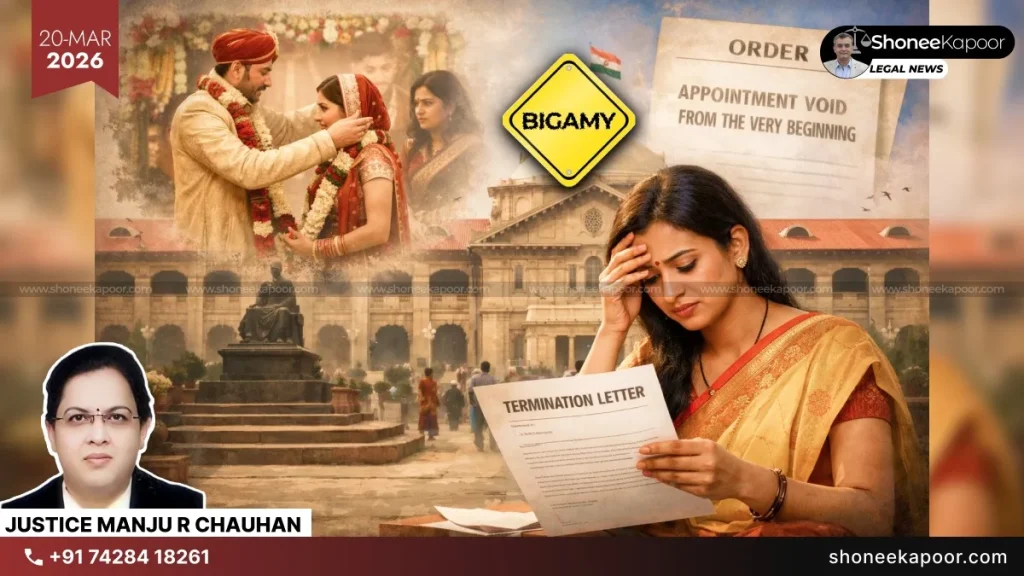
If the bigamous marriage happened before the job, can it still be treated as misconduct & bigamy later? Court says NO misconduct, but then why does the appointment itself collapse?
PRAYAGRAJ: The Allahabad High Court, in a judgment dated January 6, 2026, delivered by Justice Manju Rani Chauhan, dealt with a case where a woman teacher was removed from service because she had married a man whose first wife was still alive. The Court clarified that the issue was not misconduct during service, but eligibility at the time of appointment.
The petitioner was appointed as an Assistant Teacher in 2015, while her marriage had taken place in 2009. A complaint later led to her termination without a proper inquiry, which she challenged as illegal.
The Court clearly held that service conduct rules apply only after a person enters government service and cannot be used for actions that happened before appointment. It emphasized that any punishment without an employer-employee relationship is not valid in law.
The judge categorically observed:
“The disciplinary jurisdiction under the 1999 Rules can be invoked only when the relationship of employer and employee subsists. In the absence of such a relationship, initiation of disciplinary proceedings or imposition of punishment would be wholly without authority of law and unsustainable.”
The Court further clarified that the real issue is eligibility, not misconduct. It stated:
“Rule 12 of the Rules of 1981 does not prescribe any punishment. It merely stipulates a condition of eligibility. If such condition is violated, the appointment itself becomes void ab initio.”
Explaining the difference, the Court noted:
“A clear distinction must be drawn between: (i) ineligibility at the threshold of appointment; (ii) misconduct committed by a government servant after entering service.”
It also made it clear that punishment cannot be imposed unless the act is defined as misconduct, observing:
“Punishment can be imposed only when an act falls within the ambit of misconduct as defined under the applicable Conduct Rules.”
Finally, the High Court set aside the termination order dated 12.11.2025 and sent the matter back to the District Basic Education Officer, Mau, for a fresh decision in accordance with law after issuing a show-cause notice and giving the petitioner an opportunity of hearing.
At the same time, the Court made it clear that the core issue is not departmental misconduct but her ineligibility for appointment under Rule 12, since she had married a man whose first marriage was still subsisting.
The Court also clarified that such an appointment may be treated as void from the very beginning because the statutory disqualification existed at the time of entry into service itself.
Explanatory Table: Laws And Provisions Involved
| Law / Provision | Purpose | How applied in this case |
| Rule 3, U.P. Government Servant’s Conduct Rules, 1956 | Requires integrity and proper conduct from a government servant | Applied only after joining service; cannot be used for acts before appointment |
| Rule 29, U.P. Government Servant’s Conduct Rules, 1956 | Regulates bigamy for government servants and prescribes minimum punishment | Held inapplicable as marriage happened before entering service |
| Section 6, U.P. Basic Education Act, 1972 | Allows appointment of teachers and staff | Used to explain legal basis of appointment structure |
| Section 19, U.P. Basic Education Act, 1972 | Gives power to frame service rules | Basis for validity of 1981 Rules governing eligibility |
| Rule 12, U.P. Basic Education (Teachers) Service Rules, 1981 | Fixes marital eligibility for appointment | Central rule; made the petitioner ineligible at the time of appointment |
| U.P. Government Servants (Discipline and Appeal) Rules, 1999 | Governs disciplinary action against employees | Can be used only when employment relationship exists |
| Articles 14 & 16, Constitution of India | Ensure equality and prevent arbitrary action | Used to show action without valid service relationship is illegal |
Case Details
- Case Title: Smt Reena v. State of U.P. and 4 others
- Case Number: Writ – A No. – 18923 of 2025
- Court: High Court of Judicature at Allahabad
- Bench: Hon’ble Justice Manju Rani Chauhan
- Neutral Citation: 2026:AHC:1477
- Date of Judgment: January 06, 2026
- Counsels:
- For Petitioner: Grijesh Tiwari
- For Respondent: Ajay Kumar Yadav, C.S.C., Shashi Prakash Singh, and Shiv Bahadur Singh
Key Takeaways
- If a person is legally ineligible at the time of appointment, the appointment itself is void from the very beginning, and the issue must be addressed at its root.
- When marital facts are hidden, it is not just a technical defect; it leads to prolonged legal and social complications.
- Ineligibility at the stage of entry is fundamentally different from misconduct during service and must be treated accordingly.
- Even when an appointment is flawed from day one, authorities sometimes adopt the wrong legal route, causing unnecessary delay and confusion.
- Lack of transparency in relationships, especially involving subsisting marriages, results in disputes that ultimately revolve around void appointments rather than misconduct.
This Could Change Your Case-Get FREE Legal Advice-Click Here!
Disclaimer: The views and opinions expressed in this article are those of the Indian courts and do not necessarily reflect the official policy or position of “ShoneeKapoor.com” or its affiliates. This article is intended for informational and educational purposes only. The content provided is not legal advice, and viewers should not act upon this information without seeking professional counsel. Viewer discretion is advised.