
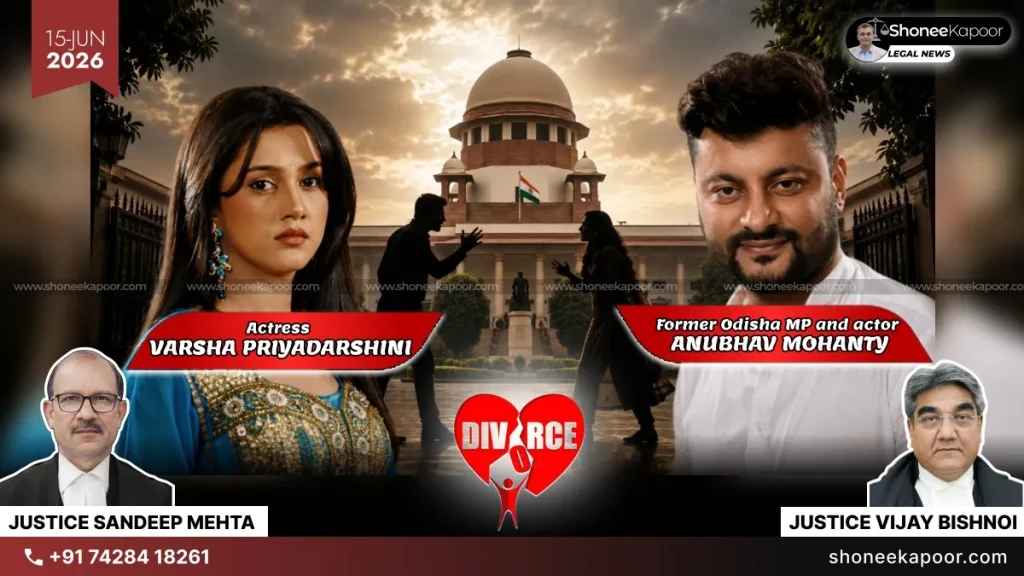
Did a broken marriage turn into years of criminal litigation for an entire family? Or is there more to the story than the allegations suggest? The Supreme Court has now stepped in and sought responses on former Odisha MP and actor Anubhav Mohanty’s plea to quash the criminal case filed by his ex-wife.
NEW DELHI: The Supreme Court Today (June 15th) issued notice on a plea filed by former Odisha MP and actor Anubhav Mohanty seeking quashing of criminal proceedings initiated against him and his family by his ex-wife in a matrimonial dispute.
A Bench of Justices Sandeep Mehta and Vijay Bishnoi sought responses from the State of Odisha and other respondents on Mohanty’s Special Leave Petition challenging the Orissa High Court judgment that had refused to discharge him from the criminal case.
Advocates RD Singh, Vaibhav Nijhawan and Divya Tripathi of Tripaksha Litigation appeared for the former MP. The petition was filed through Advocate-on-Record Ashish Choudhury and challenges the Orissa High Court’s order dated January 30, 2026, which upheld the trial court’s refusal to discharge Mohanty and his family members from offences alleged in FIR No. 276/2020 registered at Purighat Police Station, Cuttack.
Anubhav Mohanty and his former wife, both prominent names in the Odia film industry, got married in 2014. According to the petition, the marriage was never consummated and eventually broke down beyond repair.
Mohanty has stated that he filed for divorce before the Patiala House Courts in New Delhi in July 2020. He alleges that multiple legal proceedings followed thereafter, including a domestic violence complaint and other police complaints initiated by his former wife.
The criminal case presently under challenge arose from a complaint lodged in December 2020 alleging offences under Sections 498-A, 506, 341 and other provisions of the Indian Penal Code.
Before the Supreme Court, Mohanty argued that the criminal proceedings were initiated “with the sole ulterior motive of wreaking vengeance” upon him and his family.
The plea further states that the allegations are “wholly baseless, vague, omnibus in nature and devoid of any cogent material or specific particulars” and contends that the dispute is fundamentally matrimonial in nature.
It further submits, “The criminal law has been invoked as a tool of harassment and arm-twisting in what is essentially a civil and matrimonial dispute,” highlighting concerns that criminal prosecution should not become a means of pressure in family conflicts without proper scrutiny.
Mohanty has also alleged that the investigating officer ignored material supplied by him during the investigation and mechanically added additional offences while filing the charge sheet.
The petition relies on subsequent developments in connected proceedings. In December 2023, Mohanty obtained a decree of divorce from the Orissa High Court on the grounds of cruelty and non-consummation of marriage.
It also points to an April 2025 order in which a Magistrate court dismissed the domestic violence complaint filed by his former wife, observing that she had failed to establish any act of domestic violence and had not produced medical evidence supporting allegations of assault.
Challenging the Orissa High Court’s refusal to discharge him, Mohanty has argued that the criminal revision petition was dismissed in a “mechanical manner” without examining the ingredients of the alleged offences or properly considering the surrounding facts and evidence.
He has sought quashing of the criminal proceedings arising out of FIR No. 276/2020 and has also requested an interim stay on further proceedings before the trial court.
When the matter came up before the Bench of Justices Sandeep Mehta and Vijay Bishnoi on June 15, 2026, the Supreme Court issued notice and sought responses from the respondents.
The case will now be taken up for further consideration after replies are filed.
EXPLANATORY TABLE: LAWS AND SECTIONS MENTIONED
| SECTION | PROVISION | WHAT IT DEALS WITH | HOW IT APPLIES IN THIS CASE |
| Section 498-A IPC | Cruelty by Husband or Relatives | Penalises cruelty inflicted upon a married woman by her husband or his relatives. | One of the principal offences alleged against Anubhav Mohanty and his family in FIR No. 276/2020. |
| Section 506 IPC | Criminal Intimidation | Punishes threats intended to cause alarm or compel a person to act against their will. | The complainant alleged intimidation by the accused persons. |
| Section 341 IPC | Wrongful Restraint | Punishes unlawful obstruction preventing a person from proceeding in a lawful direction. | Included among the allegations made in the FIR. |
| Protection of Women from Domestic Violence Act, 2005 | Domestic Violence Proceedings | Provides civil remedies for women alleging domestic violence. | A separate complaint filed by the ex-wife was dismissed by the Magistrate Court in April 2025. |
| Special Leave Petition (Article 136, Constitution of India) | Supreme Court’s Discretionary Jurisdiction | Allows the Supreme Court to hear appeals against judgments of lower courts. | Mohanty invoked this jurisdiction to challenge the Orissa High Court order. |
| Discharge Proceedings (CrPC) | Seeking Release from Criminal Trial | Enables an accused to seek discharge if sufficient grounds to proceed are absent. | Mohanty sought discharge from the criminal case, which was refused by both the trial court and the High Court. |
CASE DETAILS
- Case Title: Anubhav Mohanty v. State of Orissa
- Bench: Justice Sandeep Mehta & Justice Vijay Bishnoi
- Hearing Date: 15 June 2026
COUNSELS
- For the Petitioner (Anubhav Mohanty): Tripaksha Litigation – Advocate R.D. Singh, Advocate Vaibhav Nijhawan & Advocate Divya Tripathi
- Advocate-on-Record: Ashish Choudhury
KEY TAKEAWAYS
- Criminal law should not become a pressure tactic in matrimonial disputes.
- An allegation against a husband cannot automatically justify prosecuting his entire family.
- Subsequent court findings dismissing related allegations deserve serious consideration.
- The process itself can become punishment when trials continue despite questionable evidence.
- Due process protects everyone. Men, too, deserve fairness, scrutiny of allegations, and equal justice.
This Could Change Your Case-Get FREE Legal Advice-Click Here!
Disclaimer: The views and opinions expressed in this article are those of the Indian courts and do not necessarily reflect the official policy or position of “ShoneeKapoor.com” or its affiliates. This article is intended for informational and educational purposes only. The content provided is not legal advice, and viewers should not act upon this information without seeking professional counsel. Viewer discretion is advised.