
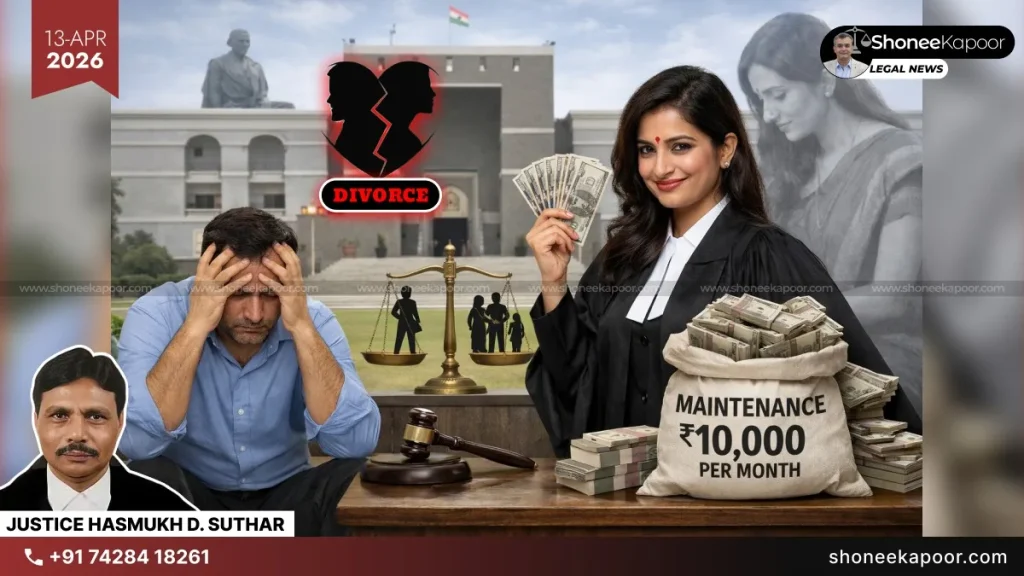
The Gujarat High Court, while considering the husband’s remarriage and additional responsibilities, still maintained his obligation towards his practising advocate ex-wife.
If a legally divorced man remarries and has a second family, why does his financial burden still remain unchanged?
AHMEDABAD: The Gujarat High Court, in a judgment delivered by Justice Hasmukh D. Suthar, dealt with a maintenance dispute where the wife demanded an increase from ₹10,000 to ₹25,000 per month, while the husband had already failed in his attempt to challenge the same order earlier.
The marriage had broken down long ago, and the wife had been living separately since 2016 after signing a divorce deed. She approached the court claiming that her husband, who was involved in singing and organizing musical shows, was earning handsome income and therefore the maintenance awarded by the Family Court was too low.
On the other hand, the husband claimed limited income, stating he earned only ₹200–₹250 per day. However, the court did not accept this claim at face value and instead assessed his income at around ₹30,000–₹33,000 per month by applying the “able-bodied” principle. The court also noted that the husband had remarried and had additional responsibilities towards his second wife and child.
Despite the wife being legally qualified and even practicing as an advocate, the court clearly stated that:
“Merely because the applicant possesses an LL.B. degree cannot be a ground to refuse maintenance”.
This shows that even when a woman has professional qualifications, the burden of maintenance on the husband continues.
The court further reinforced a long-standing legal position by observing that “a divorced wife is also entitled to maintenance” and emphasized that maintenance is not just a moral duty but a legal obligation. It went on to state that “it is the duty of the husband to maintain his wife” and that such responsibility continues irrespective of the marital status after divorce.
The court held that:
“The husband cannot escape from his liability to maintain his wife or children because it is the legal and ethical duty of the husband to maintain them”.
The judgment also clarified that the husband:
“Cannot shirk his responsibility as husband as well as father to maintain his legally wedded wife and children”
This reinforces that such liability is not easily reduced or removed even when circumstances are disputed.
The Court further emphasized the wife’s entitlement to a similar standard of living:
“Would be entitled to the same standard of living, which they were enjoying while living with them”
After reviewing all facts, the court found no error in the Family Court’s decision and concluded that ₹10,000 per month, which is approximately one-third of the husband’s assessed income, was “just and proper”. The request to increase maintenance was therefore rejected.
Explanatory Table: Laws & Provisions Involved
| Section 125 Cr.P.C. | Provides maintenance to wife, children, or parents if they cannot maintain themselves | Wife filed case under this section seeking maintenance |
| Section 127 Cr.P.C. | Allows modification of maintenance if circumstances change | Court allowed future modification if situation changes |
| Principle of “Able-Bodied Man” | Court assumes a man can earn if physically capable, even without proof of income | Husband’s income estimated at ₹30–33k despite his claim of low earnings |
| Social Welfare Principle | Maintenance laws are meant to protect dependents financially | Court prioritized wife’s financial security over husband’s claims |
| Supreme Court Precedent: Bhuwan Mohan Singh vs Meena (2015) | Husband has continuous legal duty to maintain wife | Used to reinforce that liability continues even after disputes |
| Revisional Jurisdiction Principle (Amit Kapoor vs Ramesh Chander, 2012) | High Court interferes only if there is serious legal error | Court refused to interfere as no “miscarriage of justice” was found |
Case Details
- Case Title: Dhruti Vinubhai Dodiya vs State of Gujarat & Anr.
- Court: Gujarat High Court
- Case Number: R/Criminal Revision Application No. 616 of 2022
- Bench: Hon’ble Mr. Justice Hasmukh D. Suthar
- Neutral Citation: 2026:GUJHC:24635
- Date of Judgment: 06/04/2026
- Counsels:
- For Applicant (Wife): Maulik H. Vaghela, and Ms. Khushbu M. Amlani
- For Respondent No. 2 (Husband): Mr. Yash H. Joshi
- For State: Ms. Shruti Pathak, APP
Key Takeaways
- Courts continue to impose maintenance based on assumed earning capacity, not actual proven income, placing men at a disadvantage.
- Even after divorce, a man’s financial liability does not end, reinforcing one-sided obligations under law.
- Professional qualification or earning ability of the wife is not treated as sufficient ground to deny or reduce maintenance.
- The “able-bodied” principle allows courts to fix income arbitrarily, ignoring real financial hardship faced by men.
- Judicial approach prioritizes theoretical duty over ground realities, ensuring liability on men remains constant regardless of circumstances.
This Could Change Your Case-Get FREE Legal Advice-Click Here!
Disclaimer: The views and opinions expressed in this article are those of the Indian courts and do not necessarily reflect the official policy or position of “ShoneeKapoor.com” or its affiliates. This article is intended for informational and educational purposes only. The content provided is not legal advice, and viewers should not act upon this information without seeking professional counsel. Viewer discretion is advised.