
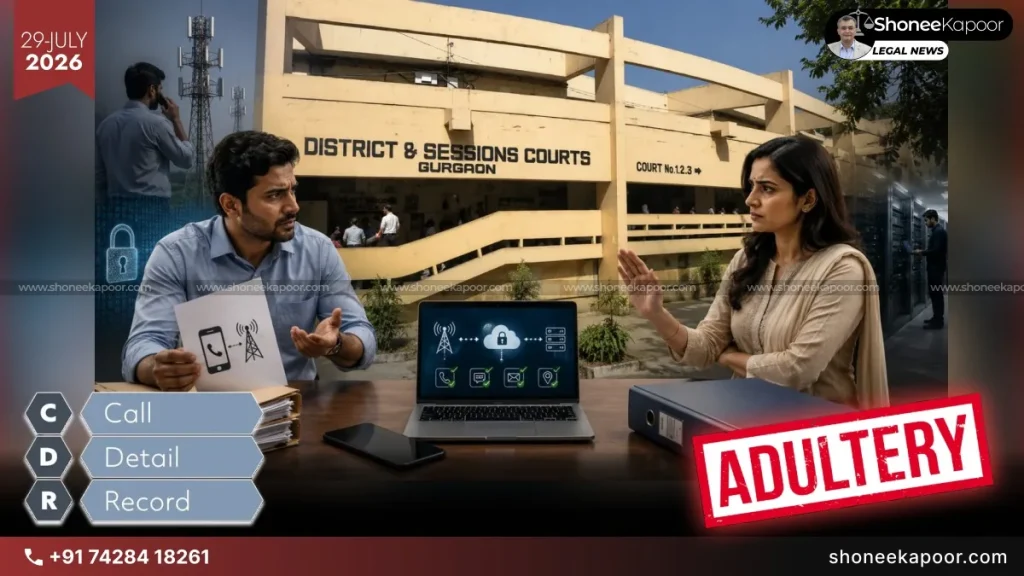
Can a Family Court direct telecom companies to preserve a wife’s call records and tower location on the husband’s allegation of adultery? The Court answered while protecting electronic evidence from being permanently deleted.
GURUGRAM: The Family Court at Gurugram has directed telecom service providers to preserve call detail records, tower locations and connected electronic data relating to the mobile numbers of the respondents.
The order was passed by Poonam Kanwar, Additional Principal Judge, Family Court, Gurugram, on 27 July 2026 in HMA No. 1521 of 2025.
The husband had moved an application seeking directions for the preservation of the Call Detail Records, commonly known as CDRs, of the respondents’ mobile numbers.
His counsel informed the Court that if the application was not decided immediately, his valuable right to produce evidence could be seriously affected. It was submitted that CDRs and other connected electronic records are retained by telecom companies only for a limited period and may later be automatically deleted.
The husband argued that these electronic records were necessary for the proper decision of the matrimonial dispute.
The respondent’s main counsel was not available on the date of hearing. However, the proxy counsel appeared and strongly opposed the husband’s application.
It was argued on behalf of the respondent that the application had been filed only to delay the matrimonial proceedings and should therefore be dismissed.
After hearing both sides and examining the case record, the Court clarified that it was not deciding whether the husband’s allegations of adultery were true or false at this stage.
The Court considered only the limited question of whether the electronic evidence could be lost because of the passage of time.
The Court noted that telecom service providers retain call detail records only for a limited duration. If preservation was not ordered immediately, the relevant records could be destroyed during the normal course of business.
Such destruction could cause irreparable prejudice to the husband and could also deprive the Court of evidence that may later become relevant for deciding the case.
The Court held that its inherent powers under Section 151 of the Code of Civil Procedure could be exercised to protect material evidence and secure the ends of justice.
It further clarified that preserving the records did not mean that their contents were being disclosed at this stage.
Questions concerning the relevance, admissibility and actual production of those records would be independently considered at the appropriate stage of the proceedings.
The Court also observed that necessary safeguards could be applied if any future request was made for the production or disclosure of the records.
It made clear that whether the husband’s allegations would ultimately be proved was a matter of evidence and could not be conclusively decided while hearing a preliminary preservation application.
The Court therefore allowed the husband’s application.
The concerned nodal officers of all relevant telecom service providers were directed to preserve the call detail records, tower locations, incoming call details, outgoing call details and other electronic records linked to the respondents’ mobile numbers.
The preservation direction covers the period from June 2024 until the date of the order, in accordance with law.
The Court also clarified that nothing stated in the order should be treated as an opinion on the merits of the matrimonial dispute.
A copy of the order was directed to be supplied to the husband. The matter was listed for 22 September 2026 for the respondent to file a reply to the CDR-preservation application and for further arguments.
EXPLANATORY TABLE OF LAWS AND SECTION
| Law / Provision | What It Means | Relevance in This Case |
| Section 151, Code of Civil Procedure, 1908 | It gives civil courts inherent powers to pass necessary orders for securing justice and preventing abuse of the judicial process. | The Family Court used this power to preserve electronic evidence that could otherwise be automatically deleted. |
| Hindu Marriage Act, 1955 | It governs marriage, divorce and related matrimonial remedies between Hindus. | The matter was registered as HMA No. 1521 of 2025, showing that it arose from proceedings under the Hindu Marriage Act. The particular substantive section is not stated in this order. |
| Electronic Evidence | Digital material such as CDRs, tower locations and incoming or outgoing call data may be relied upon in court, subject to legal requirements of relevance and admissibility. | The husband sought preservation of the respondents’ phone records for use in the matrimonial dispute. |
| Call Detail Records | CDRs generally contain information such as call numbers, dates, times and duration. They do not automatically disclose the contents of conversations. | The Court directed telecom nodal officers to preserve CDRs relating to the specified mobile numbers. |
| Tower Location Records | These records may indicate the approximate mobile-network location connected to a phone at a particular time. | Tower-location data was directed to be preserved because it could become relevant to the allegations raised in the case. |
| Preservation of Evidence | A court may protect evidence from destruction before deciding whether it should ultimately be produced or admitted. | The Court clarified that preservation did not amount to disclosure or acceptance of the evidence. |
| Relevance and Admissibility | Preservation of a record is different from deciding whether it can legally be used as evidence. | The Court stated that relevance, admissibility and the extent of production would be considered separately at the appropriate stage. |
| Principle of Irreparable Prejudice | It refers to harm that may not be adequately repaired later if timely protection is denied. | The Court found that deletion of phone records could prejudice the husband and deprive the Court of potentially relevant evidence. |
| No Opinion on Merits | An interim order should not be treated as a final finding on the truth of allegations. | The Court expressly clarified that the preservation order did not decide whether the adultery allegations were proved. |
CASE DETAILS
| Particular | Details |
| Case Title | R v.S |
| Court | Family Court, Gurugram |
| Case Number | HMA No. 1521 of 2025 |
| CNR / Registration Number | HGRG01-015909-2025 |
| Presiding Judge | Poonam Kanwar, Additional Principal Judge |
| Order Date | 27 July 2026 |
| Nature of Application | Application seeking preservation of CDRs and connected electronic records |
| Petitioner’s Counsel | Tripaksha Litigation through Vipin Gupta and Lavish, Advocates |
| Respondent No. 1’s Counsel | Shri Vinay Vats, Advocate |
| Proxy Counsel for Respondent No. 1 | Shri Shyam Tomar |
| Respondent No. 2 | Proceeded ex parte on 2 December 2025 |
KEY TAKEAWAYS
- A man cannot prove his case after evidence disappears: Timely preservation of digital records is essential.
- Seeking evidence is not delaying the case: The husband asked only to protect records before their routine deletion.
- Allegations require proof: The Court protected evidence without prematurely declaring either side guilty.
- Digital evidence can decide matrimonial cases: CDRs and tower locations may expose facts that verbal denials cannot erase.
- Procedure must not punish the husband: Losing evidence due to delay could permanently destroy his chance of a fair hearing.
This Could Change Your Case-Get FREE Legal Advice-Click Here!
Disclaimer: The views and opinions expressed in this article are those of the Indian courts and do not necessarily reflect the official policy or position of “ShoneeKapoor.com” or its affiliates. This article is intended for informational and educational purposes only. The content provided is not legal advice, and viewers should not act upon this information without seeking professional counsel. Viewer discretion is advised.