
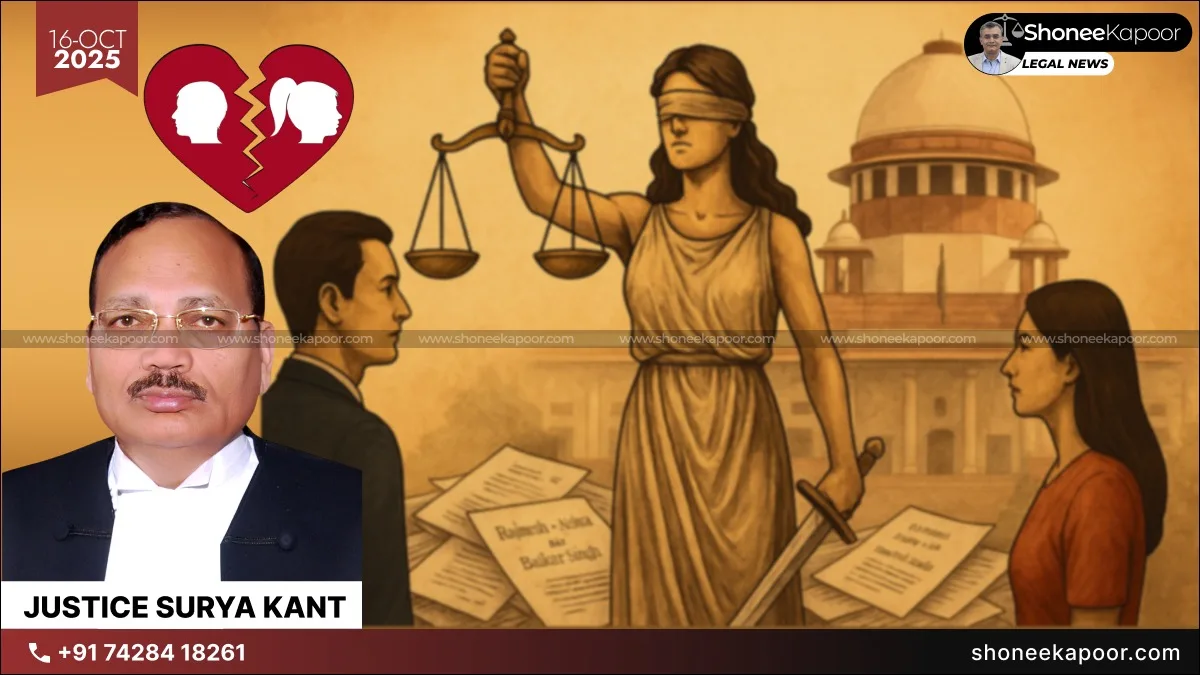
Justice Surya Kant of the Supreme Court of India called it an “uncomfortable truth” that marriage has historically been misused to subjugate women. Speaking on family law trends, he said legal and social reforms are slowly turning marriage into a dignified partnership of equals, and reaffirmed that foreign divorce judgments obtained by fraud or against Indian law will not be recognised.
NEW DELHI: Supreme Court judge Justice Surya Kant recently spoke about how marriage (Marriage Misused), in many cultures and times, has often been used as a tool to suppress women instead of empowering them.
Describing it as an “uncomfortable truth”, he said that although the situation is slowly changing, the misuse of marriage as an instrument of control over women has existed for centuries across societies.
“Across continents, cultures and eras, marriage has too often been misused as an instrument of subjugation against women”
Justice Surya Kant remarked while addressing a seminar on ‘Cross-Cultural Perspectives: Emerging Trends and Challenges in Family Law in England and India’.
He acknowledged that this harsh reality cannot be ignored but also expressed hope that change is underway.
“While this remains an uncomfortable truth, contemporary legal and social reforms in both jurisdictions are gradually transforming marriage from a site of inequality into a pious partnership grounded in dignity, mutual respect, and constitutional values of equality,” he added.
Justice Surya Kant noted that in India, both the judiciary and the legislature have been taking significant steps to safeguard women’s rights within marriage. He said that Indian courts and lawmakers have worked together to build strong legal frameworks that help ensure women are not treated unfairly in marital relationships.
Reflecting on traditional Indian beliefs, he mentioned that in the past, marriage was never seen as a mere legal arrangement. Instead, “marriage in India was regarded not as a civil contract but as a sacred and enduring sacrament.” He further explained that during pre-colonial times, family relations were largely governed by social and moral norms rather than by written laws.
On the topic of cross-border matrimonial disputes, Justice Surya Kant highlighted that the Supreme Court of India has issued clear guidelines on how foreign judgments related to marriage or divorce should be recognised in India.
He clarified,
“However, it has also been expressly held that such judgments would not be recognised in India if they were obtained by fraud, or if they contravened the principles of natural justice or the substantive laws of this country.”
Justice Surya Kant also drew attention to the increasing complexity of such cases when children are involved. He stressed that in such sensitive matters, Indian courts must balance the principle of Comity of Courts — which ensures cooperation and mutual respect between different countries’ judicial systems — with the paramount welfare of the child, which must always come first.
Through his speech, Justice Surya Kant reminded everyone that while India’s legal and social systems are evolving, the goal must be to transform marriage into a bond of equality, dignity, and mutual respect, ensuring that women are never again treated as subjects within it.
Justice Surya Kant – Background and Profile (Next Chief Justice of India)
Justice Surya Kant was born on 10 February 1962 in Petwar village, Hisar district, Haryana. He comes from a middle-class family background.
He completed his early education at Government Post Graduate College, Hisar, graduating in 1981. He earned his LL.B. degree from Maharishi Dayanand University, Rohtak, in 1984, and later pursued an LL.M. from Kurukshetra University through distance learning, where he secured First Class First position in 2011.
Justice Surya Kant began his legal practice in 1984 at the District Court in Hisar. In 1985, he shifted to Chandigarh to practice before the Punjab and Haryana High Court. He was appointed as the Advocate General of Haryana on 7 July 2000 and was designated as a Senior Advocate in March 2001.
He was elevated as a permanent judge of the Punjab and Haryana High Court on 9 January 2004. Later, on 5 October 2018, he became the Chief Justice of the Himachal Pradesh High Court. He was elevated to the Supreme Court of India on 24 May 2019.
If the seniority principle is followed, Justice Surya Kant is expected to become the 53rd Chief Justice of India. His tenure as CJI would commence after the retirement of Justice B.R. Gavai, and he is set to retire on 9 February 2027.
Justice Surya Kant has also served as the Acting Chairman of the National Legal Services Authority (NALSA) and Chairman of the Supreme Court Legal Services Committee.
Throughout his judicial career, he has handled a wide range of matters including constitutional law, civil disputes, service law, criminal jurisprudence, gender justice, prison reforms, and the recognition of foreign judgments.
He is widely known for his emphasis on human dignity, equality before law, and accessible justice. His speeches often reflect a deep concern for making the justice system more inclusive, humane, and constitutionally grounded.
Justice Surya Kant is respected across the legal fraternity for his balanced approach, humility, and scholarly command over constitutional and family law.
Explanatory Table — Laws, Sections & Legal Principles Referred / Implied
| Law / Concept | Section / Principle | Explanation / Legal Relevance |
|---|---|---|
| Hindu Marriage Act, 1955 (HMA) | Section 13 (Divorce), Section 13-B (Mutual Consent Divorce) | Governs dissolution of Hindu marriages; relevant to the discussion on recognition of foreign divorce decrees. |
| Code of Civil Procedure, 1908 (CPC) | Section 13 – When foreign judgments are not conclusive | Justice Surya Kant referred to this principle indirectly — Indian courts may refuse to recognise foreign matrimonial judgments obtained by fraud, without jurisdiction, or violating natural justice. |
| Constitution of India | Article 14 (Equality before law), Article 15 (Prohibition of discrimination), Article 21 (Right to life and dignity) | Justice Surya Kant linked evolving marriage laws to constitutional values of equality, dignity, and mutual respect. |
| Guardians and Wards Act, 1890 | — | Applied in child custody disputes; reinforces the welfare of the child as paramount consideration. |
| Comity of Courts (International Law Principle) | — | Ensures mutual respect and cooperation between courts of different nations in cross-border family disputes. |
| Indian Evidence Act, 1872 | Sections 43–44 | Permit challenge to foreign judgments on grounds of fraud or lack of jurisdiction — consistent with Justice Surya Kant’s remarks. |
| Judicial and Social Reforms | — |
Summary
- Event: Seminar on “Cross-Cultural Perspectives: Emerging Trends and Challenges in Family Law in England and India”
- Nature of Event: Legal seminar / academic address — not a judicial case or judgment
- Speaker: Hon’ble Justice Surya Kant, Judge, Supreme Court of India
- Court / Institution: Supreme Court of India (Speaker’s institutional designation)
- Bench Composition: Single Speaker: Justice Surya Kant (no judicial bench, as it was a seminar)
- Occasion & Theme: Comparative family-law discussion between England and India; focus on cross-border matrimonial issues, evolving concept of marriage, and recognition of foreign divorce decrees
- Date / Venue: Reported in October 2025; seminar titled “Cross-Cultural Perspectives: Emerging Trends and Challenges in Family Law in England and India” (exact venue not publicly specified)
- Key Issue Discussed: Historical misuse of marriage as an instrument of subjugation against women, and the shift toward equality through legal reforms in India and abroad
- Judicial Reference Made: Supreme Court’s own guidelines on recognition of foreign matrimonial judgments — stressing fraud, violation of natural justice, or conflict with Indian substantive law as grounds for non-recognition
- Child Custody Aspect: Justice Surya Kant underlined the principle of Comity of Courts and the paramount welfare of the child in cross-border custody disputes
Disclaimer: The views and opinions expressed in this article are those of the Indian courts and do not necessarily reflect the official policy or position of “ShoneeKapoor.com” or its affiliates. This article is intended for informational and educational purposes only. The content provided is not legal advice, and viewers should not act upon this information without seeking professional counsel. Viewer discretion is advised
