
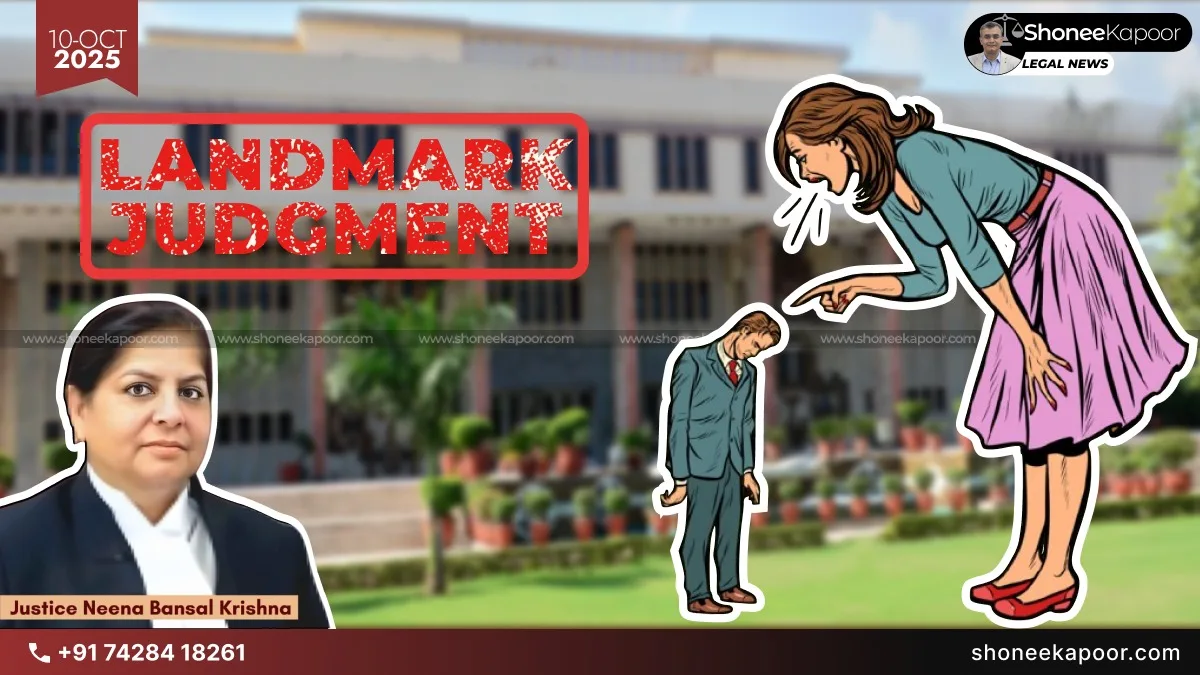
The Delhi High Court ruled that a wife can file cases from the place where she takes shelter after Separation her matrimonial Disputes. Justice Neena Bansal Krishna said the trauma of cruelty continues even after separation, giving such courts jurisdiction.
NEW DELHI: The Delhi High Court has delivered a significant ruling clarifying that when a wife leaves her matrimonial home due to harassment or cruelty, the court in the place where she takes shelter has full territorial jurisdiction to hear her case.
Justice Neena Bansal Krishna observed that even though acts of cruelty or harassment might happen in the matrimonial home, their emotional and mental effects continue to follow the woman to her parental home or the place she takes refuge in after separation.
The Court said:
“Applying these principles, especially to the matrimonial disputes, it emerges that the acts of cruelty may be committed upon a woman in a particular jurisdiction but the consequence, impact and trauma is carried by her to the place where she sets up her abode or takes shelter. This implies that the consequence of harassment manifests itself in the place where she goes to live after separation. It can also not be overlooked that even though there may be physical separation, but the relation continues even if it is acrimonious and is by way of various complaints that may follow.”
Justice Krishna explained that Sections 177, 178, and 179 of the Code of Criminal Procedure (CrPC) must be read together to determine jurisdiction:
“S. 179 further provides that the court where the consequence of the offence has ensued would also have the jurisdiction.”
The Case Background
The ruling came in the case Smt. Karuna Sejpal Gupta & Ors v. State (Govt. of NCT of Delhi) & Anr., where the in-laws of a woman sought to quash criminal proceedings under Sections 498A, 406, and 34 IPC filed for alleged cruelty and dowry harassment.
The woman had married in 2016, but within 40 days, her husband died by suicide. Following the tragedy, she accused her in-laws of dowry demands and abetment of suicide. An FIR was registered in Delhi, and a chargesheet was filed before the magistrate’s court.
The petitioners—her father-in-law, mother-in-law, and sister-in-law—contended that the Delhi court had no jurisdiction because the marriage and all related events occurred outside Delhi. They maintained that no dowry demand was ever made.
However, the High Court disagreed, finding that the mental distress and continuing trauma of the alleged cruelty persisted at the place where the wife was residing after separation.
Legal Reasoning
Justice Neena Bansal Krishna reiterated that the fundamental principle of territorial jurisdiction is that the court within whose area the offence or any part of it occurred—or where its consequences continue—has the authority to try the case.
Quoting the judgment,
Legal Rights and the Place of Shelter
“Applying these principles, especially to the matrimonial disputes, it emerges that the acts of cruelty may be committed upon a woman in a particular jurisdiction but the consequence, impact and trauma is carried by her to the place where she sets up her abode or takes shelter.”
The Court drew support from Sunita Kumari Kashyap v. State of Bihar, Sujata Mukherjee v. Prashant Kumar Mukherjee, and Rupali Devi v. State of Haryana, where the Supreme Court had held that a wife’s parental home can have jurisdiction since the effects of cruelty are continuing offences.
The High Court also cited the recent Priya Indoria v. State of Karnataka (2024) 4 SCC 749, affirming that if none of the ingredients of the offence occurred in a jurisdiction, that area cannot be the place of trial. However, if the mental trauma continues elsewhere, that area gains jurisdiction under Section 179 CrPC.
Findings and Final Order
While upholding the Delhi court’s jurisdiction, the High Court closely examined the evidence and found that the allegations of dowry demand and cruelty were vague and unsupported.
“Therefore, it is evidently a case of vague allegations and clear case of abuse of power and it is not in the interest of justice if the present proceedings are permitted to be continued.”
Accordingly, Justice Neena Bansal Krishna quashed the FIR No. 612/2016 under Sections 498A/406/34 IPC registered at PS Bindapur, New Delhi, and discharged the petitioners.
Impact of the Judgment
This ruling is both compassionate and balanced—it protects a woman’s right to seek justice from where she takes shelter after facing cruelty, while also cautioning against misuse of law through vague or retaliatory complaints.
By reaffirming that the trauma of cruelty follows the victim even after separation, the judgment strengthens the legal framework for genuine victims. Yet, by quashing the FIR due to lack of evidence, the Court emphasized that abuse of criminal process will not be tolerated.

Explanatory Table of All Laws & Sections Referred in the Case
| Law / Section | Full Provision Name | Purpose / Meaning | How Applied in this Case |
|---|---|---|---|
| Section 498A IPC | Husband or relative of husband of a woman subjecting her to cruelty | Punishes husband or in-laws for cruelty (physical or mental) or dowry harassment; up to 3 years imprisonment and fine. | Alleged by wife against her in-laws for dowry demand of ₹14 lakh; Court found allegations vague and unsupported. |
| Section 406 IPC | Criminal breach of trust | Applies when entrusted property or Stridhan is dishonestly misused. | Court held that no entrustment or misuse was proved; hence offence not made out. |
| Section 34 IPC | Acts done by several persons in furtherance of common intention | Fixes joint liability when two or more people act together with shared intent. | Alleged but dismissed — no evidence of shared intent to commit cruelty. |
| Section 177 CrPC | Ordinary place of inquiry and trial | Every offence should normally be tried where it was committed. | Petitioners argued no act happened in Delhi. |
| Section 178 CrPC | Place of inquiry or trial when uncertain, continuing, or spread across areas | Allows trial in any area where offence continues or partly occurs. | Court applied clause (c) — “continuing offence” — holding cruelty’s effect continues at wife’s parental home. |
| Section 179 CrPC | Offence triable where act is done or consequence ensues | Jurisdiction lies where offence occurs or its effect is felt. | Key section used — wife’s trauma and consequence ensued in Delhi; thus Delhi courts had jurisdiction. |
| Section 482 CrPC | Inherent powers of High Court | Lets the High Court quash criminal proceedings to prevent abuse of law or secure justice. | Used by Court to quash FIR due to vague, baseless allegations. |
| Section 125 CrPC | Maintenance of wife, child, parents | Provides financial maintenance to dependents. | Wife’s maintenance plea earlier dismissed by Family Court, Dwarka. |
| Section 12 Domestic Violence Act, 2005 | Application to Magistrate for relief | Allows aggrieved woman to seek protection or compensation. | Wife’s DV case was also dismissed earlier. |
Case Summary
- Case Title: Smt. Karuna Sejpal Gupta & Ors. v. State (Govt. of NCT of Delhi) & Anr.
- Case Number: CRL.M.C. 1593/2018 & CRL.M.A. 5777/2018
- Court: High Court of Delhi at New Delhi
- Bench / Judge: Hon’ble Ms. Justice Neena Bansal Krishna
- Reserved On: 06 August 2025
- Pronounced On: 08 October 2025
- Petitioners:
- Smt. Karuna Sejpal Gupta (Sister-in-law)
- Shri Kanhaiya Ram Gupta (Father-in-law)
- Smt. Kamlesh Gupta (Mother-in-law)
- Respondents:
- State (Govt. of NCT of Delhi) through SHO, PS Bindapur
- Smt. Nisha Gupta (Wife of Late Krishnanand Gupta)
- Petitioners’ Counsel: Mr. Rahul Shukla, Mr. Ramandeep Singh, Ms. Bachita Shukla, Ms. Nimrit Bhalla
- Respondent No. 1 (State): Mr. Utkarsh, APP for the State with SI Somika and SI Ramniwas (PS Bindapur)
- Respondent No. 2 (Complainant): Mr. Tribindh Kumar and Mr. Bineet Pandey
- Statutes / Provisions Involved: Sections 498A, 406, 34 IPC; Sections 177, 178, 179, 482 CrPC
- Date of FIR: 26 September 2016 (FIR No. 612/2016, PS Bindapur, Delhi)
- Result: FIR and all proceedings quashed under Section 482 CrPC
- Citation / Reference: Not yet reported (judgment dated 08.10.2025)
Disclaimer: The views and opinions expressed in this article are those of the Indian courts and do not necessarily reflect the official policy or position of “ShoneeKapoor.com” or its affiliates. This article is intended for informational and educational purposes only. The content provided is not legal advice, and viewers should not act upon this information without seeking professional counsel. Viewer discretion is advised
