
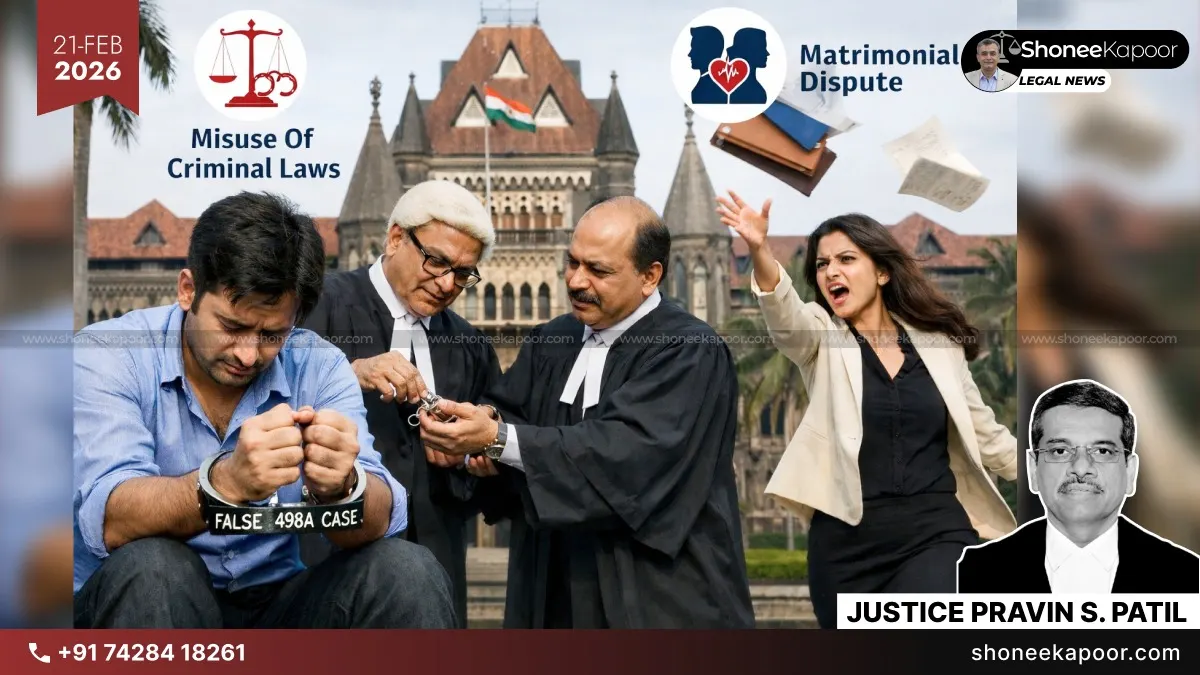
In a powerful judgment, the Bombay High Court has quashed a 498A FIR filed by an educated wife against her husband and in-laws. The Court warned that misuse of dowry harassment laws weakens genuine cases and causes irreversible damage to innocent families.
MAHARASHTRA: The Bombay High Court reinforcing judicial concern over the increasing misuse of Section 498A of the Indian Penal Code (IPC). The Court quashed FIR against a husband and his entire family, holding that the allegations were vague, omnibus and unsupported by foundational facts.
The case was heard by Justice Pravin S. Patil, who examined the complaint filed by the wife under Section 498A read with Section 34 IPC. The accused included the husband, aged parents, married sister-in-law and brother-in-law residing separately in another district.
While analysing the broader legal trend, the Court made strong observations regarding the growing pattern of matrimonial prosecutions being used as pressure tactics.
“This Court cannot remain oblivious to the disturbing pattern that has emerged in recent times, wherein matrimonial prosecutions are frequently initiated as a pressure tactic during subsistence of marital disputes and negotiations.”
The Court further noted that in several cases, educated complainants are invoking penal provisions not only against the husband but also against every member of his family, without clear or credible allegations.
“Such indiscriminate invocation of the criminal process trivialises the very object of Section 498-A IPC and erodes its moral and legal force, thereby doing disservice to genuine victims of cruelty.”
The Court cautioned that allowing criminal trials to continue without basic supporting material results in harassment, social stigma, and permanent damage to individuals who may ultimately be found innocent.
“The inherent powers of this Court are intended to act as a constitutional safety, required to be invoked to avoid the innocent persons from prosecuting in the criminal offence.”
Referring to the legislative intent behind Section 498A, the Court acknowledged its importance but expressed serious concern about its frequent misuse.
“However, it is a matter of serious concern that large number of cases continue to be filed under Section 498-A of IPC alleging harassment of married women. Most of such complaints are filed in the heat of the moment over trivial issues. Many of such complaints are not bona fide.”
The Court further observed that criminal proceedings in private matrimonial disputes can be quashed even if they are technically non-compoundable when continuation would amount to oppression.
“This Court has to exercise incidental power to quash even a non-compoundable case of private nature, if continuing the proceedings is found to be oppressive”
The marriage took place on 15 June 2020 during the COVID-19 period. Both parties were well-educated professionals working in reputed companies in Pune. After initial cohabitation, disputes arose between the couple over various issues.
The husband had earlier lodged a Non-Cognisable Report (NCR) in February 2024 at Hinjewadi Police Station, Pune, alleging abuse and apprehending false criminal complaints. Medical records showed injuries on his body. WhatsApp chats placed on record demonstrated serious marital discord.
Subsequently, divorce proceedings were initiated on 15 April 2024. A mutual settlement was discussed between both families. An agreement dated 15 May 2024 recorded a one-time settlement amount of Rs 35 lakhs. The wife’s pregnancy was medically terminated on 20 May 2024 after written consent from both parties and under medical supervision.
However, on 1 July 2024, after divorce proceedings had commenced and settlement discussions had failed, the wife lodged an FIR under Section 498A alleging mental, physical and financial harassment, forced termination of pregnancy, and installation of a hidden camera.
The Court carefully reviewed the WhatsApp conversations and documentary material submitted by the applicants.
“Perusal of this conversation clearly established the fact that Non-applicant No.2 has used unparliamentary language in her messages to the Applicant No.1. So also these messages clarify the fact that their relations were so strained that there was no other way than to separate from each other. As such, the Applicant has taken the decision and filed the divorce proceeding against the present Non-applicant No.2.”
The Court observed that the complaint did not disclose specific dates, instances or acts of cruelty of the nature required under Section 498A. The allegations were general and lacked the gravity necessary to constitute cruelty as defined under law.
“In my opinion, in the present case the Applicants have placed on record sound, reasonable and indubitable material which is relevant and impeccable allegations levelled against them. The material, which is collected and produced before this Court, in my opinion, is sufficient to reject and overruled the assertions contained in the complaint,”
After considering Supreme Court precedents including Preeti Gupta vs State of Jharkhand, Achin Gupta vs State of Haryana, and Dara Lakshmi Narayana vs State of Telangana, the High Court concluded that continuation of the criminal trial would amount to abuse of process of law.
The FIR was accordingly quashed.
Explanatory Table Of Laws And Legal Provisions Discussed
| Law / Section | Full Form / Source | What It Deals With | How It Was Applied in This Case |
| Section 498-A IPC | Indian Penal Code, 1860 | Cruelty by husband or his relatives against a married woman | FIR registered alleging mental, physical and financial harassment. Court held allegations were vague and did not meet statutory threshold. |
| Section 34 IPC | Indian Penal Code | Acts done by several persons in furtherance of common intention | Added to implicate all family members collectively. Court found no specific role attributed to each accused. |
| Section 482 CrPC | Code of Criminal Procedure, 1973 | Inherent powers of High Court to prevent abuse of process of court or secure ends of justice | Used by accused to seek quashing of FIR. Court exercised this power to prevent misuse of criminal law. |
| Section 438 CrPC | Code of Criminal Procedure | Anticipatory Bail provision | Discussed in Supreme Court precedents cited in judgment regarding remedies available to accused. |
| Section 173 CrPC | Code of Criminal Procedure | Filing of final report/charge-sheet after investigation | Mentioned in context of investigation stage and judicial restraint in quashing matters. |
| Article 226 of Constitution of India | Constitutional Provision | Writ jurisdiction of High Courts | Referred to in Supreme Court precedent on limits of interference during investigation. |
| State of Haryana v. Bhajan Lal | Supreme Court Judgment | Landmark judgment laying down categories for quashing FIRs | Cited as guiding precedent for exercising power under Section 482 CrPC. |
| Dara Lakshmi Narayana v. State of Telangana | (2025) 3 SCC 735 | Clarified scope and misuse concerns of Section 498-A | Cited to explain statutory ingredients of cruelty and misuse trend. |
| Achin Gupta v. State of Haryana | (2025) 3 SCC 756 | Observed misuse of 498A as weapon rather than shield | Relied upon to emphasize need for judicial caution. |
| Preeti Gupta v. State of Jharkhand | (2010) 7 SCC 667 | Warned against over-implication of husband’s relatives | Used to underline scrutiny of allegations against extended family members. |
| Niharika Infrastructure Pvt. Ltd. v. State of Maharashtra | (2021) 19 SCC 401 | Laid down principles for quashing and investigation stage restraint | Cited by complainant’s counsel to argue against premature quashing. |
| Pradeep Kumar Kesarwani v. State of Uttar Pradesh | 2025 SCC OnLine SC 1947 | Four-step test for quashing criminal proceedings | Applied by Court to assess whether material justified quashing FIR. |
Case Details
- Case Title: Vaibhav Gopaldas Mundada & Ors. vs State of Maharashtra & Anr.
- Court: High Court of Judicature at Bombay Nagpur Bench
- Case Number: Criminal Application (APL) No. 1349 of 2024
- Neutral Citation: 2026:BHC-NAG:2909-DB
- Coram / Bench: Justice Pravin S. Patil
- Arguments Heard On: February 16, 2026
- Pronounced On: February 20, 2026
- Applicants (Accused):
- Vaibhav Gopaldas Mundada (Husband)
- Gopaldas Shankarlal Mundada (Father-in-law)
- Usha Gopaldas Mundada (Mother-in-law)
- Aarti Amit Lahoti (Sister-in-law)
- Amit Anilkumar Lahoti (Brother-in-law)
- Non-Applicants:
- State of Maharashtra
- Neha Vaibhav Mundada (Complainant/Wife)
- Counsel for Applicants: Mr. A. R. Deshpande, Advocate
- Counsel for Non-Applicant No. 2 (Wife): Mr. S. S. Deshpande, Advocate
- Counsel for State: Ms. S. V. Kolhe, APP
- Police Station: Pulgaon Police Station, District Wardha
- FIR Number: 580/2024
- Final Order: FIR quashed and set aside.
Key Takeaways
- The Court openly acknowledged the growing pattern of 498A being used as a pressure tactic during matrimonial disputes and settlement negotiations.
- It reaffirmed that vague, general and omnibus allegations against the husband and his extended family are legally insufficient to sustain prosecution.
- The judgment stressed that indiscriminate implication of aged parents and separately residing relatives trivialises the very purpose of Section 498A.
- Documentary evidence, WhatsApp chats, prior police complaints by the husband, and chronological events played a decisive role in exposing the weakness of the complaint.
- The High Court exercised its inherent powers under Section 482 CrPC to prevent abuse of process, reinforcing that criminal law cannot become a weapon of coercion in matrimonial breakdowns.
This Could Change Your Case-Get FREE Legal Advice-Click Here!
Disclaimer: The views and opinions expressed in this article are those of the Indian courts and do not necessarily reflect the official policy or position of “ShoneeKapoor.com” or its affiliates. This article is intended for informational and educational purposes only. The content provided is not legal advice, and viewers should not act upon this information without seeking professional counsel. Viewer discretion is advised.
