
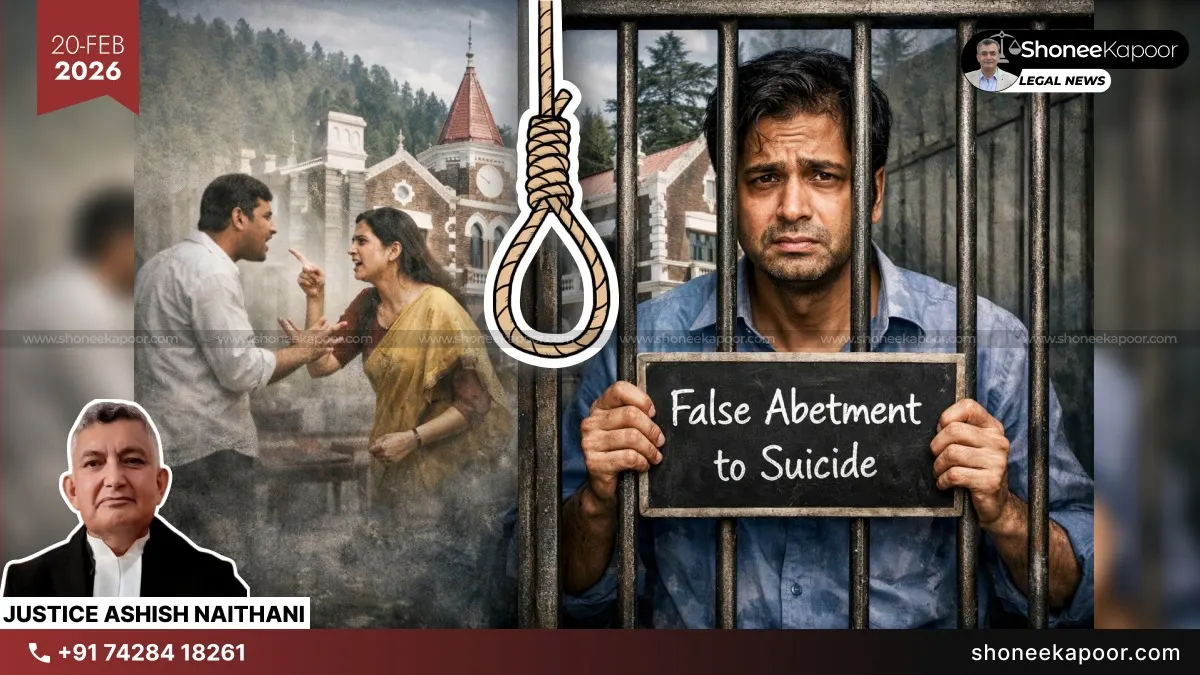
Can suspicion in a strained marriage send a man to prison for suicide? The Uttarakhand High Court says criminal law needs proof, not assumptions.
This verdict draws a sharp line between marital discord and abetment—reshaping how Section 306 IPC must be applied.
Doubting Wife Character Not Abetment of Suicide: Justice Ashish Naithani of the High Court of Uttarakhand at Nainital delivered an important judgment on 18.02.2026, allowing a criminal appeal and setting aside the conviction of a husband who had been sentenced to seven years’ rigorous imprisonment under Section 306 IPC for allegedly abetting his wife’s suicide.
The wife had committed suicide by hanging in 2004. While the trial court had acquitted the husband of charges under Sections 304-B and 498-A IPC, it convicted him under Section 306 IPC mainly on the allegation that he used to suspect her character and mentally harass her.
The High Court clearly framed the issue by stating:
“The core question that arises for consideration is whether the Appellant can be said to have abetted the commission of suicide within the meaning of Section 306 IPC read with Section 107 IPC.”
The Court explained that to prove abetment, the prosecution must establish not just suicide but also intentional instigation or active aiding.
Justice Naithani emphasized:
“The essence of abetment is a positive act on the part of the accused with the intention to provoke, incite, or encourage the commission of the act.”
He further clarified that:
“Mere harassment, ordinary domestic discord, or casual remarks cannot amount to instigation unless there is clear mens rea and a proximate nexus between the conduct of the accused and the act of suicide.”
On examining the evidence, the Court found that the allegations were general in nature and there was no specific act immediately before the suicide that could amount to instigation. It observed:
“Matrimonial discord, suspicion, and quarrels, though unfortunate, are not uncommon in marital life.”
The Court warned that criminal law cannot be used to punish every strained relationship.
Importantly, the judgment stated, “Suspicion, however strong, cannot take the place of proof.” The Court also noted the absence of a suicide note and any direct evidence showing that the husband intended to push his wife to take her life.
The High Court held that the essential ingredients of abetment were missing and that the trial court had expanded the scope of Section 306 IPC beyond its legal limits. The conviction and sentence were set aside, and the husband was acquitted.
Explanatory Table: Laws And Sections Involved
| Law / Section | Purpose | How Applied In This Case |
| Section 306 IPC | Punishment for abetment of suicide | Trial court convicted husband; High Court set aside due to lack of abetment evidence |
| Section 107 IPC | Defines abetment (instigation, conspiracy, intentional aiding) | Court held essential ingredients like instigation and mens rea not proved |
| Section 304-B IPC | Dowry death | Trial court acquitted as dowry-related harassment not established |
| Section 498-A IPC | Cruelty by husband or relatives | Trial court acquitted due to lack of proof of dowry cruelty |
| Section 374(2) CrPC | Appeal against conviction | Appeal filed by husband challenging conviction |
Case Details
- Case Title: Sunil Dutt Pathak vs State of Uttarakhand
- Court: High Court of Uttarakhand at Nainital
- Neutral Citation: 2026:UHC:1053
- Bench: Hon’ble Justice Ashish Naithani
- Dates:
- Judgment Reserved On: 22.12.2025
- Judgment Delivered On: 18.02.2026
- Counsels:
- For Appellant: Mr. Siddharth Sah
- For State: Mr. Vijay Khanduri, learned Brief Holder for the State of Uttarakhand
Key Takeaways
- Suspicion, strained marriage, or normal marital disputes cannot automatically be converted into a criminal charge of abetment of suicide. Criminal law requires strict proof, not emotional assumptions.
- Courts must insist on clear evidence of instigation, intention, and a direct link between conduct and suicide. Without mens rea and proximate acts, conviction under Section 306 IPC cannot stand.
- Acquittal under Sections like 498A or 304B shows that not every allegation of harassment or cruelty is legally sustainable. General and omnibus statements are not enough for criminal liability.
- “Suspicion, however strong, cannot take the place of proof” is a crucial reminder that men cannot be convicted merely because a tragedy occurred within marriage.
- Criminal law cannot be used to punish relationship failures. Legal accountability must be based on evidence, not moral outrage or societal pressure.
This Could Change Your Case-Get FREE Legal Advice-Click Here!
Disclaimer: The views and opinions expressed in this article are those of the Indian courts and do not necessarily reflect the official policy or position of “ShoneeKapoor.com” or its affiliates. This article is intended for informational and educational purposes only. The content provided is not legal advice, and viewers should not act upon this information without seeking professional counsel. Viewer discretion is advised.
