
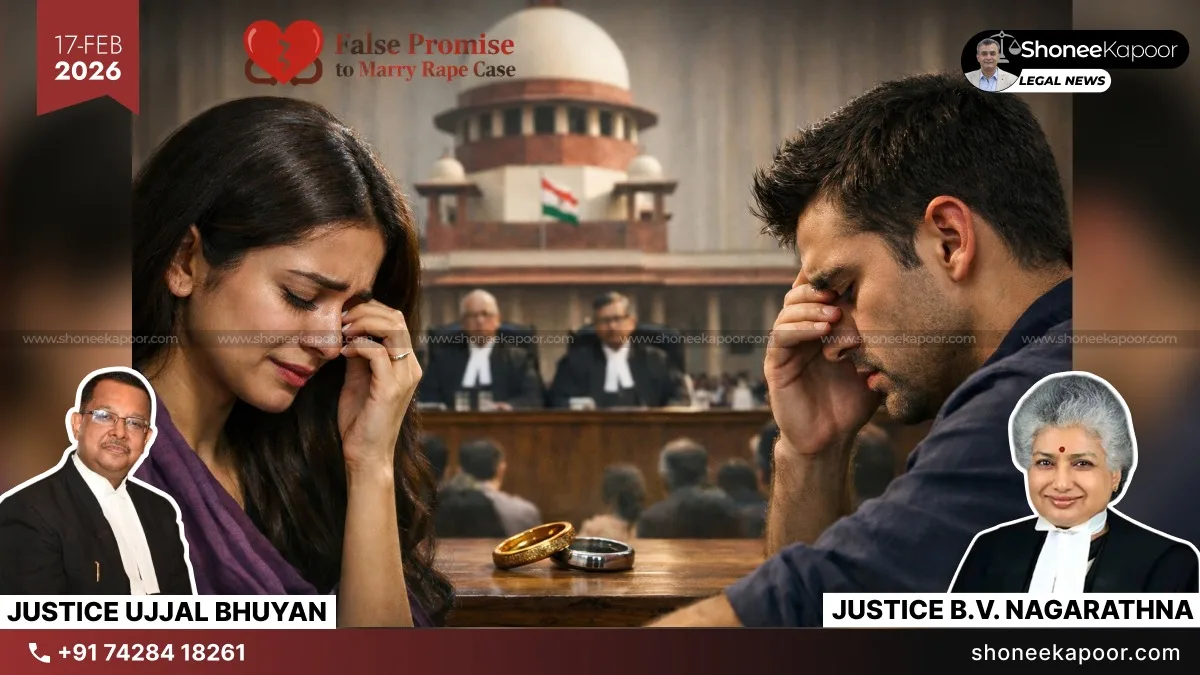
The Supreme Court raised serious questions about pre-marital relationships while hearing a bail plea in a false promise to marry rape case. The Bench’s strong remarks on consent, caution, and criminal prosecution could have a far-reaching impact on similar cases across India.
NEW DELHI: The Supreme Court of India Yesterday (16th Feb) made oral observations while hearing a bail plea in a case involving allegations of rape on the pretext of a promise to marry. The Court underlined the need for caution in pre-marital relationships and stressed that criminal law cannot be applied mechanically in cases arising out of consensual adult relationships.
The matter was heard by a Bench comprising Justice B.V. Nagarathna and Justice Ujjal Bhuyan. The accused man had approached the Court seeking bail after being charged with establishing a physical relationship with a woman allegedly on the assurance of marriage.
During the hearing, the Bench remarked that courts must carefully examine whether the essential ingredients of rape are made out in such cases. The Court noted that where a relationship appears to be consensual and arises from a matrimonial alliance between two adults, the criminal process must be evaluated with seriousness before allowing it to proceed further.
The Bench did not pass a final order on bail but indicated that the dispute may be suitable for mediation. The Court orally observed that in cases where a consensual relationship is evident, a full criminal trial may not always be necessary. The matter has been listed for further hearing on Wednesday.
In a noteworthy observation, Justice Nagarathna stated:
“Maybe we are old-fashioned but, before marriage, a boy and a girl are strangers. Whatever may be the thick and thin of their relationship, we fail to understand how they can be in a physical relationship before marriage… You must be very careful. Nobody should believe anybody before marriage.”
The Court was informed that the parties had met in 2022 through a matrimonial website and subsequently entered into a relationship. According to the prosecution, the accused had assured the complainant that he would marry her, and on that basis, she consented to a physical relationship. It was stated that the parties even met in Dubai during this period.
The prosecution further alleged that intimate videos of the parties were recorded without the woman’s consent and that she was later threatened with their circulation. It was also claimed that the complainant later discovered that the accused was already married and had contracted a second marriage in Punjab in January 2024.
During the proceedings, the Court questioned the complainant’s decision to travel abroad with the accused before marriage. When the State’s counsel submitted that the parties had met through a matrimonial platform and were planning to marry, the Bench observed that if marriage was a pre-condition for intimacy, such travel should not have taken place before the marriage was solemnised.
The Court orally remarked that such matters require careful judicial scrutiny to determine whether the relationship was truly consensual and whether the promise to marry was false from the very beginning. The Bench highlighted that in cases where a consensual relationship between adults is evident, the matter may not necessarily fall within the category of cases that demand trial and conviction.
The Supreme Court has consistently held in previous judgments that a consensual relationship between adults does not automatically amount to rape merely because the relationship does not end in marriage. For consent to be considered invalid due to “misconception of fact” under Section 375 of the Indian Penal Code, it must be clearly shown that the promise to marry was false from the start and that the accused never intended to fulfil it.
At the same time, the Court has also clarified in several decisions that where a promise to marry is made in bad faith solely to obtain sexual consent, the offence of rape would be attracted.
In the present matter, the Bench appeared to examine whether the facts reveal a long-standing consensual relationship between two adults who met through a matrimonial platform with the intention of exploring marriage, or whether there was deliberate and fraudulent inducement from the beginning.
The suggestion of mediation also reflects an evolving judicial approach in cases arising out of intimate relationships. Courts are increasingly assessing whether continuing criminal proceedings would truly serve the ends of justice, particularly at the stage of bail.
At the bail stage, the Court is required to examine whether a prima facie case exists, the duration of custody undergone, the seriousness of allegations, and the possibility of the accused influencing the investigation or trial. The Bench is not expected to conduct a detailed examination of evidence at this stage.
The case will now be taken up for further consideration on Wednesday.
Legal Framework Involved – Explanatory Table
| Law / Section | Statute | What It Deals With | Relevance in This Case |
| Section 375 IPC | Indian Penal Code, 1860 | Defines the offence of rape and circumstances under which consent is invalid | Core allegation is that sexual consent was obtained on the basis of a promise to marry |
| Section 90 IPC | Indian Penal Code, 1860 | Consent given under “misconception of fact” is not valid consent | Prosecution may argue consent was vitiated due to false promise |
| Section 376 IPC | Indian Penal Code, 1860 | Punishment for rape | Applied if the Court finds ingredients of Section 375 are made out |
| Criminal Procedure Code (Bail Provisions) | CrPC | Governs grant of bail in criminal matters | Accused approached Supreme Court seeking bail |
| Principles on False Promise to Marry (Judicial Precedents) | Supreme Court Judgments | Clarifies when a broken promise amounts to rape and when it does not | Court examined whether promise was false from inception or relationship was consensual |
- Bench: Justice B.V. Nagarathna & Justice Ujjal Bhuyan
- Hearing Date: 16 February 2026
Key Takeaways
- The Supreme Court clearly indicated that not every failed relationship can be converted into a rape case. A breakup is not automatically a criminal offence.
- The Court emphasized that for rape to be made out on “false promise to marry,” it must be proven that the promise was false from the very beginning, not merely that marriage did not happen later.
- Where a long-standing consensual relationship between adults is evident, criminal law must not be used as a tool of retaliation.
- The Bench questioned conduct before marriage, including travel and intimacy, highlighting that adult choices carry responsibility on both sides.
- At the bail stage, courts must examine whether a prima facie case truly exists instead of allowing arrest and incarceration based only on allegations arising out of broken relationships.
This Could Change Your Case-Get FREE Legal Advice-Click Here!
Disclaimer: The views and opinions expressed in this article are those of the Indian courts and do not necessarily reflect the official policy or position of “ShoneeKapoor.com” or its affiliates. This article is intended for informational and educational purposes only. The content provided is not legal advice, and viewers should not act upon this information without seeking professional counsel. Viewer discretion is advised.
