
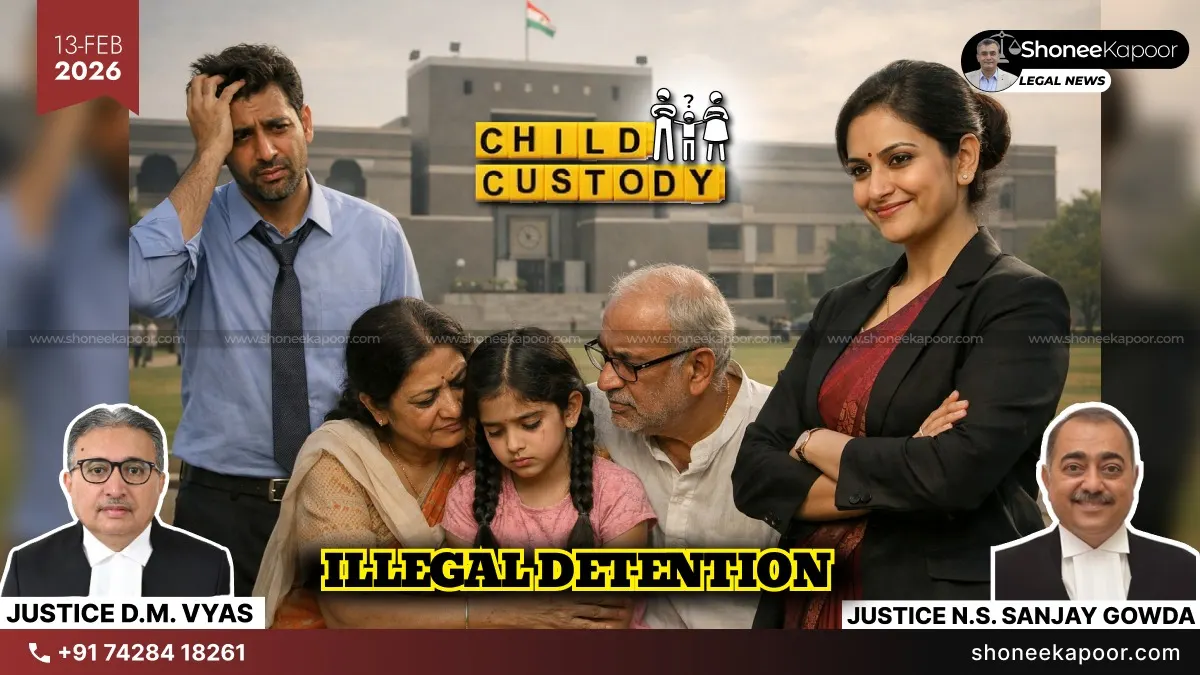
The Gujarat High Court dismissed a father’s habeas corpus plea for custody of his 4-year-old child, ruling that a working mother keeping the child with maternal grandparents is not illegal detention, and clarified that custody must be decided by the Family Court.
AHMEDABAD: In a Writ Petition decided by a Division Bench comprising Justice N.S. Sanjay Gowda and Justice D.M. Vyas of the Gujarat High Court considered a habeas corpus petition arising from a matrimonial dispute between two government employees.
The father approached the Court alleging that his minor daughter was being kept in illegal custody by the mother and her parents after she was taken to Mehsana, and he sought a direction for her immediate production and release through a writ of habeas corpus.
The Court noted that both parents were working, transfers had taken place on both sides, and serious marital discord had already set in. The child, who was very young when she was taken to the maternal grandparents’ home, had been staying there with the knowledge of both parents. The father’s main grievance was that this arrangement was made against his wishes and therefore amounted to illegal confinement.
Rejecting this argument, the Court made it clear that a minor girl staying with her mother can never be treated as unlawful custody. The Bench categorically observed:
“The custody of a minor girl, and that too a 4 year old with her mother can never be construed as either unlawful custody or illegal confinement.”
It further clarified that even if the mother seeks help from her parents due to work pressure, such an arrangement does not become illegal merely because the husband disagrees.
The judgment also reflects a strong presumption in favour of the mother when it comes to the care of a young child. The Court stated:
“The responsibility would essentially lie on the shoulders of the mother and not on the father,” while discussing the practical difficulties faced by working couples in raising small children. According to the Bench, using grandparents’ support for childcare is a normal family arrangement, not a criminal act.
This approach raises serious concerns. The father in this case was also a government employee, had parents willing to support childcare, and had actively sought access to his daughter. However, the Court’s reasoning largely treated the father’s objection as irrelevant and reduced his role to that of a visitor, rather than an equal parent. The larger issue of how easily fathers are sidelined in custody disputes involving young children remains unaddressed.
The Court ultimately concluded that habeas corpus was not the correct remedy for resolving such custody conflicts. It clearly held:
“The act of the mother entrusting the custody of her 5 year old daughter to her parents for the upkeep of the child cannot amount to illegal confinement.”
The Bench advised that if either parent seeks permanent or exclusive custody, the proper forum is the Family Court, where evidence can be led and welfare examined in detail.
While interim visitation rights were continued, the petition itself was dismissed. The ruling once again highlights how Indian courts, even while speaking of child welfare, continue to operate on an assumption that the mother’s choice automatically reflects the child’s best interest, leaving fathers to fight a long and uncertain battle in family courts.
Explanatory Table: Laws And Provisions Involved
| Law-Section / Provision | Purpose | How Applied in This Case |
| Article 226 of the Constitution of India (Writ Jurisdiction) | Empowers High Courts to issue writs including habeas corpus for enforcement of legal rights | The father invoked writ jurisdiction seeking a direction for production and release of his minor daughter |
| Writ of Habeas Corpus | Legal remedy to challenge unlawful detention and secure release of a person | Father claimed the child was in illegal custody of mother and grandparents and sought her production before Court |
| Section 498A, Indian Penal Code | Criminalizes cruelty by husband or his relatives towards a married woman | After filing of the habeas corpus petition, a complaint under Section 498A IPC was filed by the mother against the father |
| Jurisdiction of Family Court (under Family Courts Act, 1984) | Determines matrimonial disputes, custody, guardianship and related family matters | The High Court held that proper custody adjudication must be done by the Family Court after evidence is led |
| Principles of Child Welfare (Custody Jurisprudence) | Welfare of the minor child is the paramount consideration in custody matters | Court observed that custody issues must be decided on welfare principles by competent court, not through habeas corpus |
Case Details
- Case Title: Akulkumar Dineshbhai Rana & Anr. v. State of Gujarat & Ors.
- Case Type: R/Special Criminal Application (Habeas Corpus) No. 11700 of 2025
- Court: High Court of Gujarat at Ahmedabad
- Neutral Citation: 2026:GUJHC:8529-DB
- Bench: Hon’ble Mr. Justice N.S. Sanjay Gowda & Hon’ble Mr. Justice D.M. Vyas
- Dates:
- Judgments Reserved On: 06/01/2026
- Judgment Pronounced On: 06/02/2026
- Counsels:
- For Applicant No. 1: Ms. Roopal R. Patel
- For State: Mr. Chintan Dave, APP
- For Respondent Nos. 2, 3, 4, 5, 8: Ms. Punita H. Joshi
Key Takeaways
- A father’s consent is often treated as secondary when decisions about a young child’s residence are taken by the mother.
- Courts generally do not view a child staying with the maternal grandparents as illegal, even when the father strongly disagrees.
- Fathers cannot rely on habeas corpus to regain physical custody and must be prepared for a longer legal route through the Family Court.
- Equal parenting claims by fathers are rarely examined at the writ stage and are pushed into evidence-based custody proceedings.
- For fathers, the practical reality is that access and involvement with their child depends more on court-granted visitation than on recognition of equal parental rights.
This Could Change Your Case-Get FREE Legal Advice-Click Here!
Disclaimer: The views and opinions expressed in this article are those of the Indian courts and do not necessarily reflect the official policy or position of “ShoneeKapoor.com” or its affiliates. This article is intended for informational and educational purposes only. The content provided is not legal advice, and viewers should not act upon this information without seeking professional counsel. Viewer discretion is advised.
