
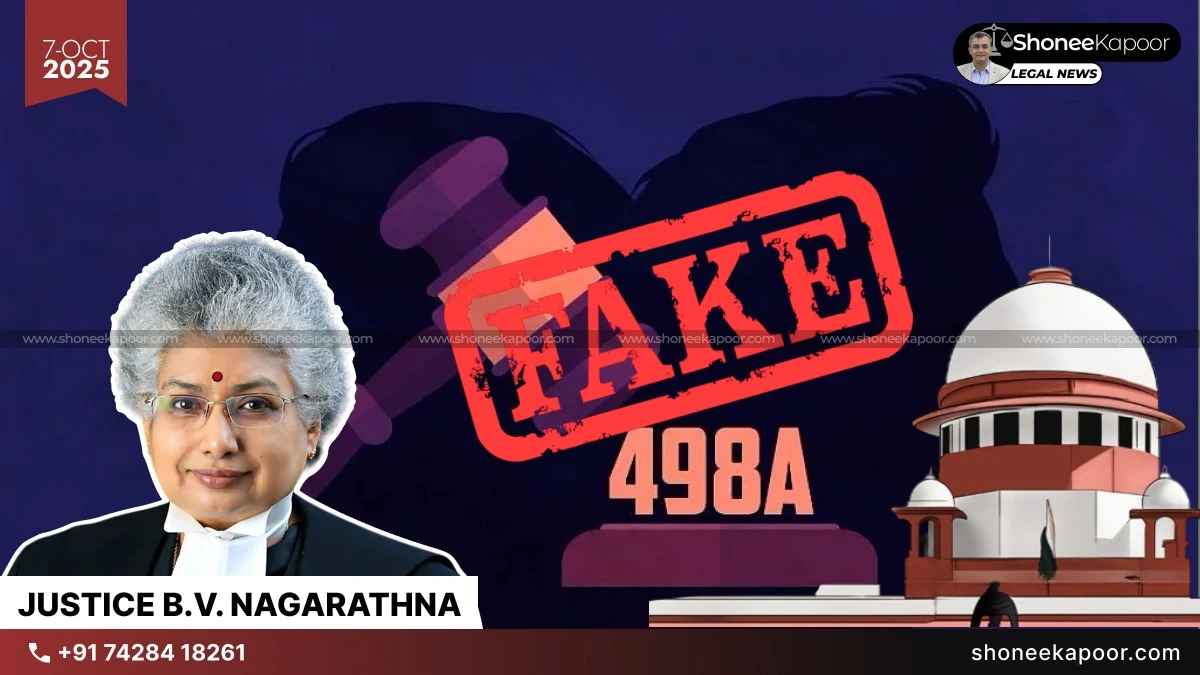
The Supreme Court quashed a false dowry and cruelty FIR against a husband’s brother, calling the allegations vague and malicious. Justice Nagarathna warned that misuse of Section 498A IPC to target innocent in-laws must be “nipped in the bud.”
NEW DELHI: The Supreme Court of India has made an important ruling in a case related to alleged cruelty in marriage and dowry harassment. The Court said that the term “cruelty” cannot be established without specific instances, and that a tendency to file cases without giving exact details weakens the prosecution’s case and raises doubts about the complainant’s version.
A bench of Justices B. V. Nagarathna and R. Mahadevan observed that the court cannot ignore missing details in the First Information Report (FIR), as the FIR forms the very base for starting any criminal investigation by the State.
The Supreme Court set aside the Allahabad High Court’s order dated February 27, 2024, which had refused to quash the FIR. The bench explained,
“In such cases involving allegations of cruelty and harassment, there would normally be a series of offending acts, which would be required to be spelt out by the complainant against perpetrators in specific terms to initiate criminal proceedings against them. Therefore, mere general allegations of harassment without pointing out the specific details would not be sufficient to continue criminal proceedings against any person.”
The case was filed by Shobhit Kumar Mittal, who challenged the Allahabad High Court’s refusal to cancel a 2023 FIR lodged by his sister-in-law against him, his brother (the complainant’s husband), and their mother.
The FIR was registered under Sections 323 and 498A of the Indian Penal Code (IPC) and Sections 3 and 4 of the Dowry Prohibition Act. The Supreme Court found that the FIR contained vague and broad allegations. The complainant claimed that her husband and in-laws had mentally harassed her and demanded dowry, but she failed to mention any specific event or act of cruelty.
The bench noted,
“She has also not mentioned the time, date, place, or manner in which the alleged harassment occurred or the details of the nature of demand or its particulars. Therefore, the FIR lacks concrete and precise allegations.”
The judges further said that simply stating that the husband’s family “mentally harassed her for dowry” is not enough to meet the requirements of Section 498A IPC, especially when there is no proper evidence or material to back such claims.

The Supreme Court highlighted that courts must be cautious and realistic while handling matrimonial disputes. It said that allegations in such cases must be examined carefully to prevent misuse of the law and avoid injustice. Referring to the legal principles laid down in State of Haryana vs. Bhajan Lal (1992), the bench stated,
“We find that none of the offences alleged against the accused/ appellant herein is made out. In fact, we find that the allegations of cruelty, mental harassment and voluntarily causing hurt against the accused/appellant herein are vague and general in nature.”
In this situation, the Court said that it would not serve justice to continue the criminal case based on such weak allegations. The bench also quoted its earlier decision in Dara Lakshmi Narayana vs. State of Bihar (2025), observing,
“There has been a growing tendency to misuse provisions like Section 498A of the IPC as a tool for unleashing personal vendetta against the husband and his family by a wife. Making vague and generalised allegations during matrimonial conflicts, if not scrutinized, will lead to the misuse of legal processes and an encouragement for use of arm-twisting tactics by a wife and/or her family.”
Based on these observations, the Supreme Court quashed the FIR dated November 9, 2023, registered at Police Station Civil Lines, Meerut, and all related proceedings against the appellant.
Explanatory Table of Laws & Sections Mentioned
| Law / Section | Description | Punishment / Key Points | Court’s Observation in This Case |
| Section 323 IPC | Punishment for voluntarily causing hurt. | Up to 1 year imprisonment or ₹1,000 fine or both. | No specific act or injury attributed to the accused; mere mention insufficient. |
| Section 498A IPC | Cruelty by husband or relatives towards wife. | Up to 3 years imprisonment and fine. “Cruelty” includes harassment for dowry or conduct driving woman to suicide. | Allegations were vague, general, and omnibus — no specific incidents or evidence cited; hence not made out. |
| Section 3, Dowry Prohibition Act, 1961 | Penalty for giving or taking dowry. | Minimum 5 years imprisonment and fine ≥ ₹15,000 or value of dowry. | No proof of any dowry transaction or abetment; not sustainable. |
| Section 4, Dowry Prohibition Act, 1961 | Penalty for demanding dowry. | 6 months–2 years imprisonment and fine up to ₹10,000. | Alleged “demand” was unspecified and unsupported by evidence. |
| Article 226, Constitution of India | Power of High Courts to issue writs. | Judicial review power to quash proceedings if abuse of law. | Allahabad HC failed to exercise writ jurisdiction despite vague FIR; Supreme Court corrected it. |
| Section 41A CrPC | Notice of appearance before police officer (protection from arrest). | Allows police to issue notice instead of arrest for certain offences. | Appellant sought protection; HC denied; Supreme Court quashed FIR entirely. |
| Section 482 CrPC | Inherent powers of High Court to prevent abuse of process. | Discretionary, used to secure justice or quash proceedings. | Reiterated via Bhajan Lal principles — vague FIRs must be quashed to prevent misuse. |
| State of Haryana v. Bhajan Lal (1992 Supp (1) SCC 335) | Landmark precedent listing situations for quashing FIRs. | Lists 7 illustrative categories where FIR may be quashed. | Applied directly; this case fell under “vague/absurd allegations” and “mala fide FIR.” |
| Dara Lakshmi Narayana v. State of Bihar (2025) 3 SCC 735 | Recent SC case on misuse of 498A. | Warned against dragging all family members without proof. | Quoted extensively; SC reiterated same caution here. |
Case Summary
- Case Title: Shobhit Kumar Mittal v. State of Uttar Pradesh & Another
- Citation: 2025 INSC 1152
- Court: Supreme Court of India
- Jurisdiction: Criminal Appellate Jurisdiction
- Appeal No. Criminal Appeal No. _ of 2025 (Arising out of SLP (Crl) No. 4069 of 2024)
- Date of Judgment: 24 September 2025
- Bench: Justice B.V. Nagarathna and Justice R. Mahadevan
- Judge Authoring Judgment: Justice B.V. Nagarathna
- Appellant: Shobhit Kumar Mittal
- Respondents: State of Uttar Pradesh & Another (Complainant: Smt. Jyoti Garg)
- Counsels: Not specifically named in the judgment text (only “learned counsel for the appellant” and “learned counsel for the respondents” mentioned).
- Impugned Order: Allahabad High Court order dated 27.02.2024 in Criminal Misc. Writ Petition No. 2676 of 2024
- Police Case: FIR No. 347/2023 dated 09.11.2023 at PS Civil Lines, Meerut
- Sections Involved: Sections 323 & 498A IPC; Sections 3 & 4 Dowry Prohibition Act, 1961
Facts of the Case
- The complainant (respondent no.2) Jyoti Garg married Mohit Mittal (brother of appellant) on 1 May 2014.
- After a few months, due to matrimonial discord, she left the matrimonial home.
- On 9 November 2023, she filed FIR No. 347/2023 under Sections 323, 498A IPC and 3 & 4 Dowry Act against her husband, mother-in-law (Shashi Mittal) and brother-in-law (the appellant).
- Allegations included:
- Harassment for dowry within 10 days of marriage.
- Forced to write a consent letter.
- Suffered paralysis in 2022 allegedly due to harassment.
Procedural History
- The appellant filed a Writ Petition (No. 2676/2024) before the Allahabad High Court seeking quashing of the FIR.
- The High Court refused to quash, holding that a prima facie cognizable offence was made out.
- The appellant approached the Supreme Court of India by way of SLP (Crl.) No. 4069/2024, which was granted.
Issue for Consideration
Whether the FIR against the appellant under Sections 323, 498A IPC and Sections 3 & 4 Dowry Act disclosed any cognizable offence or warranted quashing under Article 226 of the Constitution and Section 482 CrPC.
Legal Analysis
- The Court observed that the allegations were vague and omnibus, without details of time, date, or specific acts of cruelty or dowry demand.
- It reiterated that general and sweeping accusations cannot sustain prosecution.
- Relied upon:
- State of Haryana v. Bhajan Lal, 1992 Supp (1) SCC 335 — for categories of cases fit for quashing.
- Dara Lakshmi Narayana v. State of Bihar, (2025) 3 SCC 735 — warning against misuse of Section 498A IPC by naming entire families without specific acts.
Held
- FIR quashed qua the appellant (brother-in-law).
- Observed that vague, omnibus, and non-specific allegations cannot form the basis for prosecution.
- The Court cautioned against misuse of Section 498A IPC, emphasizing judicial scrutiny to prevent harassment of innocent relatives.
Final Order
- Appeal allowed.
- Allahabad High Court order dated 27.02.2024 set aside.
- FIR No. 347/2023 quashed only for the appellant.
- Other proceedings between parties to continue independently.
Key Takeaways
- Mere mention of relatives without specific role or act does not attract criminal liability under Section 498A IPC.
- Courts must guard against the misuse of dowry and cruelty laws.
- The Bhajan Lal principles continue to guide FIR quashing under Article 226 and Section 482 CrPC.
- Judicial restraint and scrutiny are essential in matrimonial disputes to prevent abuse of process.
Disclaimer: The views and opinions expressed in this article are those of the Indian courts and do not necessarily reflect the official policy or position of “ShoneeKapoor.com” or its affiliates. This article is intended for informational and educational purposes only. The content provided is not legal advice, and viewers should not act upon this information without seeking professional counsel. Viewer discretion is advised
