
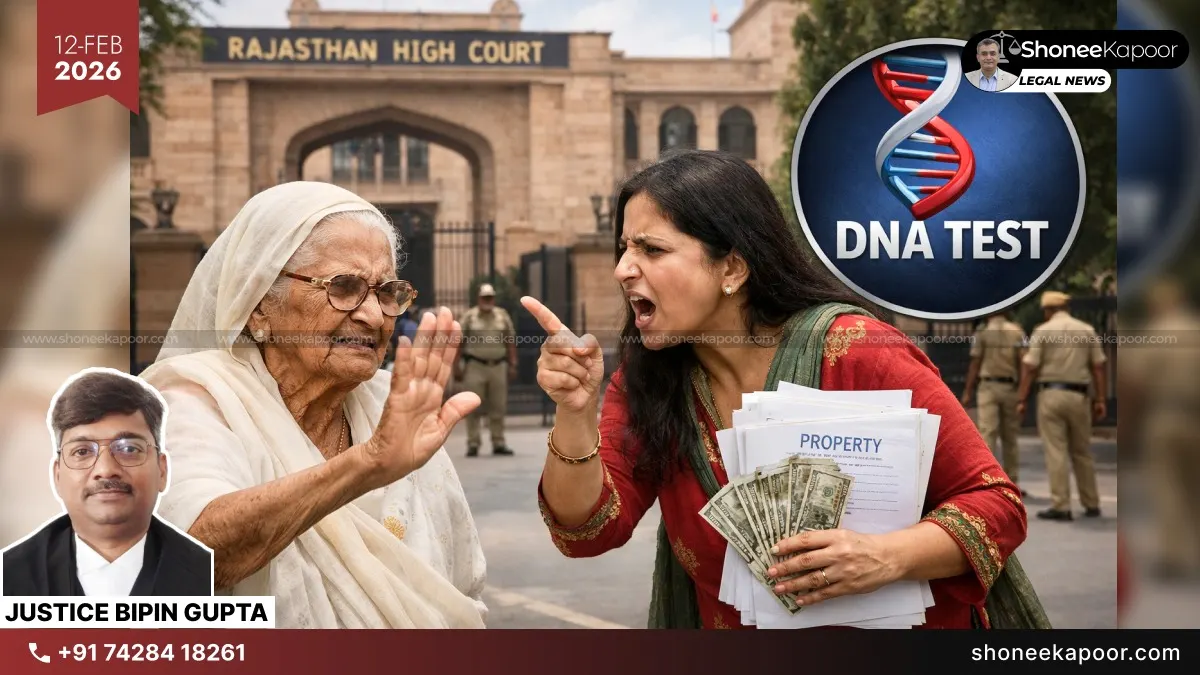
In a rare case, the Rajasthan High Court directed a 93-year-old woman to undergo DNA testing after she denied her own daughter in a property dispute. The Court held that while law presumes paternity, there is no similar presumption of maternity, and truth must be established through science.
JAIPUR: The Rajasthan High Court at Jaipur, in a rare and unusual ruling, directed a 93-year-old woman to undergo a DNA test to determine whether the petitioner is truly her biological daughter. The dispute arose in a long-pending ancestral property case where the elderly mother denied that the woman claiming a share was her daughter.
The case is titled S.B. Civil Writ Petition No. 5426/2022, decided on 07.02.2026 by Hon’ble Mr. Justice Bipin Gupta.
The petitioner filed a civil suit challenging a registered Will dated 10.04.2014 executed by her late father regarding ancestral agricultural property. She claimed that the property was ancestral in nature and that both she and her mother had a rightful share. She sought declaration that the Will was null and void and claimed half share in the property.
However, the mother, aged about 93 years, opposed the suit and denied that the petitioner was her daughter. She also denied that the petitioner was the daughter of her late husband, though she did not dispute her own marriage with him. This denial directly affected the petitioner’s right to claim any share in the ancestral property.
To resolve the issue, the petitioner filed an application under Order 26 Rule 10-A CPC seeking DNA testing of her alleged mother and also of another respondent who was claiming to be the son of the deceased father. The trial court rejected the application on the ground that it would affect the privacy of the defendants and that they had refused to undergo DNA testing.
Aggrieved by this rejection, the petitioner approached the High Court.
The High Court noted that the dispute was not about paternity in the usual sense. The mother was not denying her marriage. She was denying maternity. The Court clearly observed that this was not a routine situation.
The Court stated:
“…when a female counterpart is not disputing her marriage with a male, but she is denying the fact that a child is not her own, then it is not a case of testing the paternity, but rather a case to decide the maternity of the child…”
The Court further made a striking observation about the rarity of such cases:
“This Court is astonished by the fact that a mother denying a child to be hers is a rarest of rare cases, as in society it is usually the male who denies the paternity of a child on many grounds, including alleged infidelity of the wife.”
The Court examined Section 112 of the Indian Evidence Act, 1872 and Section 116 of the Bharatiya Sakshya Adhiniyam, 2023. These provisions create a presumption regarding legitimacy when a child is born during the subsistence of a valid marriage.
Section 112 of the Act of 1872 reads as under:
“112. Birth during marriage, conclusive proof of legitimacy.
The fact that any person was born during the continuance of a valid marriage between his mother and any man, or within two hundred and eighty days after its dissolution, the mother remaining unmarried, shall be conclusive proof that he is the legitimate son of that man, unless it can be shown that the parties to the marriage had no access to each other at any time when he could have been begotten.”
Section 116 of the BSA, 2023 reads as under:
“116. Birth during marriage, conclusive proof of legitmacy.
The fact that any person was born during the continuance of a valid marriage between his mother and any man, or within two hundred and eighty days after its dissolution, the mother remaining unmarried, shall be conclusive proof that he is the legitimate child of that man, unless it can be shown that the parties to the marriage had no access to each other at any time when he could have been begotten.”
The High Court pointed out that these provisions create a presumption regarding the father. There is no similar statutory presumption regarding maternity.
The Court framed the central issue in clear terms:
“Thus, the question that arises before this Court is that, when there is no statutory presumption in respect of a woman under the said provisions, how a person born to a female is to prove that the woman whom he or she claims to be his or her mother is, in fact, the natural mother.”
Further emphasizing the practical difficulty faced by a child in such a situation, the Court observed:
“In the modern world, where everything has become materialistic, it is easy to admit or deny the parenthood of a child. However, it is extremely difficult for a child to prove that a particular person is his or her parent.”
The Court acknowledged privacy concerns but clarified the legal position. It held that a person cannot be physically forced to undergo a DNA test. However, the Court can direct a person to undergo such testing, and if that person refuses, adverse presumption may follow under Section 114 of the Evidence Act and Section 119 of the BSA, 2023.
Relying on Supreme Court precedents, the High Court reiterated that DNA tests should not be ordered casually. There must be strong prima facie grounds and the test must be necessary for reaching the truth. At the same time, when scientific evidence is available, courts should not ignore it in favour of mere presumptions.
The judgment also referred to the principle laid down by the Supreme Court that when there is conflict between legal presumption and scientific proof, and when truth can be established through reliable scientific methods, courts must lean towards truth.
As quoted in the judgment:
“Truth must triumph” is the hallmark of justice.
On facts, the High Court found that the trial court had wrongly rejected the DNA application. The issue of maternity was central to deciding the petitioner’s right in the ancestral property. Without determining whether she was indeed the daughter, the property dispute could not be properly adjudicated.
Accordingly, the High Court allowed the writ petition. It set aside the trial court’s order and directed that the 93-year-old mother undergo DNA testing. The DNA of the petitioner is to be matched with that of the mother to determine maternity. The Court also clarified that if the mother refuses to undergo the DNA test, consequences as per Section 119 of the BSA, 2023 and Illustration (h) would follow in favour of the petitioner.
Importantly, the Court declined to order DNA testing of the other respondent who claimed to be the son, holding that it was for him to independently prove his status.
This ruling is significant because it clearly recognizes a legislative gap: while law presumes paternity in certain circumstances, it does not create a statutory presumption of maternity. In a property dispute where lineage determines legal rights, scientific evidence becomes the only reliable path to justice.
The case also indirectly highlights how denial of parentage, whether by a father or a mother, can deeply impact inheritance rights and property claims. When family disputes turn into legal battles, truth cannot depend only on oral statements. Courts must rely on objective evidence, especially where valuable ancestral property is involved.
Explanatory Table Of Laws And Sections Referred In The Case
| Law / Provision | What It Says | Why It Was Important in This Case | Court’s Interpretation |
| Order 26 Rule 10-A CPC | Allows court to issue commission for scientific investigation, including DNA testing | Petitioner filed application seeking DNA test of alleged mother to prove maternity | Trial court rejected it; High Court set aside rejection and allowed DNA test |
| Section 112, Indian Evidence Act, 1872 | Presumes legitimacy of a child born during subsistence of valid marriage or within 280 days of its dissolution | Respondents argued presumption protects legitimacy | Court held it creates presumption of paternity, not maternity |
| Section 116, Bharatiya Sakshya Adhiniyam, 2023 | Replaces “son” with “child” but continues presumption regarding birth during valid marriage | Examined to see if maternity is presumed | Court held legislature never contemplated situation where mother denies child |
| Section 114, Indian Evidence Act, 1872 | Court may presume existence of certain facts based on conduct and circumstances | Applied if person refuses DNA test | If mother refuses test, adverse presumption may be drawn |
| Illustration (h), Section 114 | If a person refuses to answer a question he is not compelled to answer, adverse inference may be drawn | Relevant in case of refusal to undergo DNA test | Court held refusal can work against denying party |
| Section 119, Bharatiya Sakshya Adhiniyam, 2023 | Corresponding provision to Section 114 of Evidence Act | Governs adverse inference under new evidence regime | Consequences to follow if DNA test is refused |
| Supreme Court in Dipanwita Roy v. Ronobroto Roy (2015) 1 SCC 365 | DNA test can be ordered if “eminently needed” after balancing privacy and truth | Cited for principle that court may permit DNA test | High Court relied on this to justify ordering DNA test |
| Supreme Court in Nandlal Wasudeo Badwaik v. Lata Nandlal Badwaik (2014) 2 SCC 576 | When scientific DNA evidence conflicts with presumption, truth must prevail | Strong precedent favouring scientific proof | Court emphasized that presumption must yield to scientific truth |
| Section 116 BSA read with Section 112 Evidence Act | Legislative presumption tied to father’s status | No equivalent statutory presumption for maternity | Core legal gap highlighted by Court |
Case Details
- Case Title: Smt. Bhauri Devi v Mahendra Kumar & Ors.
- Case Number: S.B. Civil Writ Petition No. 5426/2022
- Petitioner: Smt. Bhauri Devi D/o Badri, Wife of Late Bhaurilal
- Respondents:
- Mahendra Kumar S/o Sarvan
- Smt. Bila Devi W/o Late Badri (Aged about 93 years)
- Ramswaroop S/o Late Badrinarayan
- Neutral Citation: 2026:RJ-JP:5770
- Court: High Court of Judicature for Rajasthan, Bench at Jaipur
- Bench: Hon’ble Mr. Justice Bipin Gupta
- Date of Hearing and Conclusion of Arguments: 29.01.2026
- Date of Reservation of Judgment: 29.01.2026
- Date of Pronouncement: 07.02.2026
- Nature of Pronouncement: Full Judgment
- Counsel for Petitioner:
- Mr. Anil Mehta, Senior Advocate
- Assisted by Mr. Raj Kamal Gaur
- Mr. Yashodhar Pandey
- Counsel for Respondents:
- Mr. Prahlad Sharma with
- Mr. Ramprasad Sharma
- Mr. Khem Singh Rajawat
- Mr. Lakhan Sharma
- Mr. Akshay Sharma
Key Takeaways
- Law presumes paternity under Section 112 Evidence Act, but there is no statutory presumption of maternity — a clear legislative gap exposed by this case.
- A mother denying her own child in a property dispute can no longer rely on emotional narratives; courts can order scientific DNA testing to establish truth.
- Privacy cannot be used as a shield to block justice. Refusal to undergo DNA test can invite adverse presumption under Section 114 Evidence Act and Section 119 BSA.
- Scientific evidence prevails over legal fiction. When DNA establishes biological truth, presumptions must yield.
- Inheritance disputes often turn into identity disputes. This judgment reinforces that lineage affecting property rights must be proved, not merely asserted or denied.
This Could Change Your Case-Get FREE Legal Advice-Click Here!
Disclaimer: The views and opinions expressed in this article are those of the Indian courts and do not necessarily reflect the official policy or position of “ShoneeKapoor.com” or its affiliates. This article is intended for informational and educational purposes only. The content provided is not legal advice, and viewers should not act upon this information without seeking professional counsel. Viewer discretion is advised.
