
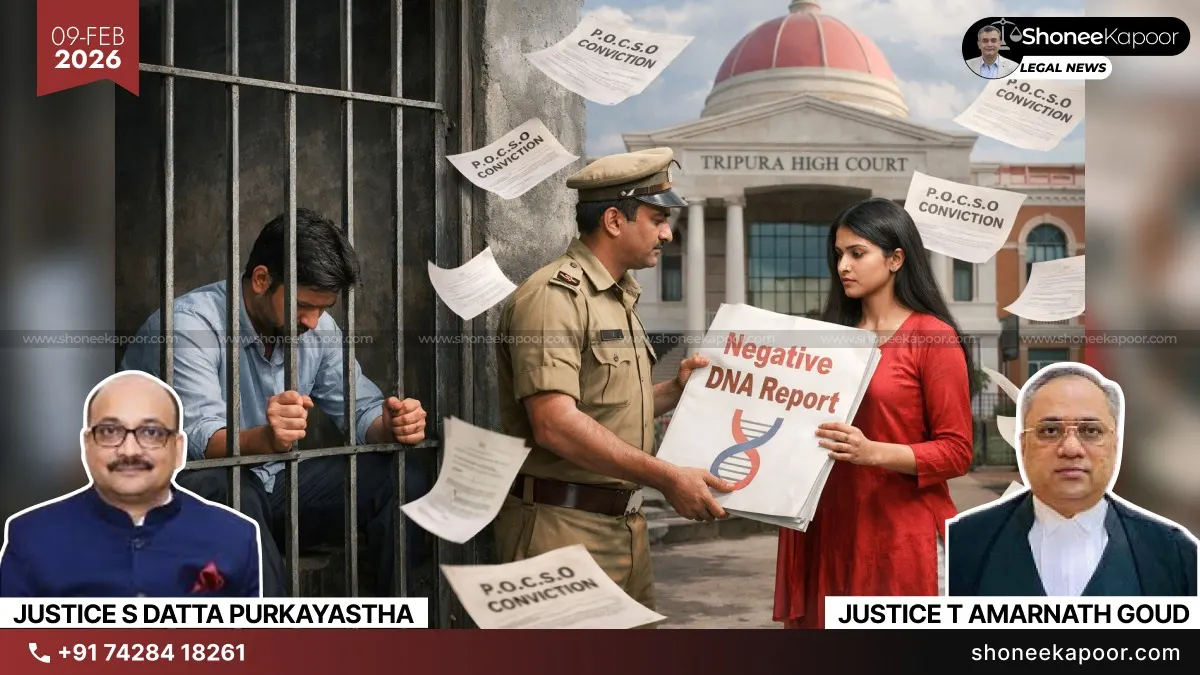
The Tripura High Court ruled that a negative DNA report only rules out paternity, not the offence of rape, and upheld a 20-year sentence under POCSO. At the same time, the Court set aside the younger brother’s conviction due to serious inconsistencies, underscoring the need for scrutiny in such cases.
AGARTALA: In a judgment dealing with the role of DNA evidence in sexual offence cases, the Tripura High Court has held that a negative DNA test report cannot by itself lead to the conclusion that the accused did not commit rape. The Court held that such a report only disproves the paternity of the child and does not automatically wipe out allegations of sexual assault.
AGARTALA: In a judgment dealing with the role of DNA evidence in sexual offence cases, the Tripura High Court has held that a negative DNA test report cannot by itself lead to the conclusion that the accused did not commit rape. The Court held that such a report only disproves the paternity of the child and does not automatically wipe out allegations of sexual assault.
The Court noted that the trial court had relied mainly on the victim’s testimony, supported by other circumstances, including the accused’s family. According to the prosecution, money was allegedly paid to arrange an abortion, and a marriage was later performed in a temple between the accused and the victim, which the Court treated asCCourtborative conduct.
At the same time, the High Court drew a clear line between emotional narratives and legal proof. While it sustained the conviction of the first accused, it set aside the conviction of the younger brother, citing serious gaps and contradictions in the prosecution’s case against him.
As per the prosecution’s February 26, 2021, statement, the minor victim lodged a complaint stating that about a year earlier, she had gone to the house of the accused, who was her neighbour, where she was subjected to forceful sexual intercourse. She further alleged that the acts continued repeatedly because the accused threatened her and warned her not to disclose the incidents.
The victim also claimed that the younger brother of the main accused blackmailed her and later assaulted her multiple times in a jungle. Over time, she became pregnant, and when this fact came to the notice of the father of the main accused, she was taken to a hospital where the doctor refused to abort the pregnancy.
It was alleged that after a few days, the main accused married the victim in a temple in the presence of parents from both sides, but she was not taken to his house. Later, the father of the accused allegedly came to her house, paid Rs. 40,000 to her father, and asked that the pregnancy be terminated. However, since the pregnancy was already at an advanced stage, the abortion could not be carried out, and after a few months, the victim gave birth to a son.
Following the trial, the Special Judge (POCSO), North Tripura, convicted both brothers and sentenced them to 20 years’ imprisonment. This conviction was challenged before the High Court, mainly on the ground that the DNA profile of the child did not match that of the accused persons, making the conviction illegal.
The defence argued that once the DNA report ruled out paternity, the entire prosecution case collapsed. On the other hand, the Additional Public Prosecutor for the State contended that the victim’s testimony was clear and trustworthy, and that the paternity test was not decisive for determining the offence of rape.
While addressing these arguments, the High Court explained the legal value of DNA evidence in rape cases. It made clear that such scientific evidence is meant to assist the court, not to inform the court of the entire record.
The Bench categorically held:
“…merely because of DNA test has negative result cannot lead to the conclusion that the victim was not raped by the accused. The purpose of DNA test in rape case is to facilitate the prosecution to prove its case against the accused and merely because the DNA test has a negative report, it does not exonerate the accused from the offence. However, it exonerates from the paternity of the child.”
Despite the negative DNA report, the Court found it deCourted as strong corroborative evidence against the first appellant. It referred to the investigation findings that the father of the accused had approached the victim’s father during the pregnancy, and paid Rs. 40,000 to arrange an abortion. This fact was supported by independent witnesses and the victim’s parents.
Examining this conduct, the Bench observed:
“It clearly means that the father of the accused had knowledge that there was a relation between the victim and the accused and it may have resulted in pregnancy of the victim”.
The Court also held that the victim was only 17 years old and that the defence did not seriously challenge this crucial fact during cross-examination. It further held that the evidence showed the first accused had initially established sexual relations on the promise of marriage and later continued the acts by putting the victim under fear.
Based on these findings, the High Court affirmed the conviction and sentence of the first accused.
However, when it came to the second accused, the Court took a non-Courtly cautious approach. After closely examining the depositions, the Bench found major inconsistencies and highlighted that the victim and close relatives were completely silent about the alleged involvement of the younger brother.
The Court noted that it made allegations against him, that the absence of support from her own family members, and the contradictions in the prosecution raised serious doubt. Emphasising the need to protect individuals from wrongful conviction based on shaky evidence, the Bench remarked:
“The discrepancies which are found in this case in respect to the appellant No. 2, appeared to be abnormal in nature which is not expected from a normal person”.
This part of the judgment quietly underlines a crucial principle of criminal law. While courts must protect victims, they must also remain alert to inconsistencies and the real risk of innocent persons being dragged into serious cases without solid proof.
Explanatory Table of Laws and Sections Involved
| Law and Section | Purpose | How Applied in This Case |
| IPC Section 376(2)(n) | Punishes repeated rape by the same offender | Applied against accused No.1 for alleged repeated sexual acts with a minor victim |
| IPC Section 506 | Punishes criminal intimidation | Applied as the victim alleged threats were used to silence her |
| POCSO Act, 2012 – Section 6 | Provides enhanced punishment for aggravated penetrative sexual assault on a child | Applied as the victim alleged that threats were used to silence her |
| DNA Profiling (Forensic Evidence) | Scientific tool to determine biological relationship or involvement | Used to convict accused No.1, considering the victim was below 18 years of age |
- Case Title: Prasanta Debnath & Anr. vs State of Tripura
- Court: Tripura High Court
- Bench: Justice T Amarnath Goud & Justice S Datta Purkayastha
Key Takeaways
- A negative DNA report clears a man of paternity but still does not protect him from a rape conviction, highlighting how scientific evidence can be sidelined.
- Convictions can rest primarily on testimony, even when forensic proof does not support biological linkage, placing accused men in a legally vulnerable position.
- Family members of accused men can be pulled into cases without solid corroboration, as seen by the initial conviction of the younger brother.
- The acquittal of Accused No.2 confirms that contradictions and lack of independent support matter, but only after years of litigation and stigma.
- The case underlines the urgent need for stronger safeguards so innocent men are not punished based on assumptions, pressure narratives, or incomplete evidence.
This Could Change Your Case-Get FREE Legal Advice-Click Here!
Disclaimer: The views and opinions expressed in this article are those of the Indian courts and do not necessarily reflect the official policy or position of “ShoneeKapoor.com” or its affiliates. This article is intended for informational and educational purposes only. The content provided is not legal advice, and viewers should not act upon this information without seeking professional counsel. Viewer discretion is advised.
