
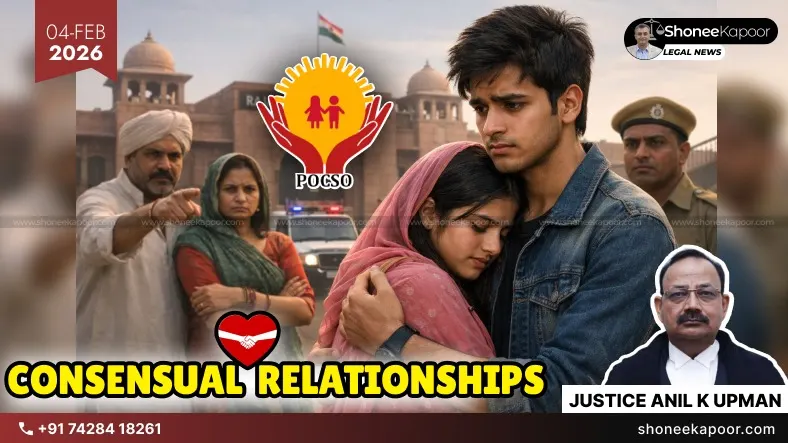
The Rajasthan High Court protected a 19-year-old boy from prosecution, holding that a consensual relationship with a near-major 17-year-old girl who was with him of her own free will, cannot be criminalised under POCSO or kidnapping laws.
JAIPUR: The Rajasthan High Court, through Justice Anil Kumar Upman, has quashed an FIR and all criminal proceedings against a 19-year-old boy who was prosecuted under serious provisions of the Bharatiya Nyaya Sanhita and the POCSO Act, even though the girl repeatedly stated that no sexual assault had taken place and that she had left her home voluntarily.
The case arose from an FIR registered at Kaladera, Jaipur Rural, alleging kidnapping and aggravated penetrative sexual assault. Following the investigation, the police filed a chargesheet and the trial court framed charges in a mechanical manner, exposing the young man to the risk of a minimum twenty-year sentence, despite the absence of any supporting evidence.
On examining the record, the High Court noted that the girl had clearly stated that no sexual relationship, whether consensual or otherwise, had occurred between her and the accused.
The Court also took note of the medical examination report, which showed no indication of sexual assault. On these facts, the Court found that the basic ingredients of the alleged offences were missing and that the criminal law had been wrongly set in motion.
Expressing serious concern over the police action, the Court observed:
“It is incomprehensible for this Court as to how the investigating agency, in the face of an uncorroborated medical report and a categorical denial by the victim herself, could arrive at a conclusion of filing a charge-sheet with the offence punishable under Section 3/4 of the POCSO Act.”
The High Court also criticised the trial court for failing to act as a judicial safeguard, reiterating settled law that a court cannot act as “a mere post office or a mouthpiece of the prosecution.” It held that charges were framed “for a crime that has not been alleged or is supported by a single piece of evidence.”
While dealing with the kidnapping charge, the Court relied on the Constitution Bench judgment in S. Varadarajan v. State of Madras, quoting that:
“There is a distinction between ‘taking’ and allowing a minor to accompany a person.”
The judgment further reproduced that where a minor left her father’s protection knowing and having capacity to know the full import of what she was doing voluntarily joins the accused person, the offence of kidnapping is not made out.
Applying this principle, the Court held that:
“The petitioner did not ‘take’ her; he merely provided company to a young girl who had already decided to leave her home.”
The Court emphasised that the girl was 17 years old, close to majority, pursuing higher studies, and capable of understanding her actions.
It clarified that POCSO was enacted to protect children from predators, not “to persecute young adults involved in consensual, albeit socially unaccepted, relationships.”
Relying on recent Supreme Court observations, the High Court reproduced the warning that:
“When an instrument of such noble and one may even say basic good intent is misused, misapplied and used as a tool for exacting revenge, the notion of justice itself teeters on the edge of inversion.”
It also reproduced the guiding principles requiring courts to “assess the context,” “consider victim’s statement,” “avoid perversity of justice,” and exercise “judicial discretion.”
Drawing parallels with other criminal laws, the Court noted that:
“This chasm between access and abuse is also mirrored in the misuse of Section 498-A IPC and the Dowry Prohibition Act, 1961,”
and reminded lawyers of their ethical duty, stating that:
“The responsibility of the advocate is profound – to examine the allegations with detachment and necessary discretion and to counsel restraint when grievance masks vengeance.”
In a broader reflection, the Court discussed the rise of so-called Romeo-Juliet cases, warning that rigid age-of-consent laws create “statutory victims” and lead to “State-sponsored harassment” rather than genuine child protection. It cautioned that such prosecutions end up “criminalizing teenage love” and destroying young lives.
Finally, the Rajasthan High Court stepped in to prevent a clear miscarriage of justice by invoking its inherent powers under Section 528 of the BNSS. The Court found that the prosecution was built on assumptions rather than evidence, that the core ingredients of the alleged offences were completely missing, and that continuing the criminal proceedings would only result in harassment of a young man.
By quashing the FIR and all related proceedings, the Court reaffirmed that criminal law cannot be allowed to be misused to settle social or familial disapproval and that the justice system must protect individuals from mechanical and vindictive prosecutions.
Explanatory Table – Laws & Sections Involved
| Law & Section | What the Section Deals With | How the Court Viewed Its Use in This Case |
| Bharatiya Nyaya Sanhita, 2023 – Section 137(2) | Kidnapping / abduction of a minor | Held not applicable as the girl left home voluntarily; no inducement or “taking” by the accused |
| Bharatiya Nyaya Sanhita, 2023 – Section 96 | Sexual offence related provision | No allegation or evidence of any sexual act; essential ingredients absent |
| Bharatiya Nyaya Sanhita, 2023 – Section 64(2)(m) | Aggravated sexual offence | Charges framed mechanically without factual foundation |
| Bharatiya Nyaya Sanhita, 2023 – Section 87 | Associated offence provision | Automatically failed once core offences were not made out |
| Bharatiya Nyaya Sanhita, 2023 – Section 528 | Inherent powers of High Court (equivalent to Section 482 CrPC) | Used to quash FIR and proceedings to prevent abuse of process |
| POCSO Act, 2012 – Sections 3 & 4 | Penetrative sexual assault | No medical or testimonial evidence; wrongly invoked |
| POCSO Act, 2012 – Section 5(l) | Aggravated penetrative sexual assault | Court found inclusion shocking and unjustified |
| POCSO Act, 2012 – Section 6 | Punishment for aggravated penetrative sexual assault (minimum 20 years) | Grossly disproportionate and misapplied in absence of any offence |
| BNSS – Sections 180 & 183 | Victim statements before police and magistrate | Victim consistently denied sexual assault or coercion |
| IPC – Section 361 (via precedent) | Kidnapping from lawful guardianship | Not attracted as per settled Supreme Court law |
| Supreme Court – S. Varadarajan v. State of Madras | Distinction between “taking” and “accompanying” | Directly applied to reject kidnapping charge |
| Supreme Court – Dilawar Balu Kurane v. State of Maharashtra | Duty of courts at stage of framing charge | Trial court criticised for acting as a post office |
Case Details
- Case Title: Aryan S/o Parshuram v. State of Rajasthan & Ors.
- Court: High Court of Judicature for Rajasthan, Bench at Jaipur
- Bench: Hon’ble Mr. Justice Anil Kumar Upman
- Neutral Citation: 2026:RJ-JP:3628
- Case Number: S.B. Criminal Miscellaneous (Petition) No. 88/2026
- Date of Judgment: 12 January 2026
- Counsels:
- For Petitioner: Mr. Prakhar Gupta, Advocate
- For State: Mr. Amit Punia, Public Prosecutor
- For Complainant / Victim: Mr. Harshit Tiwari, Advocate, and Ms. Anindya Gupta, Advocate
Key Takeaways
- POCSO is being misused as a punishment tool, not a protection law, in consensual age-proximate relationships—destroying young men’s lives without evidence.
- Consent denial by the girl and clean medical reports were ignored, showing how police and courts often proceed first and look for proof later.
- Kidnapping laws cannot apply when a girl leaves voluntarily—the Supreme Court’s settled law on “accompanying vs taking” is still routinely violated.
- Trial courts acting as prosecution post offices are a systemic failure, forcing innocent men to face decades of imprisonment for non-crimes.
- Urgent need for a Romeo–Juliet / close-age exception, or men will continue to be criminalised for relationships that society disapproves, not crimes they committed.
This Could Change Your Case-Get FREE Legal Advice-Click Here!
Disclaimer: The views and opinions expressed in this article are those of the Indian courts and do not necessarily reflect the official policy or position of “ShoneeKapoor.com” or its affiliates. This article is intended for informational and educational purposes only. The content provided is not legal advice, and viewers should not act upon this information without seeking professional counsel. Viewer discretion is advised.
