
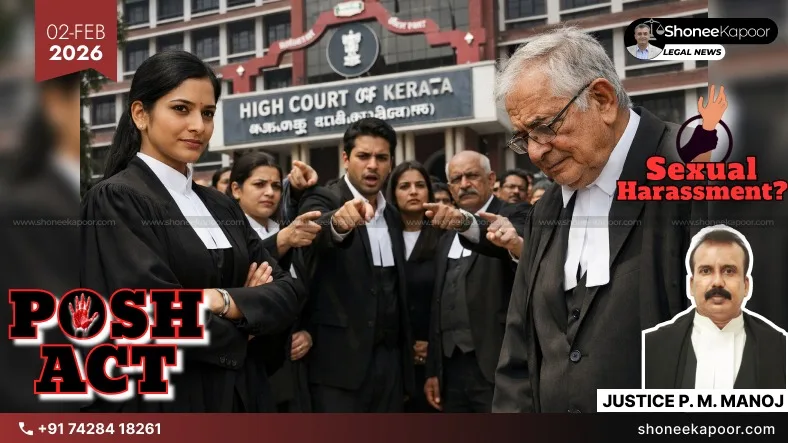
The Kerala High Court has ruled that Bar Associations are not “employers” under the POSH Act and cannot conduct sexual harassment inquiries against advocates. The Court quashed the ICC report and suspension of a 76-year-old lawyer, calling the entire process legally unsustainable.
KERALA: The Kerala High Court has delivered an important judgment that clearly limits the misuse of the POSH Act within professional bodies like Bar Associations. The case arose from a complaint made by a junior woman advocate against a senior advocate, alleging misconduct during a visit to his premises.
The complainant had approached the Bar Association, which then constituted an Internal Complaints Committee (ICC) under the POSH Act and conducted an inquiry. Based on the ICC report, the Bar Association suspended the senior advocate. This action was challenged before the High Court, where Justice P. M. Manoj examined the legality of the ICC’s constitution and the consequential suspension.
The Court framed the core issue very clearly at the beginning itself:
“The primary issues to be considered in this Writ Petition are the legality of the constitution of the Internal Complaints Committee (‘ICC’ for short) under the provisions of the Sexual Harassment of Women at Workplace (Prevention, Prohibition and Redressal) Act, 2013 (for short, the POSH Act), the enquiry conducted by the said committee, and the challenge to the suspension order issued against the petitioner by the Kollam Bar Association.”
The judge noted that the alleged incident did not take place inside the Bar Association premises, but at the private residence of the advocate. The Court recorded: “The alleged incident occurred on 14.06.2024 at the petitioner’s residence.”
The Court also highlighted that both parties were members of the Bar Association and not employees. The judge observed that the Bar Association functions more like a club of professionals rather than an employer controlling employees.
On the maintainability of the writ petition, the Court rejected the argument that Bar Associations are beyond judicial review and held: “This Court has every jurisdiction to entertain the writ petition.”
After examining the structure and powers of Bar Associations, the Court made a crucial finding that became the turning point of the case. The judge categorically stated:
“The Bar Association cannot be treated as an ‘employer’.”
The Court further held that the power to form an ICC is strictly limited and cannot be assumed by every organisation merely because a complaint is made. The judgment records:
“The formation of the ICC does not qualify under the mandate of Section 4 of the PoSH Act.”
In one of the most important observations, the Court clearly concluded:
“The constitution of the ICC by the first respondent is itself against the objective and specific requirements of Section 4 of the PoSH Act.”
Because the very formation of the ICC was illegal, the Court held that everything flowing from it automatically collapses. The judge stated in unambiguous terms:
“The report submitted by the ICC (Ext. P8) has no legal basis to stand upon.”
Accordingly, the Court passed a decisive order: “Ext. P8 should be set aside.”
The Court consciously avoided commenting on the truth or falsity of the allegations and clarified its limited scope:
“The rest of the contentions concerning the facts and merits of the alleged incident are left open.”
By doing so, the Court made it clear that criminal proceedings, if any, and other legal remedies may continue independently, but the POSH mechanism cannot be misused by bodies that have no legal authority to invoke it.
This judgment is a strong reminder that procedural safeguards matter. Even sensitive allegations cannot justify bypassing legal limits. The Court reaffirmed that law must be applied strictly as written, and not stretched based on emotions or public pressure.
The ruling sets an important precedent for advocates, professionals, and associations across India, making it clear that POSH law cannot be weaponised by non-employer bodies, and that illegal committees cannot decide careers or reputations.
Explanatory Table – Laws & Sections Involved
| Law & Section | Purpose | How Applied in This Case |
| POSH Act – Section 2(a) | Defines who is an “aggrieved woman” | Considered to decide whether the complainant could invoke POSH mechanism |
| POSH Act – Section 2(g) | Defines “employer” | Examined to determine whether a Bar Association can legally be an employer |
| POSH Act – Section 2(n) | Defines “sexual harassment” | Referred while outlining the scope of allegations |
| POSH Act – Section 2(o) | Defines “workplace” | Considered to assess whether a private residence used by an advocate qualifies |
| POSH Act – Section 3 | Prohibits sexual harassment at workplace | Mentioned as part of statutory framework governing complaints |
| POSH Act – Section 4 | Provides for constitution of Internal Complaints Committee (ICC) | Central provision examined to test legality of ICC formed by Bar Association |
| POSH Act – Section 9 | Procedure for filing complaint | Referred while tracing how the complaint was initiated |
| Indian Penal Code, 1860 – Section 354 | Assault or criminal force to woman | Mentioned in relation to FIR registered by police |
| Indian Penal Code, 1860 – Section 354A | Sexual harassment offence | Part of criminal proceedings parallel to POSH inquiry |
| Constitution of India – Article 226 | Power of High Court to issue writs | Basis for entertaining the writ petition against ICC report |
| Advocates Act, 1961 – Section 3 | Establishment of State Bar Councils | Referred while identifying statutory authority over advocates |
| Advocates Act, 1961 – Section 6 | Functions of State Bar Councils | Considered while discussing who can discipline advocates |
| Advocates Act, 1961 – Section 35 | Disciplinary proceedings against advocates | Referred as proper statutory route for professional misconduct |
| Kerala Advocates Welfare Fund Act, 1980 – Section 13 | Recognition of Bar Associations | Mentioned to explain limited statutory recognition |
| Kerala Advocates Welfare Fund Act, 1980 – Section 14 | Duties of Bar Associations | Examined to show welfare-focused role, not employer role |
| Travancore Companies Regulation, 1092 – Section 26 | Registration of associations | Used to note registration status of Kollam Bar Association |
| Code of Criminal Procedure, 1973 – Section 202 | Inquiry before process | Mentioned in related criminal proceedings |
Case Details
- Case Title: E. Shanavas Khan v. The Kollam Bar Association & Ors., WP(C) No. 39539 of 2024
- Court: High Court of Kerala at Ernakulam
- Neutral Citation: 2026:KER:6220
- Date of Judgment: 27 January 2026
- Bench: Hon’ble Mr. Justice P. M. Manoj
- Counsels:
- For Petitioner: Sri. S. Sreekumar, Senior Advocate, Sri. S. Sreekumar (Kollam), Sri. S. Navas, Sri. K. Vijayan, Smt. Namitha Rajesh, and Smt. Nithya V. D.
- For the Respondents: Sri. K. Siju, Smt. T. S. Maya (Thiyyadiyil), Sri. C. M. Mohammed Iqbal, along with other appearing advocates
Key Takeaways
- POSH law cannot be stretched beyond its limits, Bar Associations are not employers, and they cannot run Internal Complaints Committees against advocates.
- Illegal ICCs mean illegal outcomes. If the committee itself has no authority, its report and any punishment based on it collapse automatically.
- Professional bodies cannot bypass due process. Allegations against advocates must go to the Bar Council or criminal courts, not ad-hoc POSH panels.
- Parallel misuse of criminal law and POSH law is dangerous. Criminal cases may continue, but POSH cannot be used as a shortcut to suspend or destroy a man’s career.
- False or unproven allegations cannot be used to bypass due process, enable institutional overreach, or justify career-ending punishment without clear authority of law.
This Could Change Your Case-Get FREE Legal Advice-Click Here!
Disclaimer: The views and opinions expressed in this article are those of the Indian courts and do not necessarily reflect the official policy or position of “ShoneeKapoor.com” or its affiliates. This article is intended for informational and educational purposes only. The content provided is not legal advice, and viewers should not act upon this information without seeking professional counsel. Viewer discretion is advised.
