
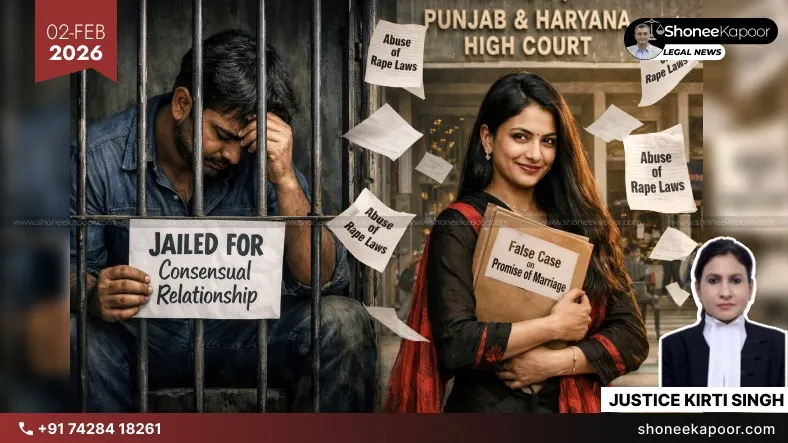
The Punjab and Haryana High Court has quashed a rape FIR filed on the pretext of marriage, holding that a consensual relationship turning sour cannot be treated as a criminal offence. The Court strongly cautioned against misuse of serious criminal laws that destroy reputations and lives without foundational facts.
CHANDIGARH: In an important judgment exposing the growing misuse of criminal law in personal relationships, the Punjab and Haryana High Court quashed an FIR alleging rape on the false promise of marriage, observing that criminal proceedings were being used as a tool of harassment rather than justice.
The petition was filed under Section 528 of BNSS, 2023, seeking quashing of FIR No.159 dated 17.07.2025 registered at Police Station Jandiala Guru, District Amritsar (Rural), along with the challan and all consequential proceedings. The matter was decided by Justice Kirti Singh on 23 January 2026.
The FIR originated from a complaint by a woman who alleged that the petitioner committed rape on 13.06.2025 in his hospital by making a false promise of marriage and later refusing to marry her. According to the complaint, the parties had met through a matrimonial website and interacted voluntarily. The complainant herself admitted that she was divorced in 2023 and was seeking remarriage. She alleged that physical relations were established in the doctor’s hospital office on the assurance of marriage.
The Court noted that before registration of the FIR, the complainant had already approached the Women Cell, Amritsar (Rural), where a detailed inquiry was conducted. After verification, the allegations were found to be false and the complaint was ordered to be consigned to the record room. Despite this, the FIR was registered later after senior police officers disagreed with the initial inquiry.
Counsel for the petitioner, Mr. Atul Goyal, Advocate (Partner – Tripaksha Litigation), argued that the case was a clear attempt to falsely implicate and extort the petitioner. It was pointed out that the complainant had a history of filing similar cases, with multiple FIRs registered at her instance against different men. This pattern, the Court observed, could not be ignored while examining whether criminal law was being misused.
The petitioner further contended that the complainant had created a fake matrimonial profile using a false name, concealed her real identity and children, and later demanded ₹10 lakh from him. When the petitioner verified her background and refused further contact, the present allegations were made. The Court also took note of serious contradictions in the complainant’s version, including claims about being confined in a locked OPD room, which were found to be factually incorrect during investigation.
Significantly, the Court highlighted the complainant’s conduct after the alleged incident. It was undisputed that she voluntarily accompanied the petitioner to his residence, had lunch with his family members, and continued to communicate with him thereafter. Such conduct, the Court observed, completely undermined the allegation of force or lack of consent.
While examining the law on sexual relations based on a promise of marriage, the Court relied heavily on recent Supreme Court rulings. Referring to Amol Bhagwal Nehul v. State of Maharashtra, the Court quoted:
“A consensual relationship turning sour or partners becoming distant cannot be a ground for invoking criminal machinery of the State. Such conduct not only burdens the Courts, but blots the identity of an individual accused of such a heinous offence.”
The Supreme Court further cautioned that treating every breach of promise as rape is a serious legal folly.
The Court also relied on Pradeep Kumar Kesarwani v. State of Uttar Pradesh, where the Supreme Court clearly distinguished between rape and consensual sex, holding that courts must carefully examine whether there was a dishonest intention at the very inception of the relationship.
It reiterated that:
“There is a clear distinction between rape and consensual sex, and criminal liability can arise only if the promise of marriage was false from the beginning.”
Applying these principles, the High Court held that the FIR did not disclose any material to show that the petitioner never intended to marry the complainant from the very start. The allegations were found to be bald assertions without foundational facts. The Court observed that a subsequent refusal to marry or breakdown of a relationship does not retrospectively convert consensual acts into criminal offences.
Another crucial factor weighed by the Court was the existence of multiple FIRs filed by the complainant and the closure of an earlier complaint on the same allegations. The Court warned that allowing such prosecutions to continue would permit the criminal process to be used as a weapon for personal vendetta rather than justice.
In a strong concluding observation, the Court held that continuation of the proceedings would amount to a “gross abuse of the process of law.” Accordingly, FIR No.159 dated 17.07.2025, the challan dated 29.10.2025, and all subsequent proceedings were quashed qua the petitioner.
This judgment once again highlights a harsh but often ignored reality: when criminal law is misused in private disputes, it is not just the accused who suffers. Careers are destroyed, reputations are permanently stained, and years of life are lost in litigation before truth finally prevails.
The ruling reinforces that courts must act as the first line of defence against such misuse, ensuring that serious laws meant to protect genuine victims are not turned into tools of oppression against innocent individuals, especially men, who are too often presumed guilty the moment an allegation is made.
Explanatory Table of All Laws & Sections Involved
| Law / Code | Section | Purpose | How the Court Viewed It |
| Bharatiya Nagarik Suraksha Sanhita, 2023 (BNSS) | Section 528 | Inherent powers of High Court to quash FIR and proceedings | Used to prevent abuse of criminal process where allegations do not disclose any offence |
| Bharatiya Nyaya Sanhita, 2023 (BNS) | Section 64 | Earlier provision relating to sexual offences | Deleted during proceedings; showed lack of clarity and shifting legal basis |
| Bharatiya Nyaya Sanhita, 2023 (BNS) | Section 69 | Sexual intercourse by deceit / false promise | Court held ingredients not made out due to lack of dishonest intent at inception |
| Bharatiya Nagarik Suraksha Sanhita, 2023 (BNSS) | Section 193(2) | Filing of police report / challan | Challan quashed as FIR itself was unsustainable |
| Bharatiya Nagarik Suraksha Sanhita, 2023 (BNSS) | Section 183 | Statement before Magistrate | Mere repetition of allegations not sufficient without foundational facts |
| Indian Penal Code, 1860 (Referenced via precedents) | Section 90 IPC | Consent under misconception of fact | Court held no misconception proved at initial stage |
| Code of Criminal Procedure, 1973 | Section 482 CrPC | Inherent powers of High Court | Principles applied by analogy under BNSS |
| Constitution of India | Article 226 | Extraordinary writ jurisdiction | Principles referenced through Supreme Court precedents |
Case Details
- Case Title: Dr. Sachin Sharma vs State of Punjab and Another
- Court: Punjab and Haryana High Court
- Case Number: CRM-M-66479-2025 (O&M)
- Date of Decision: 23.01.2026
- Bench: Justice Kirti Singh
- Counsels:
- Mr. Atul Goyal, Advocate (Partner – Tripaksha Litigation) for the Petitioner
- Ms. Aakanksha Gupta, AAG, Punjab for the State
- Mr. Kanav Goyal, Advocate (Legal Aid Counsel) for Respondent No.2
Key Takeaways
- Consensual relationships cannot be criminalised just because marriage did not happen later.
- Rape law cannot be used as a punishment tool after a relationship turns bitter.
- Courts must look beyond well-drafted FIRs and examine conduct, history, and surrounding facts.
- Multiple similar FIRs by the same complainant raise serious credibility concerns and demand strict scrutiny.
- Criminal law misuse destroys men’s careers, reputation, and life long before innocence is proven.
This Could Change Your Case-Get FREE Legal Advice-Click Here!
Disclaimer: The views and opinions expressed in this article are those of the Indian courts and do not necessarily reflect the official policy or position of “ShoneeKapoor.com” or its affiliates. This article is intended for informational and educational purposes only. The content provided is not legal advice, and viewers should not act upon this information without seeking professional counsel. Viewer discretion is advised.
