
The Allahabad High Court ruled that a wife cannot claim maintenance if her own conduct or that of her family made the husband incapable of earning. Granting maintenance in such cases would cause grave injustice to men rendered helpless by criminal acts.
PRAYAGRAJ: The Allahabad High Court has clearly held that a wife cannot take advantage of a situation where her own acts, or the acts of her family members, have destroyed her husband’s ability to earn a livelihood. The Court observed that maintenance law cannot be misused to extract financial support from a man who has been rendered physically incapable of working due to criminal violence originating from the wife’s side.
The Court stated that if a wife, by her own acts or omissions, causes or contributes to the incapacity of her husband to earn, she cannot be permitted to claim maintenance. It categorically warned that granting maintenance in such circumstances would result in “grave injustice”, especially where the husband’s earning capacity has been destroyed by criminal acts committed by the wife’s family.
While acknowledging the general principle that in Indian society a husband is expected to maintain his wife and family even if he does not have regular employment, the Court made it clear that this obligation is not absolute and cannot operate blindly against factual realities. The present case, the Court noted, stood on a completely different footing.
The Court recorded the crucial factual finding that:
“At an earlier stage, the opposite party was capable of maintaining his wife and had sufficient means, but his earning capacity was completely destroyed due to the criminal act committed by the brother and father of the revisionist”.
With these observations, the Single Judge dismissed the criminal revision petition filed by the wife seeking interim maintenance under Section 125 of the Criminal Procedure Code.
The matter arose from an order dated May 7, 2025, passed by the Additional Principal Judge, Family Court, Kushinagar at Padrauna, which had rejected the wife’s application for interim maintenance.
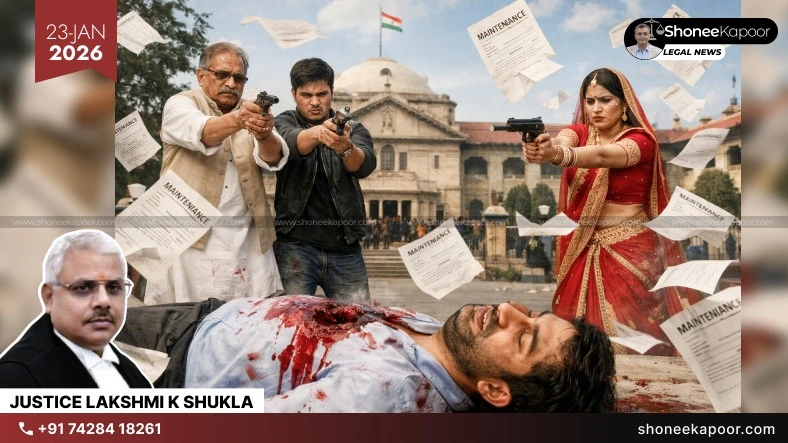
As per the findings on record, the husband was a practising homoeopathic doctor who was running his own clinic. However, on April 13, 2019, while he was attending to his professional duties, the real brother and father of the wife, along with other persons, reached his clinic and started abusing him. When the husband resisted, the wife’s brother opened fire at him.
The gunshot attack caused a serious firearm injury, with a pellet getting lodged in the bone of the husband’s spinal cord. Medical records placed before the Court showed that any attempt to surgically remove the pellet carried a high risk of paralysis. Because of this injury, the husband is unable to sit comfortably even for short periods and has become unemployed and incapable of earning any income.
Before the High Court, counsel for the revisionist-wife argued that the order rejecting interim maintenance was illegal and arbitrary, contending that a husband is bound to maintain his wife irrespective of circumstances.
The High Court, however, noted that the factual findings regarding the husband’s medical condition were not disputed. Justice Lakshmi Kant Shukla reiterated that although it is a pious obligation of a husband to maintain his wife, the law cannot ignore situations where the husband’s incapacity is directly caused by the conduct of the wife and her family members.
The Court observed that in Indian society, a husband is ordinarily expected to undertake suitable work according to his capacity to maintain his family, even without regular employment. However, in the present case, the Court emphasised that the husband’s capacity itself had been destroyed by criminal violence originating from the wife’s side.
Justice Shukla further observed that while maintenance laws are meant to prevent destitution, they cannot be converted into instruments of injustice against men who are physically incapacitated due to criminal acts beyond their control.
The Court relied upon the Supreme Court’s decision in Shamima Farooqui vs. Shahid Khan (2015), which held that a husband’s liability to maintain his wife is contingent upon his actual ability to earn. Applying this principle, the High Court held that since the husband’s physical incapacity, including the risk of paralysis from the bullet lodged in his spine, was caused by the revisionist’s side, he could not be held liable for failing to provide maintenance.
In light of the material on record, the Court concluded that the Trial Court had not committed any material irregularity or manifest illegality in rejecting the interim maintenance application. Consequently, the criminal revision petition was dismissed.
This judgment quietly but firmly reinforces an important legal truth: maintenance law is based on capacity, not gender-based assumptions. When a man’s earning ability is destroyed by criminal acts linked to the wife’s side, forcing him to pay maintenance would not be justice but punishment.
Explanatory Table: Laws & Sections Applied In The Case
| Law / Section | What the Law Provides | How the Court Applied It in This Case |
| Section 125 CrPC | Provides maintenance to wife, children, and parents if the person has sufficient means and neglects or refuses to maintain them | The Court examined whether the husband had “sufficient means” and held that physical incapacity destroyed his earning capacity |
| Section 125(1) CrPC | Maintenance is conditional on the respondent having the ability to earn | The husband’s inability to earn due to a spinal gunshot injury was decisive |
| Proviso to Section 125 CrPC (Interim Maintenance) | Allows courts to grant interim maintenance during proceedings | Interim maintenance was denied because capacity to earn was absent |
| Shamima Farooqui v. Shahid Khan (2015) 5 SCC 705 | Husband’s obligation to maintain is contingent upon his ability to earn | Relied upon to clarify that liability cannot exist when earning capacity is destroyed |
| Kalyan Dey Chowdhury v. Rita Dey Chowdhury (2017) 14 SCC 200 | Maintenance depends on status of parties and capacity to pay | Used to reinforce that financial ability is a core requirement |
| Jasbir Kaur Sehgal v. District Judge, Dehradun (1997) 7 SCC 7 | No fixed formula for maintenance; depends on facts and circumstances | Court emphasised fact-specific evaluation |
| Captain Ramesh Chander Kaushal v. Veena Kaushal (1978) 4 SCC 70 | Maintenance law is a measure of social justice | Court balanced social justice with factual injustice to an incapacitated husband |
Case Details
- Case Title: Vineeta v. Dr. Ved Prakash Singh
- Case Number: Criminal Revision No. 8658 of 2025
- Court: Allahabad High Court
- Bench: Hon’ble Justice Lakshmi Kant Shukla
- Date of Judgment: January 19, 2026
- Lower Court Order Challenged: Order dated 07.05.2025 passed by Additional Principal Judge, Family Court, Kushinagar at Padrauna in Case No. 600 of 2019
- Counsels: Counsel for Revisionist (Wife): Dinesh Kumar Singh, Gaurav Suryavanshi & Counsel for Opposite Party (Husband): Not mentioned in the order
- Outcome: Criminal Revision dismissed; rejection of interim maintenance upheld
Key Takeaways
- Maintenance is not a gender-based entitlement; it is strictly linked to a man’s real ability to earn.
- If a husband’s earning capacity is destroyed due to criminal acts from the wife’s side, the law will not punish him further through maintenance.
- Courts are now acknowledging that men can be rendered helpless and financially crippled by violence and false assumptions.
- Maintenance law cannot be used as a weapon when injustice to the man is clearly established on record.
- This judgment reinforces that facts and fairness matter more than stereotypes in family law.
This Could Change Your Case-Get FREE Legal Advice-Click Here!
Disclaimer: The views and opinions expressed in this article are those of the Indian courts and do not necessarily reflect the official policy or position of “ShoneeKapoor.com” or its affiliates. This article is intended for informational and educational purposes only. The content provided is not legal advice, and viewers should not act upon this information without seeking professional counsel. Viewer discretion is advised.
