
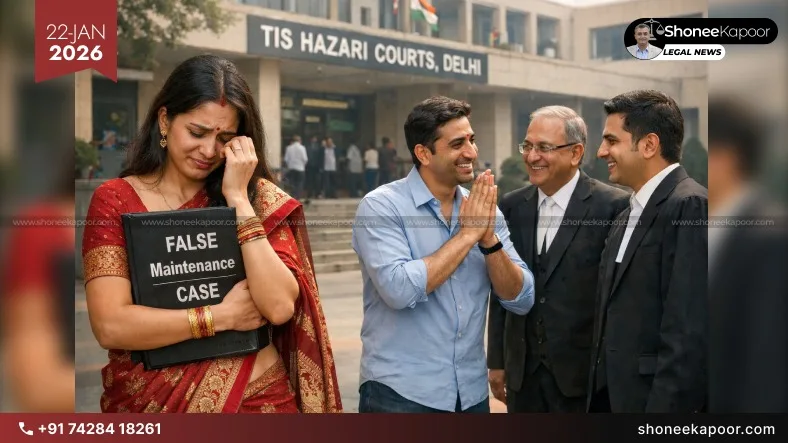
A Delhi court reduced an inflated maintenance demand after finding that the wife concealed facts and misrepresented her residence. The husband, defended by Tripaksha Litigation, was granted relief from unfair financial pressure.
NEW DELHI: In aninterim maintenance order highlighting the importance of truth and transparency in matrimonial litigation, a Delhi court reduced a wife’s maintenance claim from ₹25,000 to ₹8,000 per month after finding that she had concealed material facts and misrepresented her living arrangements.
The Court observed that the petitioner failed to approach the judiciary with clean hands and could not substantiate her allegations regarding the husband’s income, leading to a reasoned and evidence-based rejection of her inflated claims.
In this case, the wife approached the court claiming that she was a housewife, unemployed, fully dependent on her parents, and living in a rented accommodation. On this basis, she demanded interim maintenance of Rs.25,000 per month by alleging that the husband was earning between Rs.60,000 to Rs.70,000 per month from government service.
During arguments, it was brought on record that the husband was only contractually employed and that his contract had already expired. It was also submitted that he was presently unemployed and was making efforts to find a job. Despite this, he was still voluntarily paying rent of Rs.9,350 per month for the rented premises, even under financial stress.
A crucial issue before the Court was whether the wife was actually residing in the rented accommodation. Documentary evidence, including the electricity bill, showed extremely low electricity consumption of only 43 units for one month. This raised serious doubt about her claim of continuous residence. When the Court directly questioned her, the wife herself admitted that she does not stay there regularly and vaguely stated that she resides there “for more than a week.”
This admission proved fatal to her case. From her own statement, the Court concluded that she does not reside continuously in the rented premises and spends most of her time at her parental home. The Court also noted that she had received legal notices sent by the husband regarding access to the premises and later calling upon her to vacate, which further supported the husband’s version that she was not residing there on a regular basis.
The Court clearly observed that the wife had deliberately attempted to conceal her true place of residence and had not approached the Court with clean hands. Despite claiming that she was forced to live in the rented premises, she failed to substantiate this claim with any credible material. On the other hand, the husband was able to show that the premises were being maintained by him only due to financial pressure and not because of actual residence by the wife.
On the question of income, the Court found that the wife failed to produce any proof of the husband’s alleged earnings. There was no document to show that he was still employed or earning the amount claimed by her. The husband clearly stated that his contractual employment had ended and that he was currently unemployed. However, he still expressed his willingness to pay Rs.8,000 per month as interim maintenance, which could be used either towards rent or for her sustenance.
Considering these facts, and in the absence of any reliable material to prove higher income of the husband, the Court fixed interim maintenance at Rs.8,000 per month, inclusive of rent and other expenses. This was a significant reduction from the amount claimed by the wife and showed that courts will not blindly accept inflated allegations without proof.
Importantly, the Court refused to grant maintenance from the date of application. It relied upon the Supreme Court judgment in Rajnesh vs Neha, which states that arrears of interim maintenance are normally computed from the date of application to protect a genuinely aggrieved party. However, the Court made it clear that this principle cannot be extended to a litigant who suppresses material facts and fails to demonstrate bona fides.
As a result, the Court directed that interim maintenance of Rs.8,000 per month shall be payable only from the date of the order and not from the date of filing. This finding is extremely important, as it prevents misuse of maintenance law as a tool to create unfair financial burden on men through prolonged litigation.
The application for interim maintenance was disposed of with these directions, and the matter was referred to mediation for exploring the possibility of settlement. This order stands as a strong reminder that maintenance is meant to ensure fairness and dignity, not to reward concealment or penalise men on assumptions without evidence.
Explanatory Table: Laws, Sections & Judicial Principles Applied
| Law / Case / Provision | Purpose | How Applied in This Case |
| Interim Maintenance (Matrimonial Jurisdiction) | To provide temporary financial support during pendency of proceedings | The Court assessed actual need, conduct, and income instead of accepting exaggerated claims |
| Burden of Proof in Maintenance Claims | Claimant must prove need and respondent’s income | Wife failed to prove alleged income of Rs.60,000–70,000 per month |
| Principle of “Clean Hands” | Litigant must disclose true and complete facts | Court held petitioner concealed her true residence and misled the Court |
| Rajnesh vs Neha (Criminal Appeal No. 730/2020) | Guidelines on maintenance, including date from which it is payable | Court refused maintenance from date of application due to suppression of material facts |
| Concept of Bona Fide Litigant | Protection meant only for genuine and honest claimants | Court ruled that benefit cannot extend to a litigant who suppresses facts |
| Evidentiary Value of Documents | Documentary evidence prevails over oral claims | Electricity bill showing only 43 units used to disprove claim of continuous residence |
| Voluntary Support by Respondent | Shows intent and financial reality | Husband’s willingness to pay Rs.8,000 considered despite unemployment |
| Judicial Scrutiny of Alleged Income | Prevents presumptive findings against men | No presumption of earning applied due to lack of proof |
Case Details
- Case Number: 31 MC / 48 / 2025
- Court: Mahila Court-02, West District, Tis Hazari Courts, Delhi
- Presiding Judge / Bench: Ms. Shruti Sharma-II, Judicial Magistrate First Class
- Date of Order: 26.09.2025
- Case Title: Shruti Sharma vs Simranjeet Singh
- Nature of Proceedings: Application seeking interim maintenance
- Petitioner (Wife): Shruti Sharma
- Respondent (Husband): Simranjeet Singh
- Counsel for Petitioner: Sh. Pankaj Singh, Ld. Counsel
- Counsel for Respondent: Ms. Vibhuti and Ms. Simran Bhatti, Ld. Counsels (Respondent defended by Tripaksha Litigation)
- Mode of Hearing: Hybrid (Video Conferencing as well as physical)
- Interim Maintenance Claimed: Rs.25,000 per month
- Interim Maintenance Granted: Rs.8,000 per month inclusive of rent and ancillary charges
- Effective Date of Maintenance: From the date of order, not from the date of application
Key Takeaways
- Maintenance is not automatic; false narratives collapse when courts demand proof instead of acting on assumptions against men.
- Concealment of facts by the claimant can completely change the outcome, including denial of arrears from the date of application.
- Courts are willing to rely on hard evidence like electricity bills rather than emotional allegations.
- Unemployment of the husband cannot be ignored merely because he is male; income must be proved, not presumed.
- Maintenance law is meant for support, not for pressurising men into unfair financial settlements.
This Could Change Your Case-Get FREE Legal Advice-Click Here!
Disclaimer: The views and opinions expressed in this article are those of the Indian courts and do not necessarily reflect the official policy or position of “ShoneeKapoor.com” or its affiliates. This article is intended for informational and educational purposes only. The content provided is not legal advice, and viewers should not act upon this information without seeking professional counsel. Viewer discretion is advised.
