
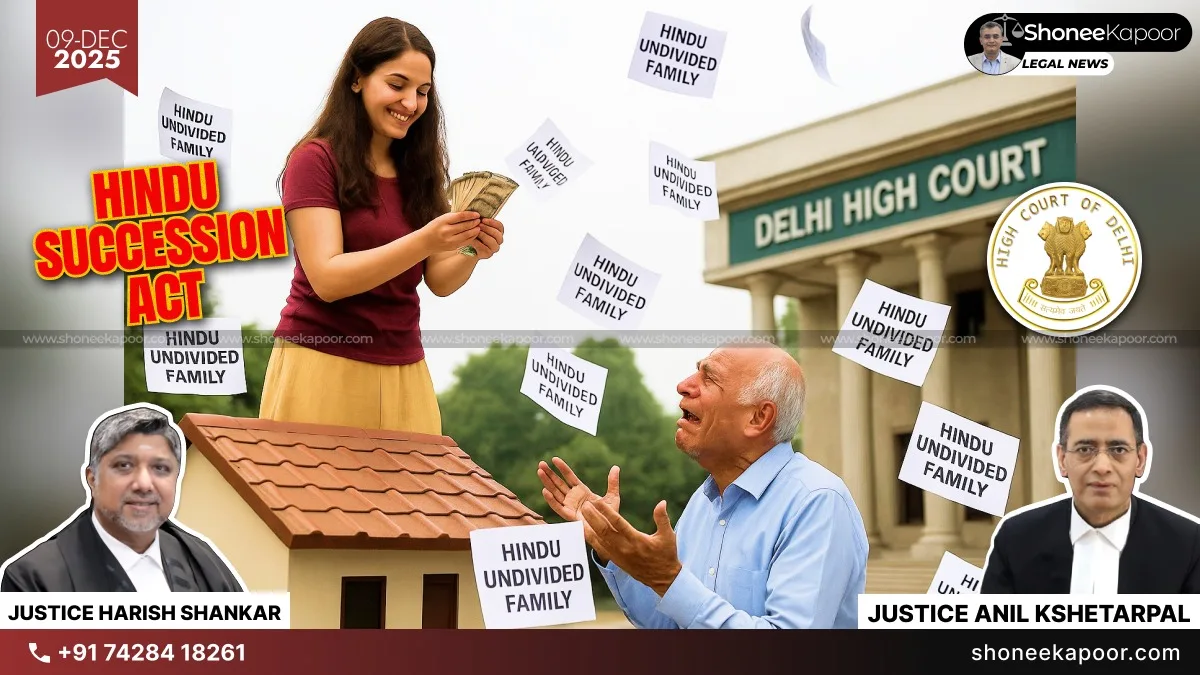
Delhi High Court has ruled that a daughter can independently claim her share in HUF property even if her father earlier signed a family settlement. The Court said a minor daughter cannot be bound by a compromise done between adults.
Daughter’s Property Share Cannot Be Denied: The Delhi High Court has made a ruling protecting the rights of daughters in Hindu Joint Family property. The Court clearly said that a daughter can claim her share in HUF property as a coparcener, even if her father had earlier signed a settlement or compromise with other family members.
The Division Bench of Justice Anil Kshetarpal and Justice Harish Vaidyanathan Shankar said that such old settlements do not automatically take away the daughter’s independent legal rights under the Hindu Succession Act, 1956.
This judgment came in the case Sanjay Gupta v. Sonakshi Gupta & Ors., where the Appellant tried to stop the daughter’s partition suit by using Order VII Rule 11 CPC. He argued that the suit should be rejected at the very beginning because there was already a compromise decree signed on 09.01.2006 between the father and other members of the “L.R. Gupta HUF”.
The Court noted that the daughter had clearly explained how her cause of action arose. Paragraph 68 of her plaint was also reproduced in the judgment.
The important part states:
“68. That the cause of action arose in favour of plaintiff on the commencement of the Hindu Succession (Amendment) Act, 2005 which came into force with effect from September 9, 2005.That the cause of action has further arisen upon the plaintiff attaining majority and the plaintiff coming to know of the illegal acts of defendant No.3 and other defendants in selling/transferring/alienating the valuable properties of the HUF and also upon defendant No.3 making efforts/endeavours to change the nature of the suit properties.That the cause of action accrued to the plaintiff in November 2011: when the plaintiff demanded the partition of the properties and assets specifically mentioned in Schedule A & B annexed hereto and the defendant No.2. & 8 refused to do so. A compulsive and effective cause of action accrued to the plaintiff in the year 2012 on 22.03.2012 and then a week back when the defendant Nos. 2 & 3 finally refused to partition the properties, assets and render accounts and to pay heed to the requests and demands of the plaintiff not to carry on the construction of the new buildings at 47, Amrita Shergil Marg, New Delhi and with the threat and apprehension that the said defendant will make all efforts to create charge, lien, encumbrances, lease or by way of sale of HUF properties mentioned in Schedule-A and the cause of action further accrued when defendants 2 & 3 refused to pay heed to the demand of the plaintiff.
That the cause of action has arisen in favour of the plaintiff and against defendant No.2 & 3 as the plaintiff is not getting her due share of money and profits out of the HUF properties, the plaintiff is not allowed inspection of books of accounts, the plaintiff is not allowed to operate the bank accounts, the plaintiff’s share is being usurped and eaten away by defendants 2 & 3.”
The Appellant argued that this suit was filed only to attack the 2006 decree indirectly. However, the Court rejected this argument strongly. It said:
“For the limited purpose of Order VII Rule 11(a) of the CPC, the plaint does disclose a cause of action, and the learned Single Judge was correct in so holding.”
On the issue of the 2006 settlement, the Bench gave a very clear finding:
“The Plaintiff was not a party to the compromise decree dated 09.01.2006, which adjudicated disputes inter se her father and the other defendants. At that point in time, she was a minor, and therefore it was not necessary for her to seek annulment of a decree that may not bind her.”
The Court also added that because the daughter was asking for partition—a relief larger than a simple declaration—there was no need for her to file a separate challenge to the 2006 decree. It held that Section 34 of the Specific Relief Act did not require a separate declaration.
The Appellant relied on Supreme Court judgments like K Akbar Ali and Rohit Chauhan, but the Court distinguished all of them. On this point, the Court said:
“At this preliminary stage, it would be wholly inappropriate to reject the plaint in the face of such factual disputes.”
Coming to the main principle behind Order VII Rule 11 CPC, the Court repeated the well-settled law:
“The jurisdiction under Order VII Rule 11 of the CPC, being a drastic power to terminate proceedings at the threshold, cannot be invoked where the plaint discloses a cause of action requiring adjudication.”
Finally, the Court dismissed the appeal and made it clear that the daughter has every right to continue with her partition suit and prove her claim during trial.

Explanatory Table Of All Laws & Sections Mentioned
| Law / Provision | What It Means (Simple Explanation) | How It Applies in This Case |
| Order VII Rule 11 CPC | Allows rejection of a plaint at the very beginning if it shows no cause of action or is barred by law. | Appellant wanted the daughter’s suit thrown out at the threshold. Court refused, saying the plaint clearly shows a cause of action. |
| Section 6 – Hindu Succession Act, 1956 (as amended in 2005) | Gives daughters equal coparcenary rights in ancestral/HUF property from birth. | Daughter claimed she is a coparcener in the “L.R. Gupta HUF” and has an independent right to claim partition. |
| Hindu Succession (Amendment) Act, 2005 | Gave daughters the same legal status as sons in HUF property. | Daughter’s cause of action arose on 09.09.2005 when this amendment came into force. |
| Section 34 – Specific Relief Act, 1963 | When someone seeks a declaration, they must ask for all consequential reliefs together. | Appellant argued she should have separately challenged the 2006 compromise decree. Court said it is not indispensable, because partition is a larger relief. |
| CS(OS) 1965/2012 (Partition Suit) | Civil suit filed by the daughter for partition, accounts, injunctions. | This is the main suit the Appellant wanted rejected. |
| Compromise Decree dated 09.01.2006 in CS 1968/2003 | A settlement recorded among family members excluding the daughter. | Court held it does not bind the daughter because she was a minor and not a party. |
| Income Tax Returns (ITRs) | Used to show whether the HUF still exists. | Daughter argued that ITRs show the HUF continued even after 1993; Court said this is a matter for trial. |
| Supreme Court Judgments Cited by Appellant (Akbar Ali, Rohit Chauhan, etc.) | Appellant used precedents to argue the plaint was defective. | Court held these cases do not apply at the stage of Order VII Rule 11. |
Case Summary
- Case Title: Sanjay Gupta v. Sonakshi Gupta & Ors.
- Case Number: FAO(OS) 37/2025
- Appeal From: Order of Single Judge in CS(OS) 1965/2012
- Date Reserved: 27.11.2025
- Date Pronounced: 06.12.2025
Bench (Division Bench):
- Justice Anil Kshetarpal
- Justice Harish Vaidyanathan Shankar
Counsel for Appellant:
- Mr. Manish Vashisht, Senior Advocate
- With Mr. Sameer Vashisht
- Mr. Vedansh Vashisht
- Mr. Swapan Singhal
- Ms. Harshita Nathrani
- Ms. Khushboo Mittal
Counsel for Respondent No. 1 (Plaintiff / Daughter):
- Mr. Giriraj Subramanium
- Mr. Simarpal Singh Sawhney
- Ms. Bijaharini G.
- Mr. Jaisal Baath
Counsel for Respondents 6–21:
- Mr. Rajesh Yadav, Senior Advocate
- With Mr. Rikky Gupta
- Ms. Ruchira Arora
- Ms. Ananya Singh
Key Facts Of The Case
- Daughter filed a 2012 suit seeking partition, accounts, injunction of L.R. Gupta HUF properties.
- She said her right arises from Section 6 of HSA after 2005 Amendment.
- Appellant argued a 2006 family compromise decree already settled the dispute.
- The decree recorded that family branches separated in 1993.
- Daughter said she was a minor in 2006 and not bound by it.
- She also alleged illegal sales, construction, and refusal of partition in 2011 and 2012.
- Appellant tried to reject the plaint using Order VII Rule 11 CPC.
- Court refused — saying factual issues require full trial, not summary rejection.
Key Takeaways
- Courts again clarified that settlements signed by a father cannot bind children, yet men alone remain held responsible for every family dispute even decades later.
- Old compromises are easily questioned, but men are still expected to honour every document they ever signed, while others get fresh rights.
- The burden of continuous litigation falls on men because any family member can reopen property disputes anytime, even after full settlements.
- Once again, the system shows how men’s rights in HUF matters remain fragile, while claims against them stay open-ended.
- Instead of finality in family arrangements, men face prolonged legal uncertainty, proving how gender-neutral reforms in property and succession laws are long overdue.
This Could Change Your Case-Get FREE Legal Advice-Click Here!
Disclaimer: The views and opinions expressed in this article are those of the Indian courts and do not necessarily reflect the official policy or position of “ShoneeKapoor.com” or its affiliates. This article is intended for informational and educational purposes only. The content provided is not legal advice, and viewers should not act upon this information without seeking professional counsel. Viewer discretion is advised.
