
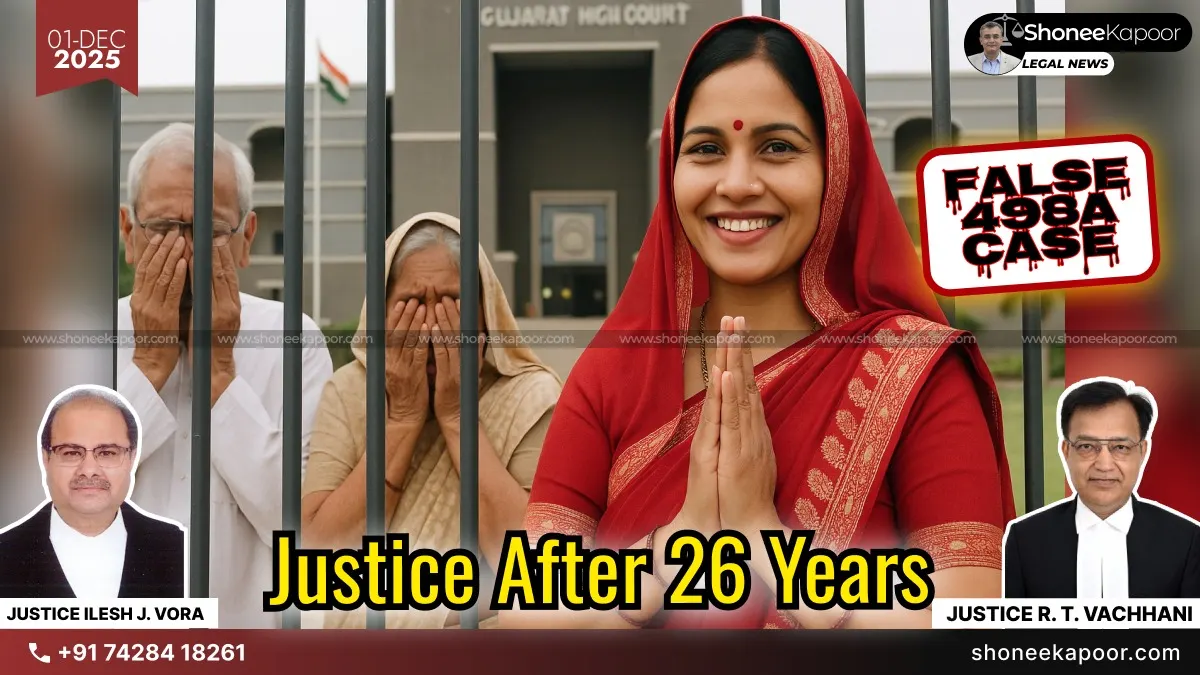
Gujarat High Court ruled that refusing a daughter-in-law permission to accompany her in-laws to a temple is not “cruelty” under Section 498A IPC. The Court upheld the acquittal in a 498A, 306, 304B dowry-death case, holding that the incident was just normal matrimonial wear-and-tear.
Ahmedabad: The Gujarat High Court upheld the acquittal of a husband and his family members in a 498A, 306 (abetment of suicide) and 304B (dowry death) case, holding that the wife consuming poison after she was not allowed to accompany her mother-in-law and husband to a temple cannot legally be considered cruelty or harassment under Section 498A IPC.
The Court made it clear that the alleged act—refusing the deceased permission to come to Santram Mandir—was only a small domestic issue, something that routinely happens in households. Such an incident, the Court held, cannot be stretched into a criminal offence.
Quoting directly from the judgment, the Court noted:
“The incident that immediately preceded the deceased consuming poison was trivial and formed part of the ordinary wear and tear of matrimonial life.”
The Bench of Justice Ilesh J. Vora and Justice R.T. Vachhani recorded that even the dying declaration of the woman showed only this one incident, and there was no proof of dowry demands or sustained cruelty.
The Court reproduced the incident in clear words:
“The substance of the complaint and the dying declaration (Exh.68) itself reveals that on the fateful day the mother-in-law and husband of the deceased were proceeding to Santram Mandir at Nadiad for darshan. The deceased insisted on accompanying them, but was not permitted. Hurt by this refusal, she consumed poisonous substance (Celphos).”
The Bench then categorically held that such a refusal cannot be treated as cruelty under Section 498A:
“A mere refusal to allow the wife to accompany the in-laws to a temple cannot, by any stretch of imagination, be construed as wilful conduct of such nature as is likely to drive a woman to commit suicide within the meaning of the Explanation (a) to Section 498-A IPC, nor does it constitute harassment with a view to coercing her or her relatives to meet any unlawful demand for property or valuable security under clause (b) thereof.”
Prosecution Failed to Prove Cruelty, Says Court
The Court also noted that the prosecution had “utterly failed to prove cruelty within the meaning of Section 498-A IPC.”
It stressed that apart from the single temple-related incident, there was no clear evidence of beating, harassment, starvation, dowry demands or continuous cruelty.
The judgment said:
“Apart from the solitary incident of refusal to take the deceased to the temple, no specific instance of physical or mental cruelty has been established through any independent or corroborative evidence.”
Further, contradictions in the statements of the mother and sister of the deceased weakened the prosecution’s case:
“There is no evidence of recurring ill-treatment, beating, starvation or persistent harassment. The contradictions between the testimony of the mother (PW-4) and the sister (PW-7) on vital aspects of alleged dowry demand and the manner of harassment further erode the credibility of the prosecution case.”
No Ground to Presume Abetment of Suicide
Because cruelty was not proved, the Court held that Section 113A of the Evidence Act (presumption of abetment of suicide within 7 years of marriage) could not be applied.
The Bench observed:
“In the absence of proof of cruelty under Section 498-A IPC, the discretionary presumption of abetment of suicide under Section 113-A of the Indian Evidence Act cannot be pressed into service.”
Even otherwise, the Court found no direct or indirect role of the accused in provoking suicide:
“The material on record does not disclose any active instigation, intentional aiding or engagement in a conspiracy by any of the accused that directly led the deceased to commit suicide (Section 107 IPC).”
It clarified that the woman’s act was emotional, not forced:
“The act of the deceased in consuming poison appears to be a spontaneous reaction born out of her own sensitivity rather than any positive act of abetment on the part of the accused persons.”
And significantly:
“Mere hurt feelings arising from a trivial domestic disagreement do not constitute abetment of suicide under Section 306 IPC.”
Husband Tried to Save Her — No Abetment, Says Court
The Court highlighted that the husband acted responsibly:
“The conduct of accused No.1 (husband) in immediately rushing the deceased to the hospital after she consumed poison clearly negatives any intention on his part to cause her death or to abet the extreme step. This act is wholly inconsistent with the theory of abetment.”
Other Charges Also Fail
The State also alleged offences under Sections 201 and 176 IPC (not informing police and alleged destruction of evidence by burial). But the Court found these allegations unproved.
The judgment records:
“Insofar as Sections 201, 176 and 304B/114 IPC are concerned, the evidence of IOs… shows that accused delayed informing police and buried the body hastily, but this is rebutted by their explanation of cultural/religious haste in burial and lack of intent to destroy evidence.”
Regarding dowry death under 304B IPC, the Court stressed:
“For 304B, dowry death requires proof of demand soon before death, which remains general without specifics.”
Acquittal Affirmed
Finally, the High Court fully upheld the acquittal:
“In overall, it is found that learned Sessions Court has not committed error to reach to the conclusion of acquitting the accused.”
The appeal filed by the State of Gujarat was dismissed.
Explanatory Table Of All Sections / Laws Involved
| Section / Law | Meaning in Simple English | Why It Was Mentioned in This Case | High Court’s Finding |
| Section 498A IPC | Cruelty by husband or in-laws (physical or mental cruelty or dowry harassment) | Prosecution claimed the woman was tortured, harassed and driven to suicide | Not proved. Court said refusal to go to temple is normal household issue, not “cruelty.” |
| Explanation (a) to 498A | Cruelty means wilful conduct likely to drive a woman to suicide or cause serious harm | Prosecution used this to claim the incident triggered suicide | Court held incident was “ordinary wear and tear of matrimonial life.” |
| Explanation (b) to 498A | Harassment for dowry or property | Prosecution alleged dowry demands | No specific dowry evidence; contradictions in statements. |
| Section 306 IPC | Abetment of suicide | Claimed family instigated suicide | No instigation. Husband actually rushed her to hospital. |
| Section 107 IPC | Definition of abetment (instigation, aiding or conspiracy) | Needed to prove 306 IPC | Court found no instigation, no aiding, no conspiracy. |
| Section 304B IPC | Dowry death (death within 7 years + dowry demand “soon before death”) | Prosecution claimed death was dowry-related | No proof of dowry demand “soon before death.” FIR itself silent. |
| Section 113A Evidence Act | Court may presume suicide was abetted if there was cruelty within 7 years of marriage | Prosecution relied on presumption | Court: No cruelty proved → presumption cannot apply. |
| Section 113B Evidence Act | Presumption of dowry death | Used for 304B IPC | No dowry demand proved → presumption fails. |
| Section 201 IPC | Causing disappearance of evidence | Prosecution said body was buried fast | Family explained cultural/religious urgency; later body was exhumed → no intent to hide offence. |
| Section 176 IPC | Failure to inform police about unnatural death | State claimed delay in police intimation | No proof that accused intentionally hid information. |
| Section 114 IPC | Common intention (when abettor is present) | Added with 304B, 201, 176 | Since main offences failed, 114 also fails. |
| Section 378(1)(iii) CrPC | State’s right to file appeal against acquittal | Basis for State appeal | Appeal dismissed; no perversity in trial court ruling. |
| Section 209 CrPC | Committal of cases to Sessions Court | Mentioned as procedural step | Routine step, not disputed. |
- Case Title: State of Gujarat vs. Rajeshbhai Pitamberbhai Parmar & Others (Criminal Appeal No. 457 of 2002)
- Court: High Court of Gujarat at Ahmedabad
- Date Of Judgment: 19 November 2025
- Type Of Judgment: Oral Judgment (Acquittal Upheld)
Bench:
- Hon’ble Mr. Justice Ilesh J. Vora
- Hon’ble Mr. Justice R. T. Vachhani
Counsel:
- For Appellant (State of Gujarat): Ms. Maithili Mehta, APP
- For Respondents (Accused): Mr. Nitin M. Amin, Advocate
Sessions Court Details:
- Judgment under challenge: 22.01.2002
- Court: Additional Sessions Judge, Nadiad
- Sessions Case: No. 102 of 1999
Fir Details:
- FIR No.: I-C.R. No. I-21 of 1999
- Police Station: Mahuva Police Station
- Allegations: 498A, 306, 304B, 201, 176 IPC
Allegation Summary:
- Wife consumed Celphos poison after being denied permission to accompany mother-in-law & husband to Santram Mandir, Nadiad.
- Prosecution claimed cruelty, dowry demands, and abetment.
- Defence argued false implication and lack of evidence.
Final Outcome:
- Appeal dismissed.
- Acquittal confirmed due to lack of proof of cruelty, dowry demand, or abetment.
Key Takeaways
- Refusing a wife to join a temple visit is normal family discretion, not cruelty or a criminal offence.
- Courts again confirm that 498A cannot be invoked for routine marital disagreements.
- No dowry demand, no cruelty, no instigation — yet a full criminal case dragged an entire family for 26 years.
- Emotional reactions by a spouse cannot be converted into criminal liability for the husband or in-laws.
- This judgment exposes how ordinary domestic issues are weaponised into false criminal allegations against men and their families.
This Could Change Your Case-Get FREE Legal Advice-Click Here!
Disclaimer: The views and opinions expressed in this article are those of the Indian courts and do not necessarily reflect the official policy or position of “ShoneeKapoor.com” or its affiliates. This article is intended for informational and educational purposes only. The content provided is not legal advice, and viewers should not act upon this information without seeking professional counsel. Viewer discretion is advised.
