
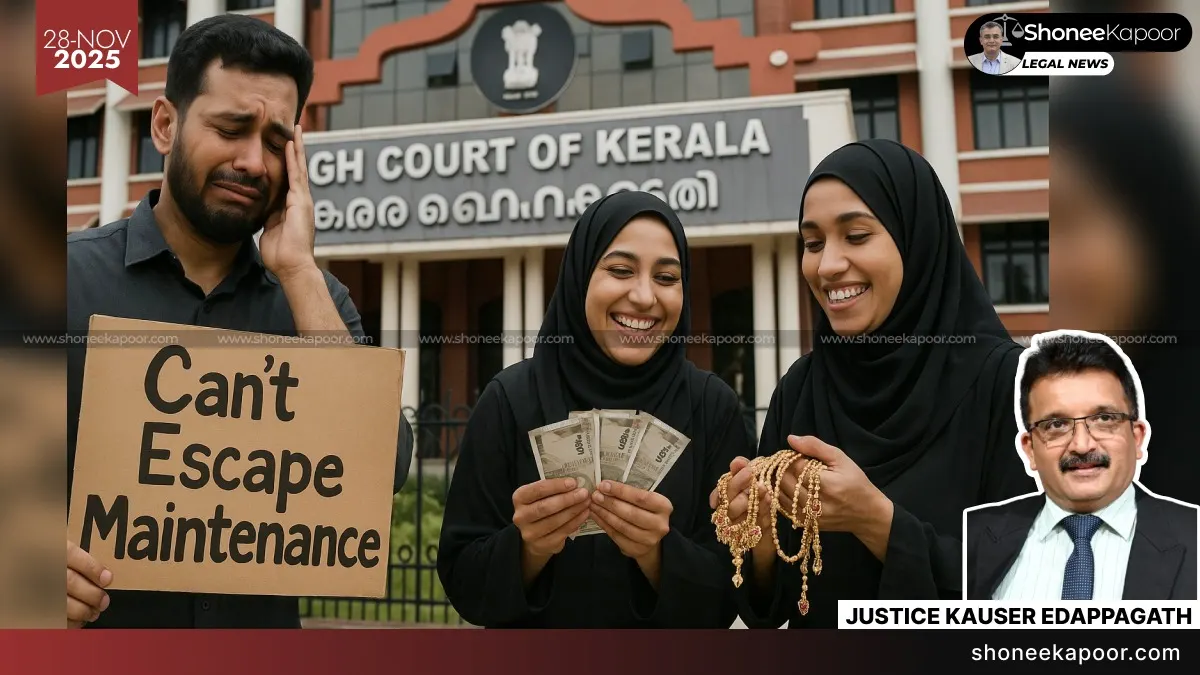
The Kerala High Court ruled that a Muslim man cannot deny maintenance to his first wife by saying he must support his second wife or that his son is already helping her. The Court said polygamy is only an exceptional situation and the husband must treat all wives fairly, including in maintenance.
KOCHI: The Kerala High Court held that a Muslim man cannot avoid paying maintenance to his first wife by saying that he has a second wife to support or that his son is giving her money.
Justice Kauser Edappagath gave this ruling while dismissing two connected petitions filed by the husband, Muhammed Vappinu, against orders passed by two family courts.
The Court explained that Muslim personal law may permit more than one marriage, but this is only allowed in very rare situations and only when the husband can do complete justice to all wives.
The Court said:
“A Muslim husband does not have a vested right to have more than one wife. Monogamy is the rule and polygamy is an exception under Muslim law. Polygamy for men is allowed under Muslim law only in exceptional and extraordinary circumstances, that too, under the strict injunction that all the wives must be treated equally and equitably.”
The Court added that fairness does not mean only love or emotional care, but also proper financial support. It stressed that when a man chooses to enter into a second marriage while the first marriage is still valid, he must take full responsibility for both wives.
The Judge referred to the Quranic verse and stated:
“The verse in the Quran (IV: 3) which permits polygamy makes it abundantly clear that if one is apprehensive of dealing justly with all his wives, he must marry only one. The term ‘to do justly with all wives’ implies not only the equality in love and affection but also the equality in maintenance. Therefore, a Muslim husband who contracted a second marriage during the subsistence of his first marriage cannot contend that he has no means to maintain his first wife. The fact that the husband has a second wife and is liable to maintain her cannot be a factor in denying maintenance to the first wife or reducing the quantum of maintenance she is entitled to.”
Background Of The Dispute
The first wife, Fathima, had filed a maintenance case in 2016 stating that she had no job or income and her husband, who worked in the Gulf for more than 40 years, had enough means to support her. The Family Court granted her ₹5,000 per month.
The husband challenged this order in the High Court, claiming that he was jobless, that his wife ran a beauty parlour and earned money, and that he also had to support his second wife. He also argued that his son was maintaining his mother, so he (the husband) should not be forced to pay.
However, the Court found that he had produced no evidence to show that his wife was earning anything, and it also took note of the fact that he was living with and maintaining his second wife. The Court said that his responsibility towards the first wife cannot stop simply because he chose to remarry.
Wife’s Right To Maintenance Is Independent
The Court also clarified an important point regarding Section 144 of the Bharatiya Nagarik Suraksha Sanhita (BNSS), which deals with maintenance of wives, children and parents. It said a wife’s right under this section is not affected even if her children support her.
The Court observed:
“The fact that the son or daughter of a woman has sufficient means and provides maintenance to her would not absolve the husband of his independent statutory obligation under Section 144(1)(a) of BNSS (Section 125(1)(a) of Cr.P.C.) to support his wife if she needs it.”
So, even if the son is taking care of his mother, the husband must still pay maintenance as per the law.
Living Separately Is Justified If Husband Marries Again
The husband also argued that his first wife left him without any reason and therefore she should not get maintenance. But the Court rejected this argument, saying that entering into a second marriage without the consent of the first wife is a completely valid reason for her to live separately.
It stated that a Muslim wife is not barred from claiming maintenance only because she chooses to live apart after the husband enters into another marriage.
Final Decision
After considering all facts and the law, the Kerala High Court upheld both the family courts’ orders:
- The first wife is entitled to maintenance.
- The husband has no right to claim maintenance from his son.
- Both petitions by the husband were dismissed.
The Court concluded that the Family Court orders were correct and there was no illegality in granting maintenance to the first wife.

Explanatory Table Of All Laws & Sections Mentioned
| Law / Section | Meaning in Simple English | How It Applies in This Case |
| Sharia Law & Muslim Personal Law (India) | Allows polygamy only in exceptional situations — with strict fairness to all wives. | Court held husband cannot use second marriage to escape maintaining first wife. |
| Quran Verse (Surah An-Nisa 4:3) | Says a man may marry more than one wife only if he can do complete justice; otherwise he must marry only one. | Court quoted: “If one is apprehensive of dealing justly… he must marry only one.” |
| Section 144 BNSS (formerly Section 125 CrPC) | Provides maintenance to wives, children, parents when they cannot maintain themselves. | Wife entitled to maintenance from husband. Son’s support does NOT cancel husband’s duty. |
| Section 144(1)(a) BNSS (Earlier 125(1)(a) CrPC) | A wife can claim maintenance from husband if he has means and refuses or neglects to maintain her. | Husband has the means (worked 40+ years abroad) → must pay. |
| Section 144(1)(d) BNSS (Earlier 125(1)(d) CrPC) | Children must maintain parents if parents can’t maintain themselves. | Husband tried to claim maintenance from son — Court rejected. |
| Section 144(4) BNSS (Earlier 125(4) CrPC) | Wife cannot claim maintenance if she leaves without “sufficient reason.” | Second marriage by husband is valid reason for first wife to live separately. |
| Case Law — Haseena v. Suhaib (2025 (1) KHC 543) | Second marriage of Muslim husband gives first wife legal ground to live separately and still claim maintenance. | Court relied on this precedent to uphold maintenance. |
Case Summary
- Case Title: Vappinu v. Fathima & Connected Case (RPFC No. 398 of 2018 & RPFC No. 366 of 2024) Kerala High Court, Ernakulam Bench
- Judgment dated: 12 November 2025
- Bench: Hon’ble Dr. Justice Kauser Edappagath Kerala High Court, Ernakulam
Counsels
- For the Husband (Petitioner):
- Sri. K. Jagadeesh
- Smt. V. Renju
- Shri. Nikhil K. Gopinath (in RPFC 366/2024)
- For the Wife & Son (Respondents):
- Shri. Sunil Nair Palakkat
- Shri. K.N. Abhilash
- Shri. Rishi Varma T.R.
- Shri. Rithik S. Anand
- Sri. V. Sreejith
Parties
- Case 1 — RPFC 398/2018
- Petitioner (Husband): Vappinu, 63 years
- Respondent (Wife): Fathima, 53 years
- Case 2 — RPFC 366/2024
- Petitioner (Husband): Muhammed Vappinu, 66 years
- Respondent (Son): Vasif Muhammed, 31 years
Key Facts
- Marriage between husband & first wife took place on 20.04.1983.
- They have three children:
- Vasif Muhammed (respondent in 366/2024)
- Faseela
- Fahima
- Couple living separately since 2015.
- Husband entered into second marriage.
- Wife filed for maintenance in 2016 → Family Court granted ₹5,000/month.
- Husband also filed case seeking maintenance from his son → dismissed.
Litigation Outcome
- Maintenance of ₹5,000/month to first wife UPHELD.
- Husband NOT entitled to maintenance from son.
- Both petitions dismissed.
Key Takeaways
- A Muslim husband’s second marriage cannot be used as an excuse to reduce or avoid maintenance to the first wife.
- Even if the son is supporting the mother, the husband’s legal liability remains fully intact.
- Courts expect a man to enter a second marriage only if he can maintain all wives equally, financially and emotionally.
- A husband who has worked abroad for decades is assumed to have sufficient means, even if he later claims unemployment.
- A man cannot claim maintenance from his adult son while simultaneously choosing a second marriage and maintaining another household.
This Could Change Your Case-Get FREE Legal Advice-Click Here!
Disclaimer: The views and opinions expressed in this article are those of the Indian courts and do not necessarily reflect the official policy or position of “ShoneeKapoor.com” or its affiliates. This article is intended for informational and educational purposes only. The content provided is not legal advice, and viewers should not act upon this information without seeking professional counsel. Viewer discretion is advised.
