
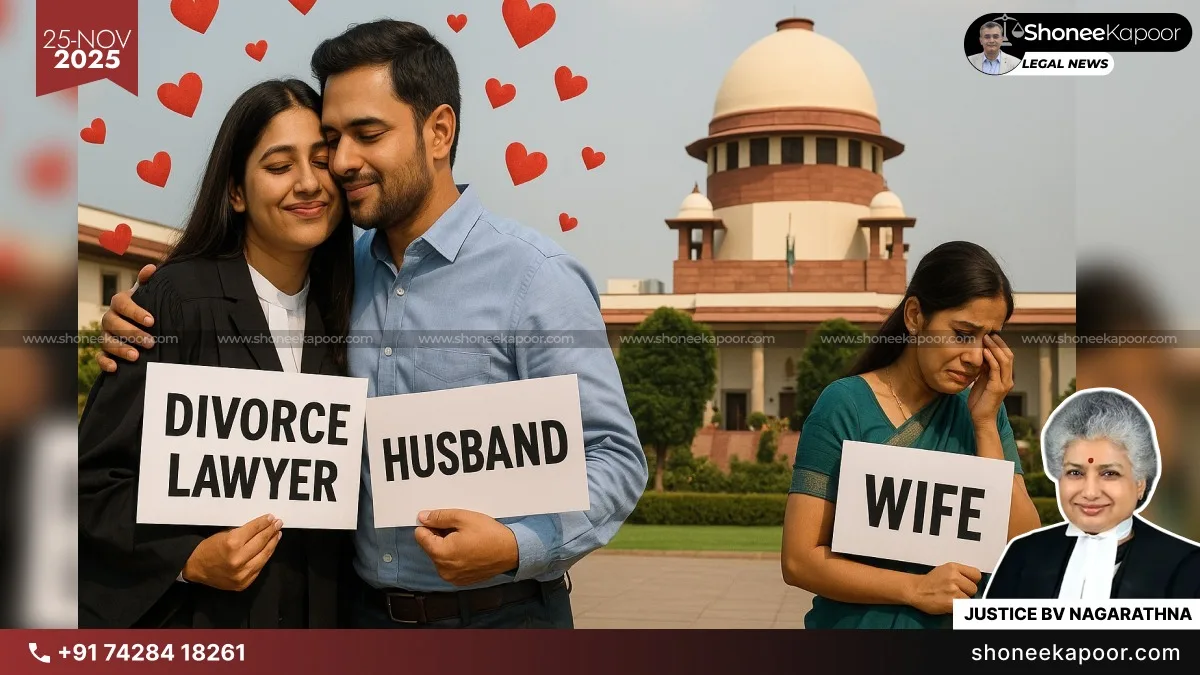
The Supreme Court strongly criticised a woman advocate for entering an intimate affair with her own divorce client. The Court questioned her professional ethics and protected the man from arrest while seeking a detailed affidavit from the woman.
NEW DELHI: The Supreme Court of India came down heavily on a woman lawyer who got into a personal and intimate affair with a man who had approached her for legal guidance in his divorce case.
During the hearing, the bench sharply asked her:
“Why did you get into this mess?”
Expressing surprise and disappointment that a practising advocate would allow such a situation to develop with her own client.
A bench of Justices BV Nagarathna and R Mahadevan said that as a lawyer, she was expected to maintain a clear professional boundary, especially because the man’s divorce case had not even reached its final stage. The judges questioned why the 36-year-old advocate entered into a personal relationship with someone who had come to her for legal help.
The bench said:
“She is an advocate. She is handling the petitioner’s divorce case. Why did you do that? We don’t expect this.”
The woman lawyer, however, tried to defend herself by saying she only advised him and did not officially appear in court for him. But the Court explained that even if she did not file a vakalatnama, the problem remained the same because she acted as his legal advisor while getting personally involved.
The case before the Supreme Court was the man’s petition seeking anticipatory bail. The complaint had been filed by the same woman he had been in a relationship with, and who had previously advised him in his matrimonial dispute.
His counsel, senior advocate Rishi Malhotra, told the Court that the complainant had filed “four identical cases” of sexual assault against different people, and that even the Bombay High Court had ordered an inquiry into her conduct.
Justice Nagarathna noted the woman’s professional background and questioned how an advocate could get personally involved with her own divorce client. The judge stated:
“She should have known that until he gets a divorce decree, he cannot get married to your party. She is not an ordinary, uneducated or naive person. She is an advocate. She is handling the petitioner’s divorce case. Why did you do that?”
At this point, the woman advocate intervened personally and said:
“No, I was not handling his case. He only came to me for the guidance. I never appeared for him. I never represented and did not take any case.”
However, the bench did not accept her explanation and stayed firm in its criticism.
When her lawyer tried to claim that the man, who now lives in London, was absconding or trying to avoid the investigation, the Supreme Court rejected this argument. The bench said that the man had been living abroad long before the dispute started.
The Court also dismissed the allegation that he had been declared a proclaimed offender. During the exchange, the woman’s counsel said:
“He has not even joined investigation… It was a love relation, I cannot testify what had transpired between the love birds”
-but the Court was not convinced.
The Supreme Court then protected the man from arrest and ordered:
“No coercive steps against him for the time being.”
The bench then told the woman’s side to file a detailed affidavit explaining her version of events clearly, saying that it would not accept her allegations without proper verification. The judges added:
“Advise your client. Get out of this mess. Let her concentrate on her profession.”
The Court also noted that the charge sheet in the case had already been filed and that the man had expressed willingness to cooperate with the investigation once he returns to India.
The Supreme Court will take up the matter again on December 12.

Explanatory Table For All Laws & Sections Referred To In This Case
| Law / Section | Where It Applies in the Case | Simple Explanation (Easy Indian English) | Why It Matters Here |
| Section 438 CrPC — Anticipatory Bail | The male petitioner approached Supreme Court for anticipatory bail | Allows a person to request bail in advance to avoid arrest | The man feared arrest due to the woman’s complaint, so he filed for anticipatory bail |
| Sexual Assault Provisions (IPC Section 376/354 etc., implied) | Woman filed a sexual assault case (exact section not mentioned, but “sexual assault cases” referred) | Sexual assault laws punish non-consensual acts or misconduct | The complainant allegedly filed “four identical cases” earlier; SC questioned credibility |
| Bombay High Court Inquiry (Administrative/Disciplinary) | Mentioned that the HC ordered an inquiry into the woman advocate | High Court has power to examine conduct of advocates under its supervisory role | Used by petitioner to cast doubt on complainant’s pattern of filing similar cases |
| Divorce Law (Hindu Marriage Act — General Reference) | Her role as his legal advisor in a divorce matter | A person cannot remarry until a divorce decree is granted | SC said the lawyer should have known the legal position before entering a relationship |
| Proclaimed Offender Proceedings (CrPC Sections 82–83) | Respondent tried to claim the man was a proclaimed offender | A proclaimed offender is someone declared absconding by court | SC rejected argument; said he lived abroad long before the dispute |
| Investigation Compliance (CrPC general) | SC noted: he will cooperate with investigation | Police must investigate fairly; accused must cooperate | SC protected him: “No coercive steps” |
Key Takeaways
- Supreme Court directly questioned the woman lawyer’s conduct, proving that professional boundary violations are not gender-exclusive.
- The bench openly asked, “Why did you get into this mess?”, showing that women in authority can also misuse their position.
- The complainant had filed “four identical cases” earlier, highlighting the pattern of repeated allegations often used to pressure men.
- The Court refused to accept her story at face value and demanded a detailed affidavit. This reinforces that allegations by women are not automatically true.
- The Supreme Court protected the man with “No coercive steps”, acknowledging possible misuse of criminal law.
- The attempt to label the man as absconding was rejected. Men are often falsely painted as runaways even when they have legitimate reasons to be abroad.
- The Court reminded the woman lawyer that she knew the man was still legally married, yet entered a relationship. Accountability must apply equally.
- Despite a chargesheet, the Court still granted protection. A reminder that filing a chargesheet is not the end of a man’s right to fair treatment.
- The Court advised her to “get out of this mess” and focus on her profession, indirectly recognising that emotional fallout should not be converted into criminal cases.
- The case strengthens the growing recognition that men can also be victims of manipulation, false accusations, and misuse of gender-biased laws.
This Could Change Your Case-Get FREE Legal Advice-Click Here!
Disclaimer: The views and opinions expressed in this article are those of the Indian courts and do not necessarily reflect the official policy or position of “ShoneeKapoor.com” or its affiliates. This article is intended for informational and educational purposes only. The content provided is not legal advice, and viewers should not act upon this information without seeking professional counsel. Viewer discretion is advised.

You missed the case information. Clever.
Crl.A. No.-000093-000093 – 2026
The article clearly mentions that the matter arose from anticipatory bail proceedings before the Supreme Court, records the Court’s oral observations, and reports the protective directions passed (“no coercive steps”)—which is standard legal reporting when the order is not yet uploaded or numbered publicly.
Every Supreme Court hearing does not instantly come with a visible CrI.A number, and oral observations + interim protection are very much part of the judicial record. Pointing fingers without understanding Supreme Court procedure only exposes ignorance, not “cleverness”.
Facts don’t disappear just because someone doesn’t know how the system works.