
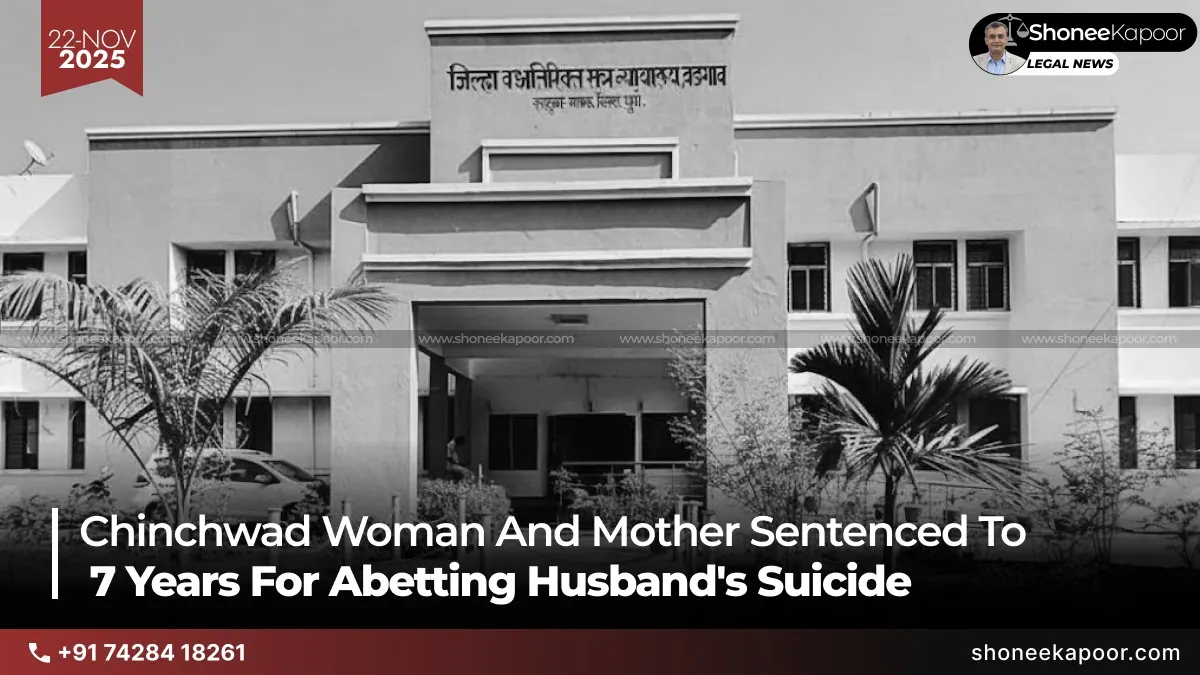
Pune: A sessions court in the city convicted and sentenced the wife and mother-in-law of Chinchwad resident Dipak Chaudhari to seven years’ rigorous imprisonment for abetting Husband’s Suicide on Nov 24, 2015.
Additional Sessions Judge A I Perampalli also imposed a Rs 25,000 fine each on convicts Komal Dipak Chaudhari and her mother, Shalini Krishna Kolhe, but acquitted Komal’s father for want of evidence. Based on police investigation, evidence on record, and statements recorded by witnesses, the prosecution’s case was that Dipak (32), who was working with an automotive MNC in Talegaon Dabhade, committed suicide due to continued harassment and mental cruelty from his wife Komal and mother-in-law Shalini.
His wife would constantly quarrel with him, abuse his mother and sister, beat him, and starve him. She compelled him to take a loan from her father to buy a flat. Later, she and her mother started harassing him to repay the loan, which eventually drove him to take the extreme step.
Dipak first attempted to hang himself in his house but did not succeed. Despite his disturbed state of mind, his wife and mother-in-law quarreled with him and insisted that he repay the loan immediately. He then left his house and ended his life by hanging at his friend’s vacant flat at Udaynagar in Pimpri on Nov 24, 2015.
Additional public prosecutor G P Gehalot said, “Testimonies from Dipak’s sister, Rajani Aashish Rao, and mother, Sunanda Swami Chaudhari, the building watchman and Dipak’s friends besides a suicide note purportedly written by Dipak detailing his marital woes and the harassment, proved crucial in the conviction.”
Two days prior to his death, Dipak had confided in his mother over phone that he was kept confined in the house and was being harassed for money he owed to his in-laws. The court found this narration and the suicide note admissible as dying declarations.
The note explicitly stated: “I am committing suicide due to the mental agony caused by my wife and my mother-in-law and father-in-law. My wife Komal is responsible for this.”
Handwriting expert Suryakant Bhanudas Kamble confirmed the gennineness of the note written by Dipak. The court held that the conduct of both accused was intentional and purposeful.
On the point of sentence, the judge said, “I would like to state that the deceased was in the heyday of youth. His plight has come in the evidence of watchman (Yashwant Kadam). Before him, the deceased uttered the words, ‘Every day there are quarrels at home.’ This shows the condition of the deceased when he was cohabiting with his wife. It is a proved fact that for the first time the deceased attempted to commit suicide in his own house but could not commit suicide for the reason mentioned in the evidence.
That time both the accused uttered, ‘Now pay the money, we will leave.’ The moment of attempt to commit suicide was apogee. Instead of appeasing the deceased or heartening him or calming him, they uttered the above words.”
Explanatory Table Of All Laws And Sections Mentioned In The Case
| Law / Section | Name of Provision | Explanation | How It Applies in This Case |
| Section 306 IPC | Abetment of Suicide | Makes abetment (instigation, conspiracy, or aiding) of suicide a punishable offence. Punishment: up to 10 years imprisonment and fine. | Initial FIR was registered under Section 306 r/w 34 IPC because the prosecution alleged that the accused abetted Dipak Chaudhari’s suicide. |
| Section 304 IPC | Culpable Homicide Not Amounting to Murder | Applies when someone causes death without intention to kill but with knowledge that the act may cause death. Punishment varies based on gravity (up to life imprisonment or up to 10 years). | At the end of trial, charges were changed. Accused No.1 and No.2 were convicted under Section 304 r/w 34 IPC, not Section 306. The court held that their sustained cruelty and harassment amounted to culpable homicide. |
| Section 34 IPC | Common Intention | When several persons commit an act with a shared intention, each is liable as if they committed the act alone. | Applied to all accused to show shared responsibility. Accused No.1 and No.2 were convicted under Section 304 read with 34 IPC (common intention). |
| Section 498-A IPC (mentioned in evidence) | Cruelty by Husband or Relatives | Punishes cruelty by husband or relatives of husband, including harassment and mental torture. | Mentioned by PW1: Komal (A2) allegedly threatened Dipak with filing a false case under Section 498-A IPC. It appears only in oral evidence, not as a charge. |
| Section 32, Indian Evidence Act | Dying Declaration | Allows statements made by a deceased person regarding the cause of their death to be admissible as evidence. | Used for admitting the suicide note and Dipak’s complaint dated 22/11/2015 as “dying declarations.” |
| Section 428 CrPC | Set-off of Period of Detention | If an accused spent time in detention during the investigation or trial, it will be counted (“set off”) against their final sentence. | Mentioned in the sentencing chart: all accused had only nominal arrest; hence almost no set-off. |
| Section 313 CrPC | Examination of Accused | Accused are questioned on evidence appearing against them to allow explanation. | Statements of accused No.1–3 recorded under Section 313 CrPC and considered by court. |
| Crime Registration Rules / Criminal Manual Para 44 (Part A, B, C) | Court Procedure Format | Specifies formats for “Part A”, “Part B”, “Part C” of judgment (FIR details, witness lists, etc.). | Court followed Para 44 for structuring judgment sections (as seen in exhibit lists and formatting). |
| Letters for CDR (Call Data Records) | Procedure under CrPC and Police Manual | Used for obtaining call data during investigation. | IO issued letters to obtain CDR; admitted in evidence. |
| Cadastal Surveyor Letter | Mapping of Scene | Letters issued under CrPC investigation powers to map location. | Scene map obtained for accuracy of location of suicide. |
| Postmortem Report Procedure | Section 174/175 CrPC (implicitly used) | Govern inquest and postmortem procedures. | Inquest panchnama and postmortem report were key to confirming suicide by hanging. |
- Case Title: State of Maharashtra vs. Shalini Krishna Kolhe & Others (Sessions Case No. 161/2017)
- Court And Bench: Court of Sessions Judge, Pune Presided over by: A. I. Perampalli, Additional Sessions Judge
- Counsels
- For Prosecution: Additional Public Prosecutor Shri G. P. Gehalot
- For Accused (All): Shri Tayade P. N., Advocate
- Parties
- Prosecution: State of Maharashtra Through Pimpri Police Station, Pune
- Complainant / Informant:
- Rajani Ashish Rao – Age: 42 years
- Occupation: LIC & BIC Adviser
- Resident: Shri Heramb Society, Nashik
- Accused
- Shalini Krishna Kolhe – Age: 55
- Komal Dipak Chaudhari – Age: 31
- Krushna Bajirao Kolhe – Age: 66
- All residents of: Plot No. 26, Surakshanagar, Amravati Road, Dattawadi, Nagpur – 23
- Case Details
- Crime No.: 629/2016
- Offence: Section 306 read with 34 IPC
- Police Station: Pimpri Police Station, Pune
- Important Dates
- Date of Offence: 18/11/2010 to 24/11/2015
- Date of FIR: 25/11/2015
- Date of Charge-sheet: 25/10/2016
- Date of Framing of Charges: 15/07/2022
- Commencement of Evidence: 24/01/2023
- Judgment Reserved: 06/10/2025
- Judgment Pronounced: 13/11/2025
- Sentencing Order: 13/11/2025
Final Order
- Accused No.1 – Shalini Krishna Kolhe
- Convicted under Section 304 read with 34 IPC
- Sentence: Rigorous Imprisonment for 7 years
- Fine: Rs. 25,000 (in default, 6 months Simple Imprisonment)
- Accused No.2 – Komal Dipak Chaudhari
- Convicted under Section 304 read with 34 IPC
- Sentence: Rigorous Imprisonment for 7 years
- Fine: Rs. 25,000 (in default, 6 months Simple Imprisonment)
- Accused No.3 – Krushna Bajirao Kolhe
- Acquitted
Need Free Legal Advice? — Sahodar NGO Fighting Against Misuse of LawDisclaimer: The views and opinions expressed in this article are those of the Indian courts and do not necessarily reflect the official policy or position of “ShoneeKapoor.com” or its affiliates. This article is intended for informational and educational purposes only. The content provided is not legal advice, and viewers should not act upon this information without seeking professional counsel. Viewer discretion is advised.
